
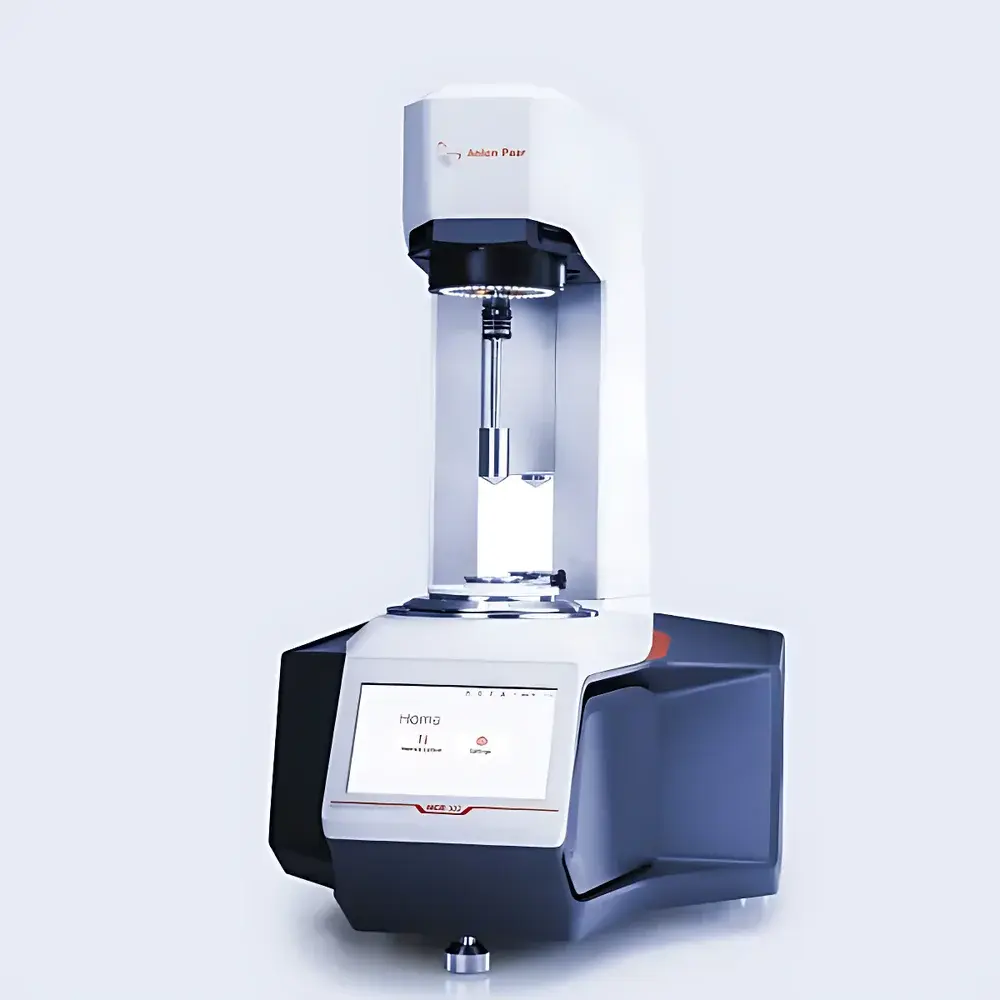
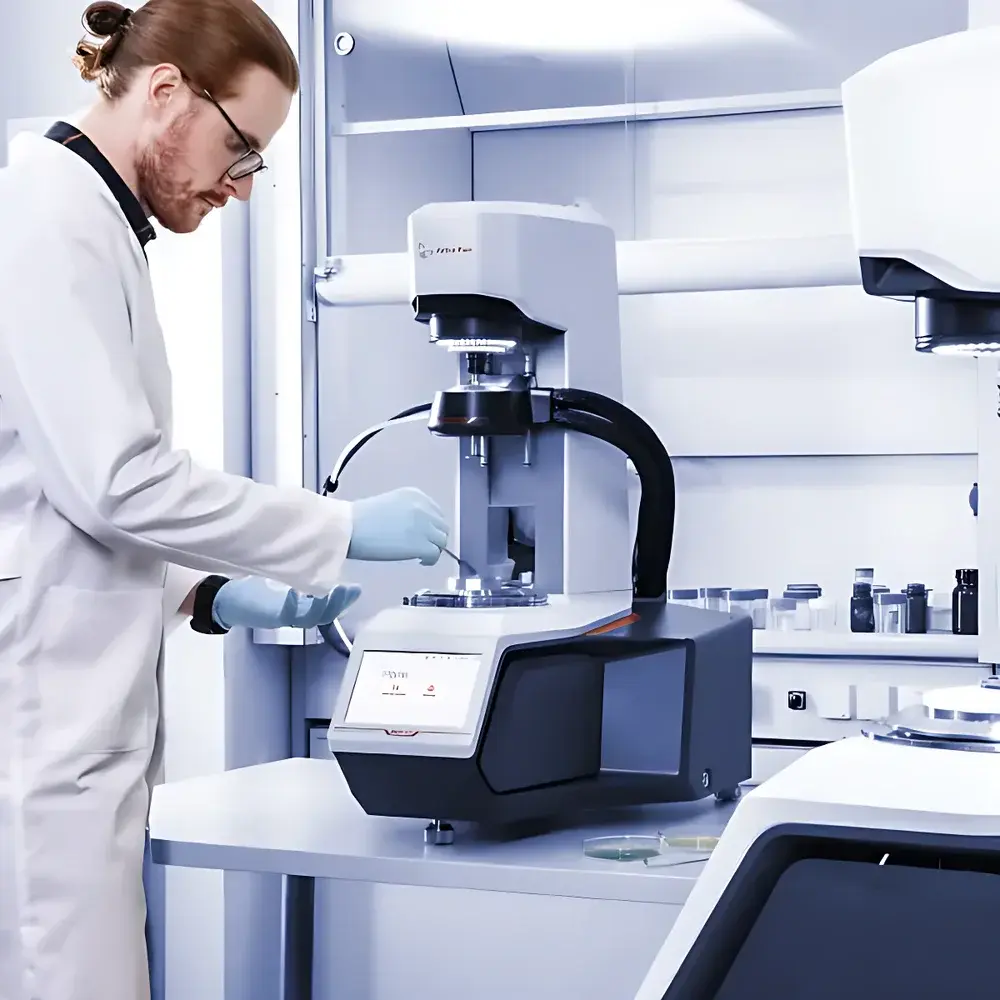
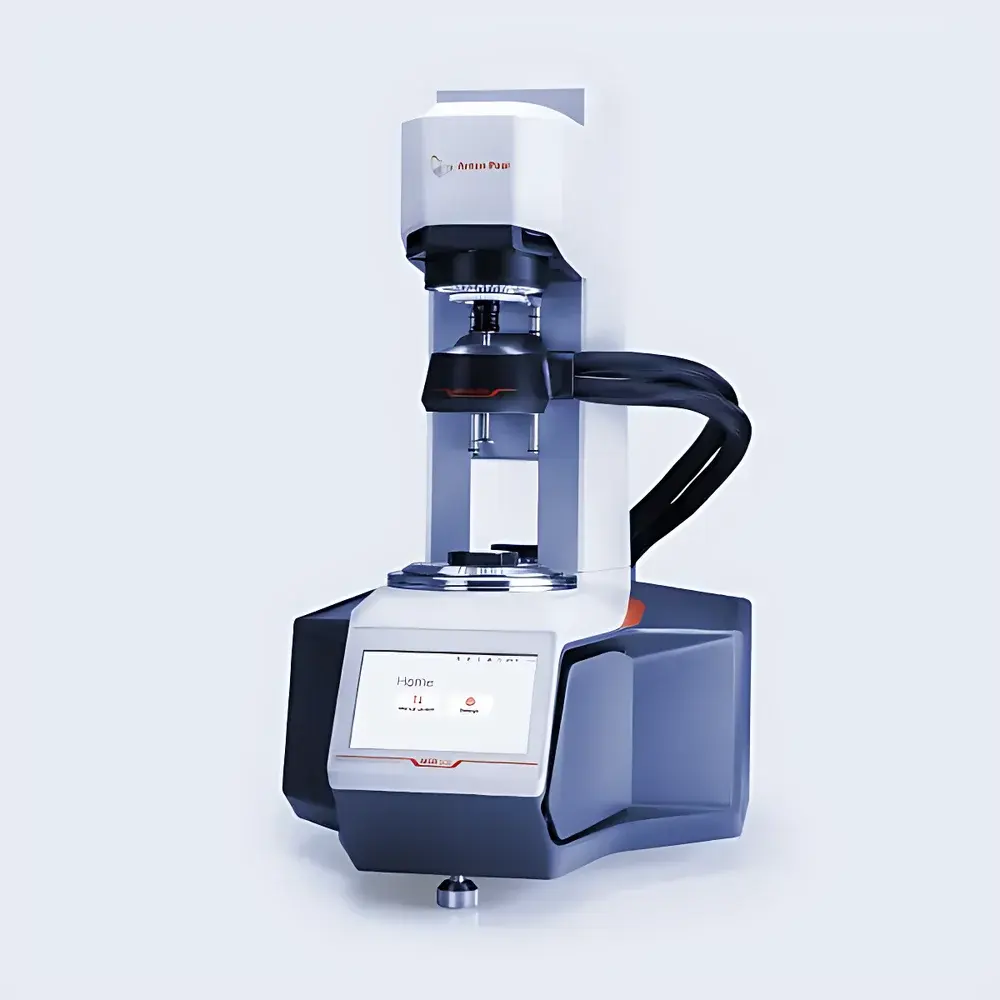
Anton Paar MCR303/MCR503 Modular Compact Rotational Rheometer with Magneto- and Electrorheological Capability
| Brand | Anton Paar |
|---|---|
| Origin | Austria |
| Manufacturer Type | Original Equipment Manufacturer (OEM) |
| Product Category | Imported Instrument |
| Model | MCR303 / MCR503 |
| Instrument Type | Rotational Rheometer |
| Sample State | Liquid |
| Bearing System | Air Bearing |
| Temperature Range | −160 °C to 1000 °C |
| Minimum Rotational Speed | 0 rpm |
| Frequency Range | 2 × 10⁻⁸ Hz |
| Maximum Rotational Speed | 3000 rpm |
| Maximum Torque | 215 mNm / 230 mNm |
| Torque Resolution | 0.1 nNm / 0.06 nNm |
Overview
The Anton Paar MCR303 and MCR503 are high-precision modular compact rotational rheometers engineered for advanced material characterization across research, quality control, and industrial development environments. Built on a unified platform architecture, these instruments implement Couette and parallel-plate rheometry principles—leveraging controlled shear stress (CSS) and controlled shear rate (CSR) modes—to quantify viscoelastic behavior, yield stress, thixotropy, time-dependent deformation, and nonlinear responses under oscillatory, steady-state, and transient conditions. The MCR series uniquely integrates magneto-rheological (MR) and electro-rheological (ER) measurement capabilities, enabling in situ investigation of field-responsive fluids under precisely regulated magnetic or electric fields—critical for functional fluid development, smart material design, and adaptive damping systems. With temperature control spanning from cryogenic (−160 °C) to ultra-high-temperature (1000 °C) regimes, the system supports structural transitions in polymers, melts, ceramics, and composites—making it suitable for both fundamental rheokinetics and process-relevant simulation.
Key Features
- Ultra-low torque detection: 0.2 nNm minimum oscillatory torque (MCR503 with TruStrain™ activated), enabling reliable measurement of weakly structured gels, dilute polymer solutions, and low-viscosity nanofluids.
- Air-bearing motor system with electronic commutated (EC) permanent-magnet synchronous drive—ensuring zero mechanical friction, long-term torque stability, and drift-free operation over multi-day experiments.
- Integrated 360° capacitive normal force sensor—providing real-time, non-contact normal force monitoring with ±0.1 mN resolution across 0.001–50 N (MCR303/503) or up to 70 N (MCR503 Power).
- High-speed data acquisition at up to 200 Hz—capturing rapid curing kinetics, fast gelation events, and transient yield phenomena with sub-millisecond temporal fidelity.
- TruRay optical alignment system combined with automated刮样 (scraping) mirror—ensuring reproducible sample loading, gap definition, and meniscus correction for accurate shear geometry.
- Toolmaster™ auto-recognition technology—detecting geometry type, calibration constants, and thermal history upon attachment—eliminating manual configuration errors.
- SmartPave™ and TruStrain™ modules—supporting asphalt binder grading per ASTM D7405 and true strain-controlled LAOS (Large Amplitude Oscillatory Shear) analysis compliant with ISO 6721-10.
Sample Compatibility & Compliance
The MCR303/503 accommodates liquid, paste, semi-solid, and thermosetting samples—including MR/ER suspensions, polymer melts, bituminous binders, pharmaceutical suspensions, food emulsions, and battery slurries. Its modular design permits seamless integration of environmental chambers (e.g., Peltier, liquid nitrogen, furnace), humidity controllers, pressure cells, and electrical stimulus units—enabling multi-parameter testing under GLP/GMP-aligned workflows. Software compliance includes FDA 21 CFR Part 11-ready audit trails, electronic signatures, and role-based access control in RheoCompass. Instrument validation adheres to ISO/IEC 17025 requirements, with traceable calibration protocols aligned with ASTM D2196, ISO 3219, and USP for rheological characterization of dosage forms.
Software & Data Management
RheoCompass v4.x serves as the unified software platform—featuring a fully touchscreen-optimized interface supporting 12 languages, intuitive workflow navigation, and context-aware guidance. Over 250 pre-validated method templates cover QC routines (e.g., viscosity vs. shear rate, frequency sweeps, temperature ramps) and advanced research protocols (e.g., SAOS/LAOS, creep-recovery, step-strain, yield mapping). Customizable reporting engines generate PDF/Excel outputs with embedded metadata, raw data export (ASCII/HDF5), and batch processing for statistical comparability. Data integrity is reinforced via automatic versioning, timestamped audit logs, and encrypted local/cloud storage options compatible with LIMS integration.
Applications
- Development and qualification of magnetorheological fluids for automotive dampers and haptic interfaces.
- Rheokinetic modeling of epoxy and acrylic resin curing under electric field stimulation.
- Temperature- and field-dependent modulus mapping of shape-memory polymers and ferrofluids.
- Bitumen performance grading per AASHTO TP 105 and EN 13587 using dynamic shear rheometry (DSR) and multiple stress creep recovery (MSCR).
- Yield stress profiling of ceramic slips, electrode slurries, and cosmetic gels using controlled-stress ramping and Herschel-Bulkley fitting.
- Multi-mode mechanical testing—including DMA in tension/bending/compression (via TruStrain™), powder flow analysis (with Powder Cell), and tribological evaluation (via MCR Friction Module).
FAQ
What distinguishes the MCR303 from the MCR503?
The MCR503 features enhanced torque sensitivity (0.2 nNm min. oscillatory torque), higher maximum torque (230 mNm), improved torque resolution (0.05 nNm), and expanded normal force range (up to 70 N)—optimized for demanding R&D applications requiring ultra-low signal detection and extended dynamic range.
Can the MCR series perform simultaneous temperature and electric/magnetic field control?
Yes—using optional ER/MR test cells with integrated electrodes or electromagnets, coupled with precise temperature control (e.g., ETC 150 or FURNACE 1000), enabling true multi-stimulus rheology under ISO/ASTM-compliant conditions.
Is RheoCompass validated for regulated pharmaceutical environments?
Yes—RheoCompass supports 21 CFR Part 11 compliance through electronic signature workflows, immutable audit trails, user privilege management, and IQ/OQ documentation packages available upon request.
How does Toolmaster™ ensure measurement traceability?
Toolmaster™ stores geometry-specific calibration coefficients, thermal expansion profiles, and usage history directly in each tool’s RFID chip—automatically applied during mounting to eliminate manual entry errors and support ISO 17025 traceability requirements.
What is the minimum measurable frequency, and how is it achieved?
The theoretical lower limit of 2 × 10⁻⁸ Hz corresponds to one oscillation cycle over approximately two years—realized via ultra-stable air-bearing suspension, digital phase-locked loop (PLL) control, and sub-nanoradian angular resolution (≤1 nrad) enabled by high-fidelity optical encoders.



