
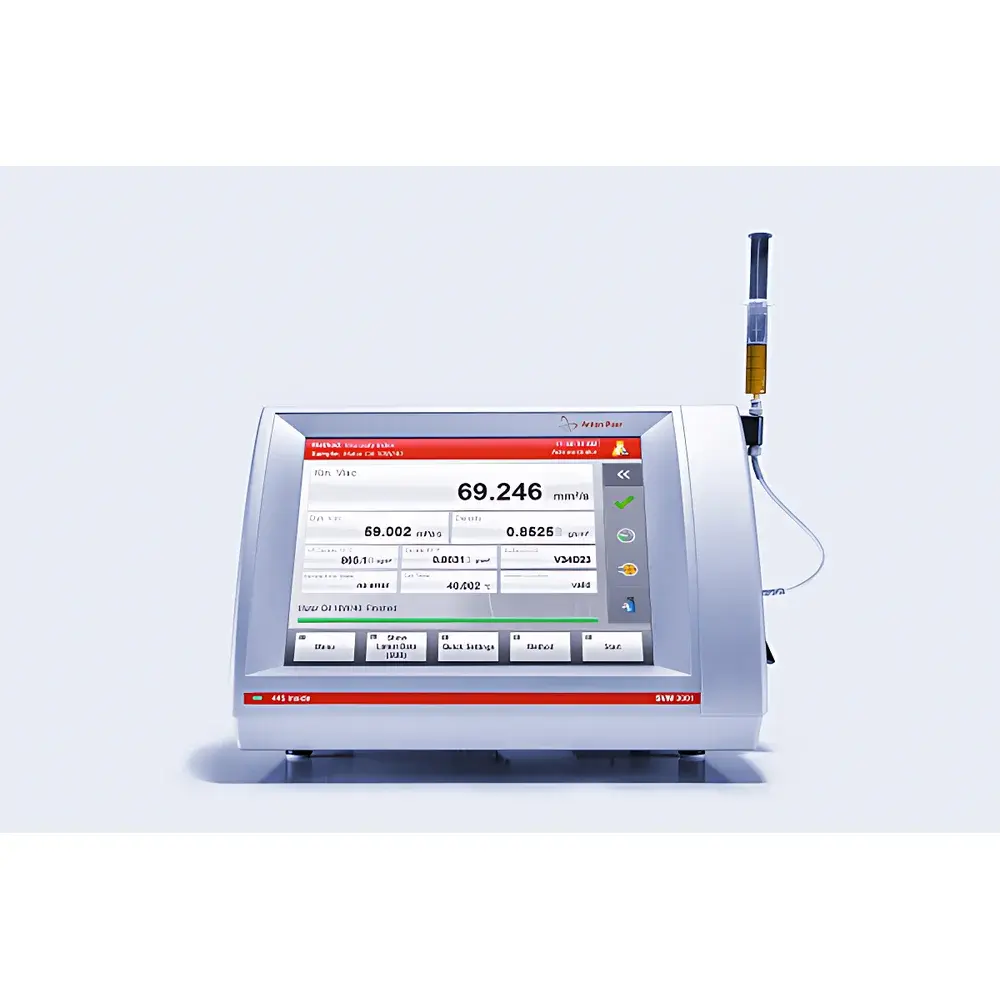
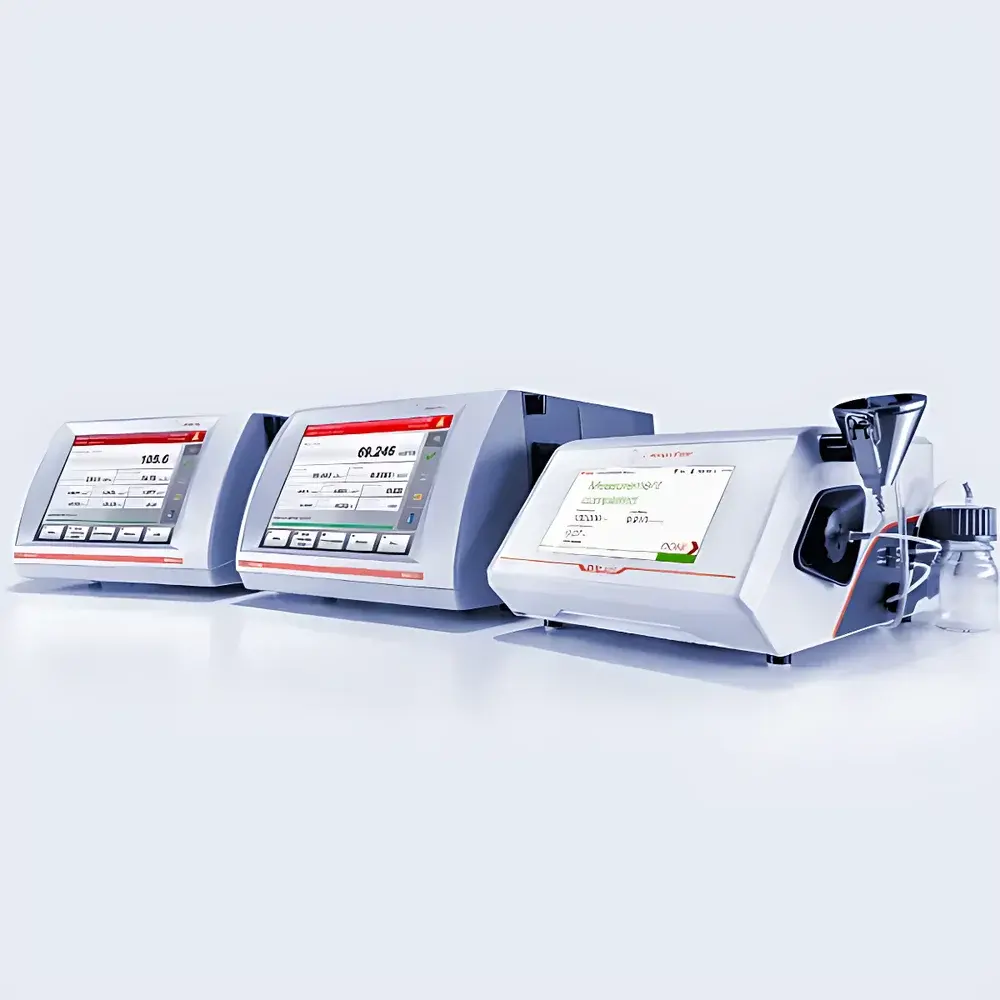
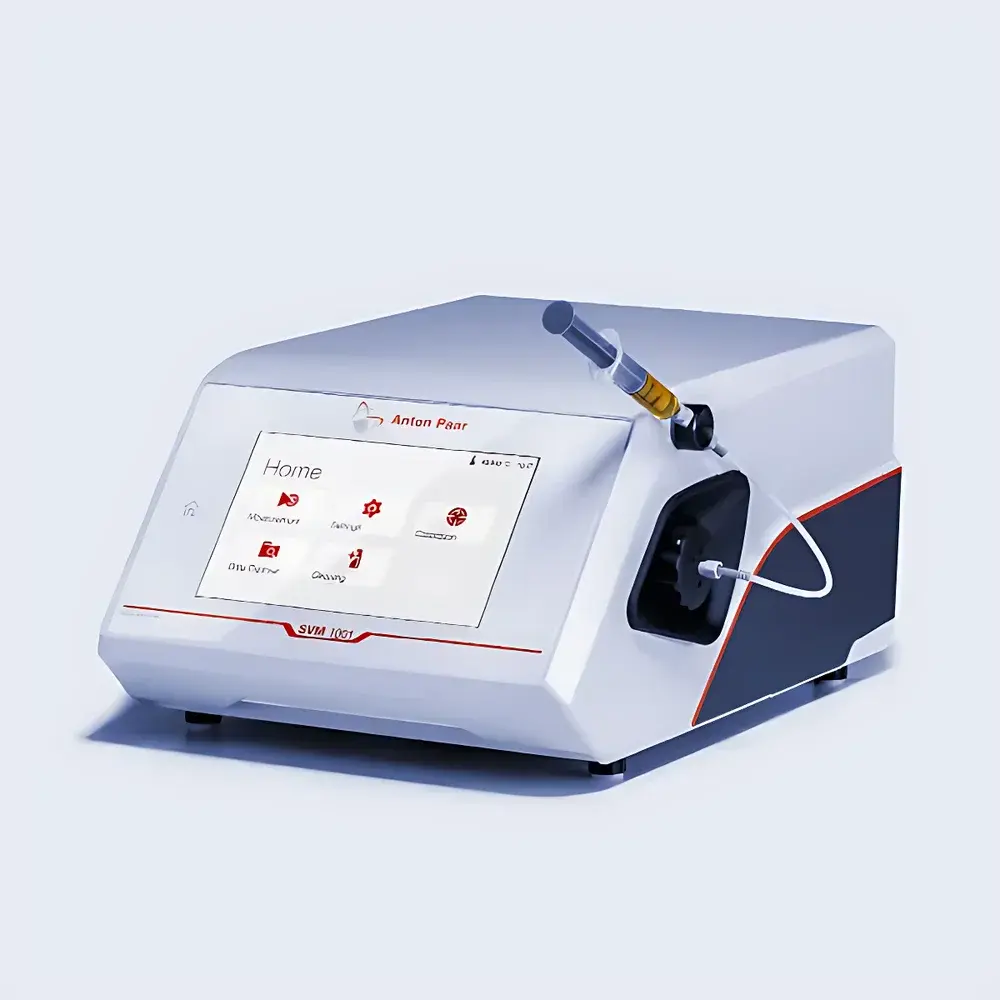
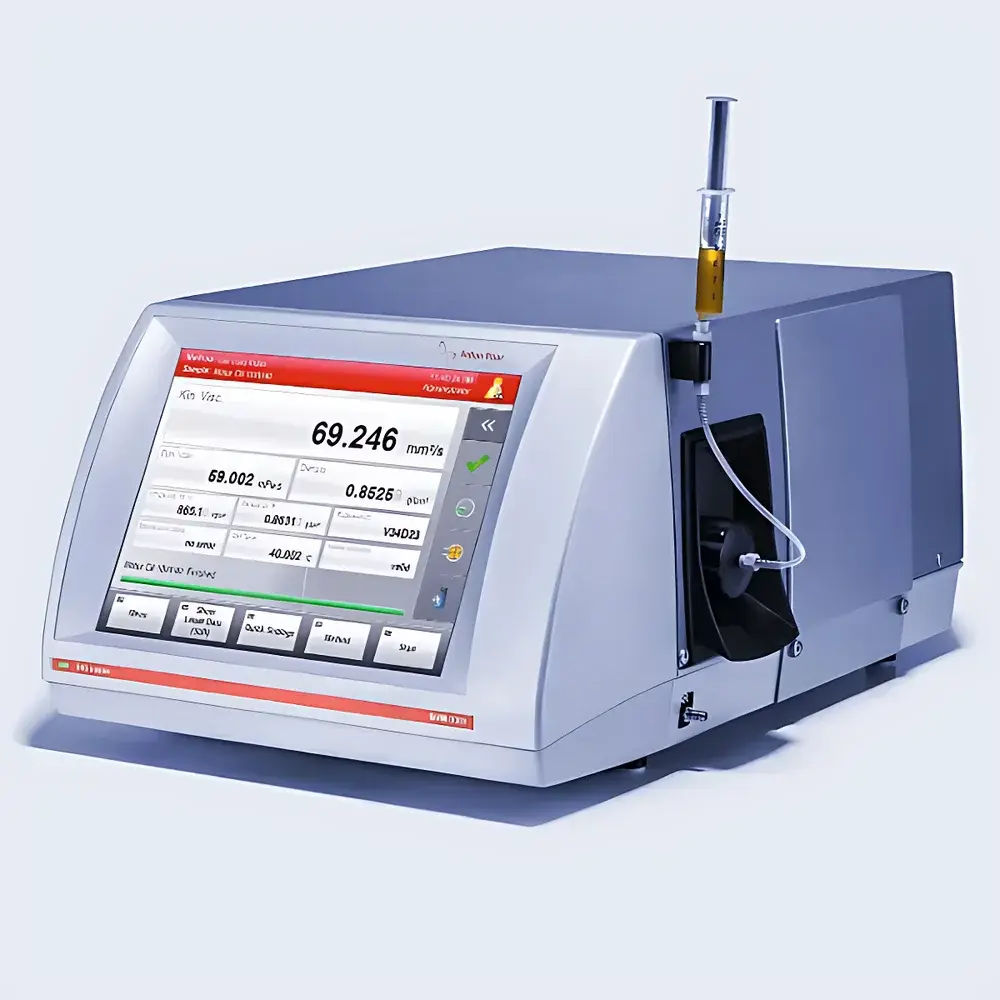
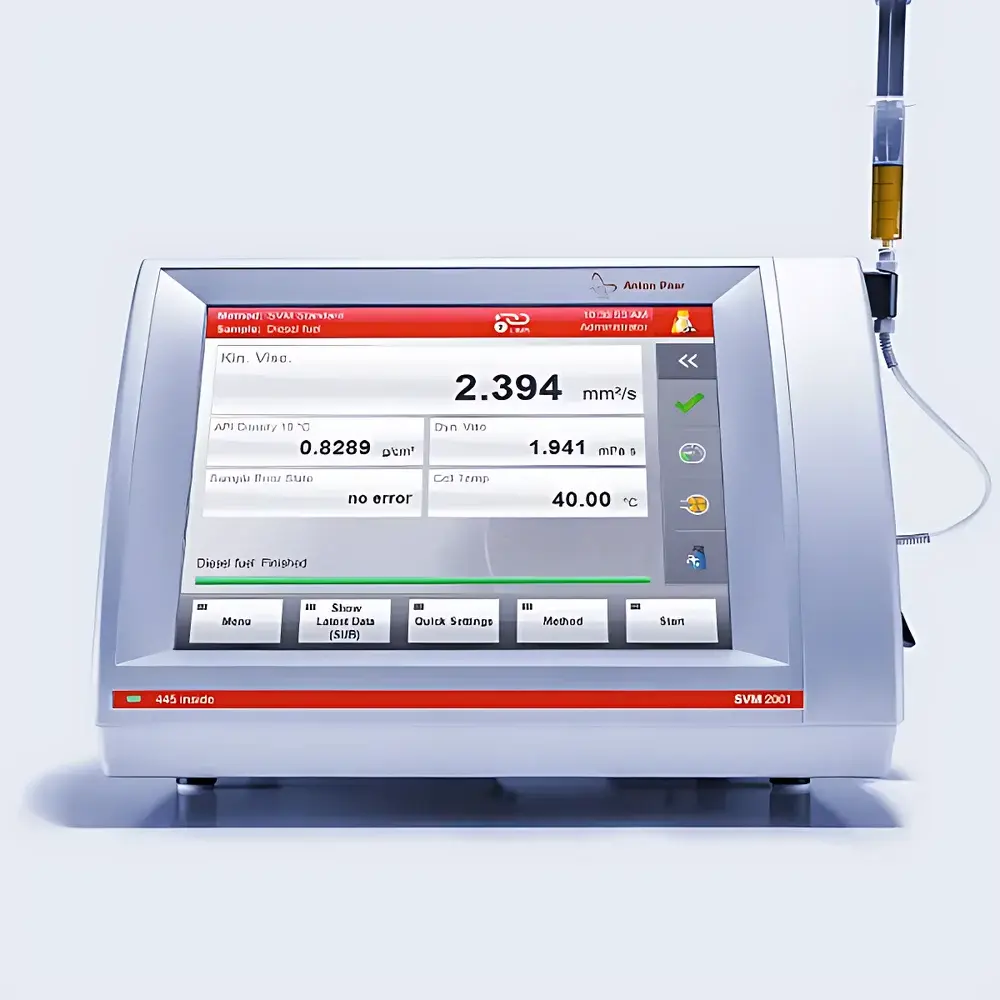
Anton Paar SVM Series Automated Kinematic Viscometer
| Brand | Anton Paar |
|---|---|
| Origin | Austria |
| Manufacturer Type | Original Equipment Manufacturer (OEM) |
| Product Origin | Imported |
| Model | SVM Series |
| Instrument Category | Kinematic Viscometer |
| Instrument Form Factor | Benchtop Fixed System |
| Operating Environment | Ambient Temperature |
| Kinematic Viscosity Range | 0.2 to 30,000 mm²/s |
| Temperature Control Range | 15 °C to 100 °C (standard) |
| Compliance | ASTM D7042, ASTM D445 (with bias correction), ISO 23581, EN 16896, ASTM D4052, ISO 12185, ASTM D2386, ASTM D2500, ASTM D396, D975, D1655, D3699, D6158, D6823, D7467 |
| Patents | AT516058 (B1), US10036695 (B2), CN105424556, EP2995928 (B1), AT516302 (B1), CN105628550 |
Overview
The Anton Paar SVM Series is a fully automated, benchtop kinematic viscometer engineered for high-precision, multi-parameter fluid characterization in regulated industrial and research laboratories. Unlike traditional capillary-based systems requiring multiple tubes and manual handling, the SVM platform employs a single, robust metal measurement cell operating on the oscillating U-tube principle—where fluid density and kinematic viscosity are determined simultaneously via precise resonant frequency and damping analysis. This physics-based dual-measurement architecture eliminates inter-method variability and enables traceable, first-principles derivation of dynamic viscosity, viscosity index (VI), cloud point, pour point, and density—all within one automated run. Designed explicitly for compliance-critical environments, the SVM Series implements ASTM D7042 as its primary test method while incorporating certified bias correction algorithms to generate ASTM D445–equivalent reporting without physical capillary calibration. Its Peltier-driven thermal control ensures rapid, stable temperature equilibration (≤60 s), supporting routine operation across the full 15–100 °C range—and down to –60 °C in cold-property variants—making it suitable for petroleum distillates, biofuels, lubricants, synthetic esters, and aviation fuels.
Key Features
- Single-cell, all-in-one measurement: Simultaneous determination of kinematic viscosity, dynamic viscosity, density, VI, cloud point, and pour point—no tube switching or recalibration required.
- Patented oscillating U-tube technology: Metal measurement cell eliminates glass breakage risk, improves mechanical stability, and enables long-term reproducibility under repeated thermal cycling.
- ASTM D7042–based workflow with D445 bias correction: Validated against reference oils per ASTM D7042 Annex A1; outputs both D7042 and D445–compliant reports from identical data sets.
- Simple Fill sampling interface: Direct sample introduction via gravity-fed funnel—no syringes, pipettes, or operator-dependent volume transfer—reducing human error and contamination risk.
- Low-consumption operation: As little as 1.5 mL sample and 1.5 mL solvent per analysis; total power draw ≤75 W (typical operational load).
- Integrated Peltier temperature control: Achieves ±0.005 °C repeatability and ±0.03 °C reproducibility across the 15–100 °C span; optional dual-temperature capability for VI calculation.
- Automated cleaning cycle: Full solvent flush and drying completed in ≤2 minutes; scheduled maintenance intervals extend to 30 minutes without system downtime.
Sample Compatibility & Compliance
The SVM Series accommodates a broad spectrum of Newtonian and mildly non-Newtonian liquids—including diesel fuel, jet fuel (Jet A-1, JP-8), base oils, transformer oils, biodiesel (FAME), synthetic lubricants, and hydraulic fluids—without modification. All models comply with global regulatory frameworks: ASTM methods (D7042, D445, D4052, D2386, D2500), ISO standards (23581, 12185), EN 16896, IP 365, DIN 51562, DEF STAN 91-91, MIL-DTL-83133, GB/T 265, and GOST R 52663. The SVM 3001 Cold Properties and SVM 4001 variants support low-temperature testing per ASTM D2500 (cloud point) and ASTM D2386 (pour point), with documented repeatability <0.5 °C and reproducibility <2.5 °C. Density measurements meet ASTM D4052 requirements (±0.00005 g/cm³ repeatability) when configured with the integrated densitometry module. Data integrity is maintained through full audit trail logging, electronic signatures, and 21 CFR Part 11–ready firmware (via AP Connect software integration).
Software & Data Management
All SVM instruments feature an embedded Linux-based OS with a 7″ or 10.4″ capacitive touchscreen HMI, supporting intuitive method setup, real-time diagnostics, and local result review. Measurement data—including raw frequency, damping, temperature, and derived parameters—is stored internally (up to 1,000 results) with timestamping, user ID tagging, and checksum validation. Export options include USB mass storage (CSV, PDF, XML), Ethernet (FTP/SFTP), and direct integration with Anton Paar’s AP Connect platform for centralized LIMS synchronization, remote monitoring, and GLP/GMP-compliant report generation. AP Connect provides role-based access control, electronic signature workflows, and full revision history for all method files and calibration records—ensuring alignment with FDA 21 CFR Part 11, EU Annex 11, and ISO/IEC 17025 documentation requirements.
Applications
The SVM Series serves as a core analytical tool in quality control laboratories across refining, petrochemicals, aviation, power generation, and automotive sectors. Typical use cases include: batch release testing of diesel and gasoline per ASTM D975 and D439; viscosity grading of engine oils per SAE J300; cold-flow property verification for arctic-grade lubricants; density and VI assessment of base stocks per ASTM D2593; and specification conformance of aviation turbine fuels per ASTM D1655. Its high throughput (up to 37 samples/hour on SVM 1001) and 24/7 unattended operation—enabled by optional HTV high-throughput platforms and robotic auto-samplers—make it ideal for contract testing labs and production facilities managing hundreds of daily samples.
FAQ
How does the SVM Series achieve ASTM D445–equivalent results without capillary viscometers?
It applies empirically validated bias correction factors derived from extensive correlation studies between oscillating U-tube kinematic viscosity and reference capillary data across >200 certified standard oils. These corrections are embedded in firmware and applied automatically during D7042 analysis.
Can the SVM measure highly viscous or waxy samples?
Yes—models such as the SVM 3001 Cold Properties and SVM 4001 support viscosity up to 30,000 mm²/s and operate down to –60 °C, enabling reliable pour point and wax appearance temperature (WAT) determination in heavy fuel oils and bitumen blends.
Is external PC software required for routine operation?
No—full standalone functionality is provided via the onboard touchscreen interface. AP Connect is optional and used only for advanced data aggregation, remote diagnostics, or regulatory reporting.
What maintenance is required beyond daily cleaning?
Annual calibration verification using NIST-traceable viscosity standards is recommended. No optical alignment, lamp replacement, or mechanical recalibration is needed—the metal measurement cell requires no periodic adjustment.
Does the SVM support 21 CFR Part 11 compliance?
Yes—when paired with AP Connect v3.0+, the system supports electronic signatures, audit trails, role-based permissions, and data encryption meeting FDA requirements for electronic records and signatures.



