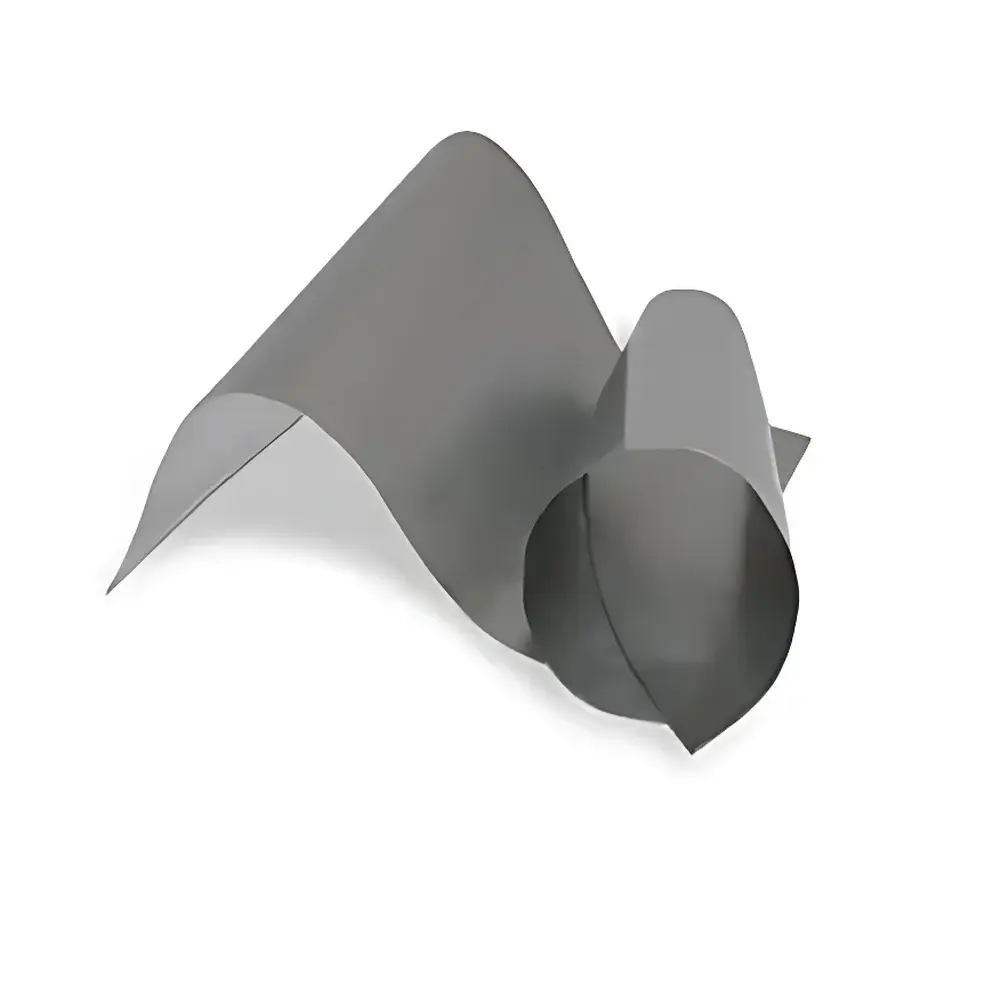
Pyrolytic Graphite Sheet (PGS) for Aluminum Battery Research –合肥科晶 Model PGS-125×210-17μm
| Brand | Hefei Kejing |
|---|---|
| Origin | USA |
| Manufacturer Type | Authorized Distributor |
| Origin Category | Imported |
| Model | PGS-125×210-17μm |
| Carbon Content | 99.9% |
| Thickness | 17 μm (0.017 ± 0.005 mm) |
| Standard Dimensions | 125 mm × 210 mm |
| Density | 2.1 g/cm³ |
| In-Plane Thermal Conductivity (a-b plane) | 1700–1900 W/(m·K) |
| Through-Plane Thermal Conductivity (c-axis) | 15–20 W/(m·K) |
| Tensile Strength | 650 psi |
| Electrical Conductivity | 19,000 S/cm |
| Maximum Operating Temperature | 450 °C |
| Packaging | Class 1000 cleanroom environment, sealed in Class 100 clean bags |
Overview
Pyrolytic Graphite Sheet (PGS) is a highly oriented, synthetic graphite film produced via chemical vapor deposition (CVD) under high-temperature pyrolysis conditions. Its crystalline structure exhibits exceptional anisotropy—extremely high thermal and electrical conductivity within the basal (a-b) plane, coupled with significantly lower but still functional transport properties along the c-axis. This directional behavior makes PGS uniquely suited for thermal management and current-collecting applications where lateral heat spreading or in-plane conduction dominates system performance requirements. Designed specifically for advanced electrochemical research—including aluminum-ion battery development—this material serves as both a thermally stable current collector and a low-resistance interfacial layer between active materials and metallic substrates.
Key Features
- Ultra-high in-plane thermal conductivity (1700–1900 W/(m·K)), enabling rapid lateral heat dissipation from localized hotspots in battery electrodes and power electronics
- High electrical conductivity (19,000 S/cm), minimizing ohmic losses in high-current-density configurations
- Controlled thickness tolerance of ±0.005 mm at 17 μm, ensuring consistent mechanical integration and interfacial contact pressure across electrode stacks
- Density of 2.1 g/cm³ reflects optimized graphitization degree and structural integrity without excessive brittleness
- Thermal stability up to 450 °C in inert atmospheres, supporting high-temperature electrode processing and cycling protocols
- Carbon purity ≥99.9%, minimizing catalytic side reactions and electrolyte decomposition during long-term electrochemical operation
- Supplied in ISO Class 1000 cleanroom environments and double-bagged in Class 100 clean packaging to prevent particulate contamination critical for lab-scale battery fabrication
Sample Compatibility & Compliance
This PGS grade is compatible with standard slurry-casting, hot-press lamination, and dry-film transfer processes used in academic and industrial battery R&D labs. It adheres to ASTM D3746 (Standard Practice for Evaluating Thermal Management Materials) for thermal interface characterization and meets baseline material specifications referenced in USP for non-metallic components in electrochemical systems. While not certified to ISO 13485 or FDA 21 CFR Part 11 (as it is a passive material component, not a software-controlled instrument), its documented traceability, lot-specific test reports, and cleanroom handling align with GLP-compliant laboratory practices for materials qualification in energy storage research.
Software & Data Management
As a passive instrumentation-grade material component—not an electronic device—this PGS product does not incorporate embedded firmware, data logging, or software interfaces. However, full material certification documentation (including carbon content analysis by combustion IR spectroscopy, thermal diffusivity measurements per ASTM E1461, and dimensional metrology reports) is provided with each shipment. These reports are structured in PDF format with machine-readable metadata, supporting integration into institutional LIMS (Laboratory Information Management Systems) and digital sample tracking workflows compliant with ISO/IEC 17025 requirements for reference material traceability.
Applications
- Anode and cathode current collectors in aluminum-ion battery prototypes, especially where low interfacial resistance and high thermal resilience are required
- Thermal interface layers between Li-ion pouch cells and cold plates in modular test fixtures
- Substrate films for thin-film solid-state electrolyte deposition, leveraging low surface roughness and chemical inertness
- Reference standards for in-situ XRD and Raman mapping of phase evolution during battery cycling
- Shielding layers in high-frequency electromagnetic interference (EMI) test setups due to broadband conductivity and minimal eddy-current loss
- Calibration substrates for micro-thermography systems requiring known, stable thermal diffusivity baselines
FAQ
Is this PGS material compatible with aqueous electrolytes used in Al-ion batteries?
Yes—its high carbon purity and low defect density minimize parasitic water reduction and hydrogen evolution, though long-term immersion testing under specific salt concentrations should be conducted per your cell chemistry.
Can custom dimensions be cut with laser micromachining without compromising thermal anisotropy?
Yes—laser ablation at controlled fluence preserves bulk crystal orientation; however, kerf width and edge graphitization must be validated via Raman mapping for critical electrode edge applications.
What is the recommended method for bonding PGS to aluminum foil substrates?
Thermal compression at 120–150 °C under 5–10 MPa for 60–120 seconds achieves robust adhesion without delamination; solvent-based conductive adhesives are discouraged due to interfacial carbon diffusion risks.
Does the product include batch-specific thermal conductivity validation data?
Yes—each lot undergoes flash diffusivity measurement (ASTM E1461) on three representative samples, with full uncertainty budgeting reported in the CoA.
How should PGS sheets be stored to maintain surface integrity?
Store flat in original clean bags under dry nitrogen purge at 20–25 °C; avoid stacking or bending, as permanent plastic deformation may degrade in-plane conductivity homogeneity.