
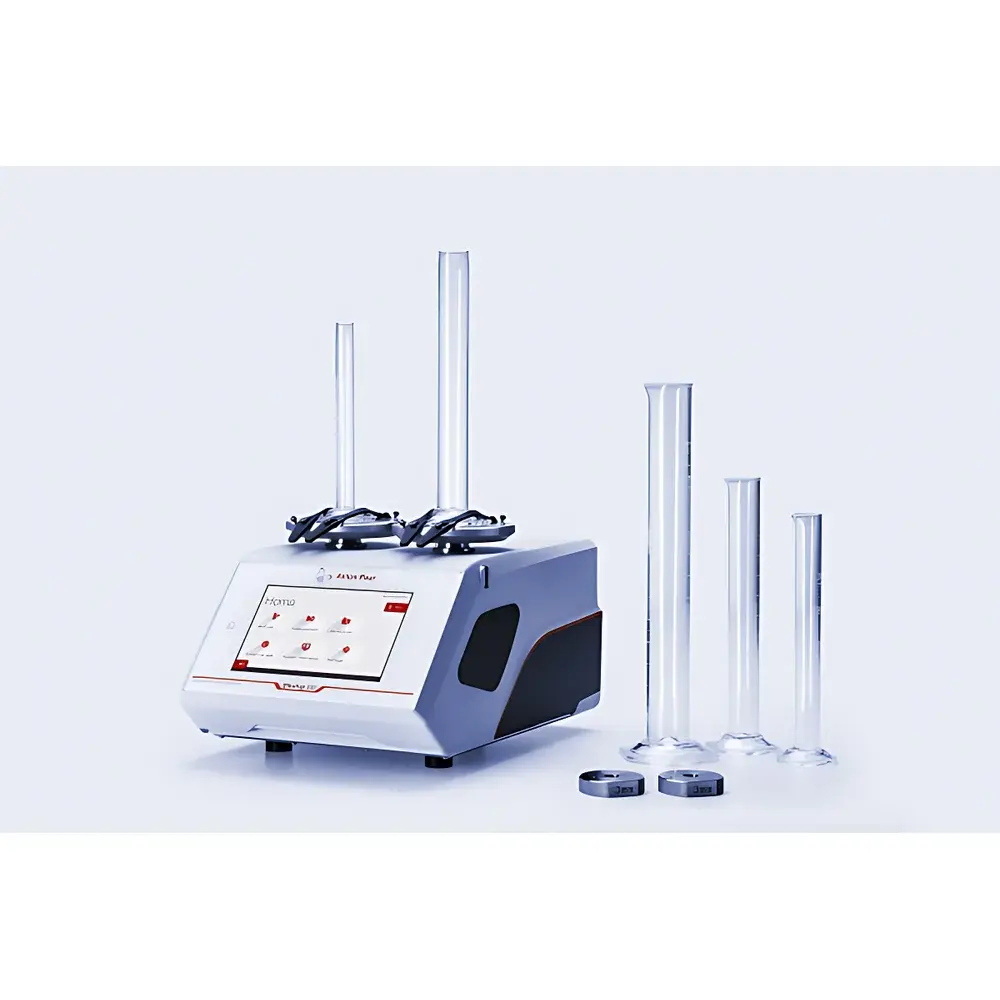
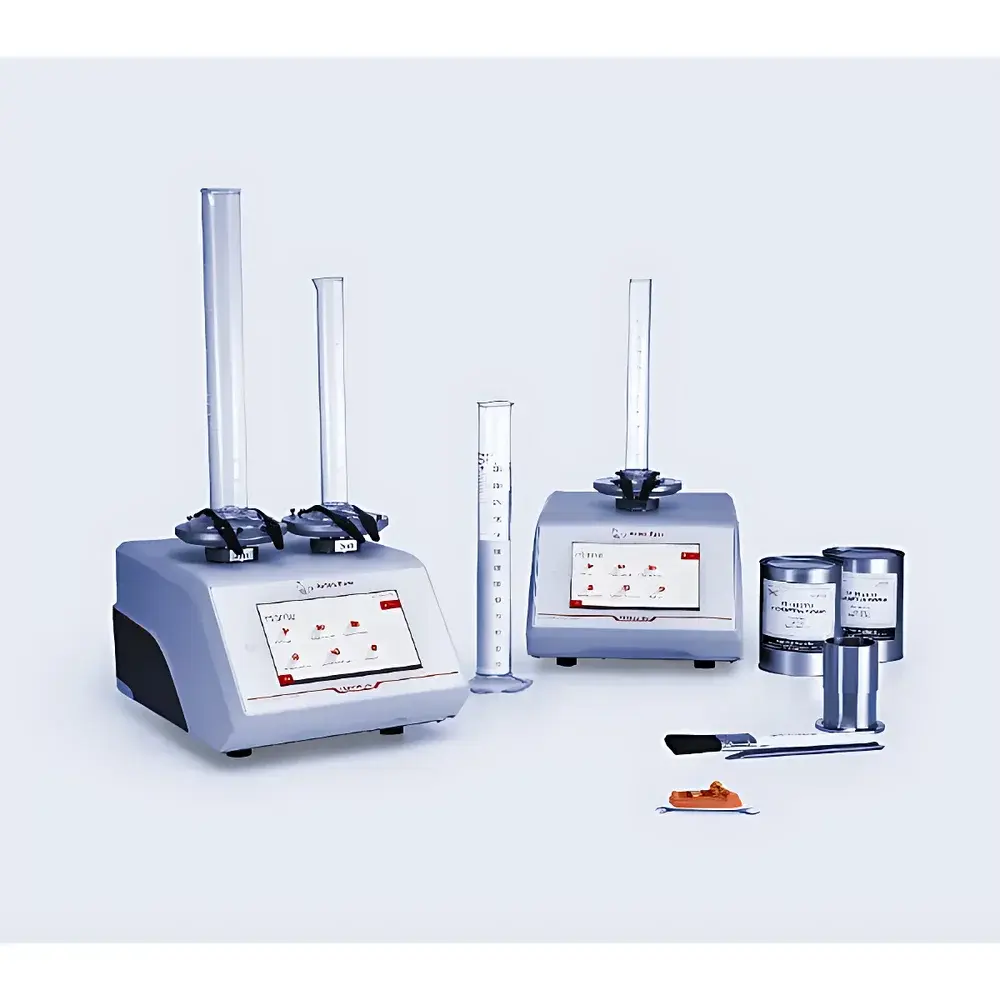
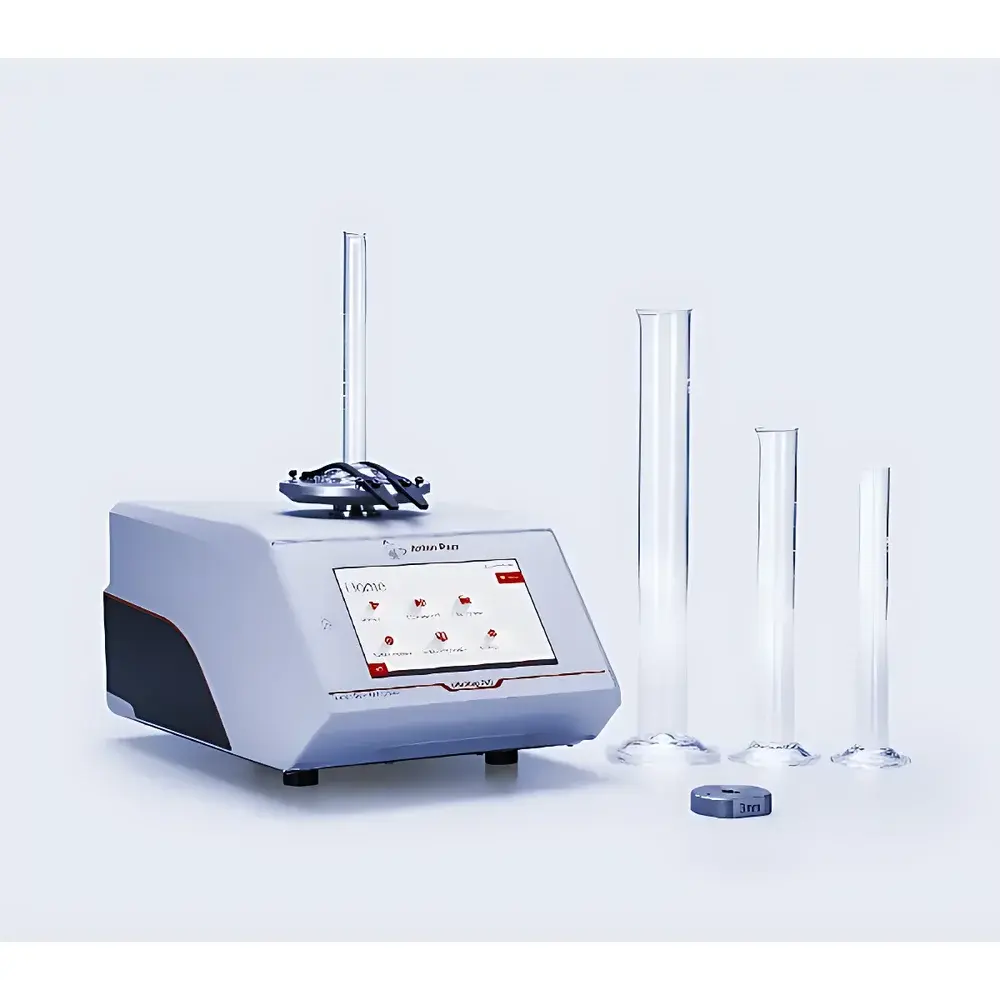
Anton Paar Ultratap 500 Series Tap Density Tester
| Brand | Anton Paar |
|---|---|
| Origin | USA |
| Manufacturer Type | Manufacturer |
| Origin Category | Imported |
| Model | Ultratap 500 |
| Instrument Type | Bulk Density Tester |
| Instrument Class | Benchtop Laboratory |
| Sample Type | Solid Powders & Granules |
| Density Accuracy | 0.001 g/cm³ |
| Repeatability | 0.0001 g/cm³ |
| Resolution | 0.0001 g/cm³ |
| Minimum Sample Volume | 5 mL |
| Vibration Frequency Range | 50–350 taps/min |
| Tap Amplitude | 3 mm ± 0.2 mm or 14 mm ± 1 mm |
| Noise Level | 65 dB (58 dB with optional noise-reduction cabinet) |
| Touchscreen | 7-inch TFT WVGA (800 × 480 px), PCAP |
| User Management | Password-protected |
| Built-in Methods | 24 (ASTM, ISO, USP <616> Methods 1–3) |
| Data Storage | 1,000 reports / 100 custom methods |
| Dimensions (H×W×D) | 228.6 × 263.5 × 361 mm (9 × 10.4 × 14.2 in) |
| Weight | 14.5 kg (single station) / 17.6 kg (dual station) |
| Power Input | 24 V DC, 2.1 A (51 W) / 2.6 A (63 W) |
Overview
The Anton Paar Ultratap 500 Series Tap Density Tester is a precision-engineered benchtop instrument designed for the standardized determination of bulk density, compressibility, and flowability indices of free-flowing powders and granular solids. It operates on the principle of controlled mechanical tapping—repeated vertical displacement of a graduated cylinder containing a powder sample under defined amplitude and frequency—to simulate compaction behavior under gravity-driven settling conditions. This method aligns directly with internationally recognized pharmacopeial and materials testing standards, including USP , ASTM D4781, ISO 3953, and EP 2.9.33. Unlike legacy tap testers relying on mechanical cams or solenoids prone to drift, the Ultratap 500 employs a robust electromagnetic drive system with real-time amplitude monitoring and closed-loop feedback control—ensuring metrological traceability and long-term stability over its rated service life of 25 million taps.
Key Features
- Durability Engineered for Metrological Integrity: Certified for ≥25 million taps without calibration shift; validated via internal amplitude detection and periodic self-diagnostic routines.
- Regulatory Compliance by Design: Preloaded with 24 standardized test methods—including all three USP protocols (Method I: fixed tap count; Method II: variable tap count until mass change ≤0.1%; Method III: volumetric endpoint)—with full audit trail support for GLP/GMP environments.
- TruLock Cylinder Mounting System: Tool-free, one-motion clamping mechanism accommodating standard volumetric cylinders from 5 mL to 1000 mL (including ISO/USP-compliant 250 mL calibrated glass cylinders).
- Low-Noise Operation: Acoustic emission reduced to 65 dB(A) at 1 m—comparable to ambient office noise—achieved through optimized electromagnetic actuation and vibration-damped chassis architecture; optional acoustic enclosure lowers noise to 58 dB(A).
- Integrated Data Processing: On-device calculation of bulk density (g/cm³), tapped density (g/cm³), Carr Index (%), Hausner Ratio, and compressibility index per ASTM D6393, with automatic unit conversion and uncertainty propagation based on input sample mass and volume tolerances.
Sample Compatibility & Compliance
The Ultratap 500 supports dry, non-cohesive to moderately cohesive powders and granules across pharmaceutical, chemical, food, metallurgical, and additive manufacturing applications. Its minimum sample requirement of 5 mL enables efficient testing of high-value or limited-availability materials. All measurements comply with the repeatability threshold of ≤0.0001 g/cm³ (RSD <0.1% for repeated determinations on homogeneous samples), satisfying the precision requirements of USP and ISO 3953 Annex A. The instrument’s firmware implements electronic signature-capable user management (role-based access control), time-stamped method execution logs, and tamper-evident report generation—fully aligned with FDA 21 CFR Part 11 data integrity expectations when paired with validated networked printing or USB export workflows.
Software & Data Management
Controlled via an intuitive 7-inch capacitive touchscreen interface running embedded Linux OS, the Ultratap 500 provides immediate access to all 24 preconfigured methods, customizable test parameters (tap count, duration, amplitude selection), and real-time graphical feedback during measurement. Reports are generated in PDF format with embedded metadata: operator ID, timestamp, method version, cylinder ID, raw mass/volume inputs, calculated indices, and pass/fail status against configurable acceptance criteria. Data export supports USB-host peripherals (keyboard, barcode scanner, thermal printer, analytical balance via RS-232/USB-serial adapter). Internal storage retains up to 1,000 test records and 100 user-defined methods, with optional cloud synchronization via Anton Paar’s LabX® software platform for centralized instrument fleet management and statistical process control (SPC) reporting.
Applications
- Pharmaceutical solid dosage development: excipient characterization, blend uniformity assessment, capsule fill weight prediction.
- Quality control of active pharmaceutical ingredients (APIs) and intermediates per ICH Q5C stability guidelines.
- Flowability evaluation of metal powders prior to laser powder bed fusion (LPBF) or binder jetting processes.
- Compliance verification of detergent, catalyst, and pigment powders against ASTM D4781 and ISO 3953 specifications.
- Research into particle–particle interaction forces using compressibility profiles derived from multi-tap sequences.
FAQ
What regulatory standards does the Ultratap 500 natively support?
It includes full implementations of USP Methods I–III, ASTM D4781, ISO 3953, and EP 2.9.33—with method parameters pre-validated against reference materials.
Can the instrument be integrated into a validated LIMS or ERP environment?
Yes—via LabX® software with OPC UA or REST API connectivity, supporting automated data ingestion, electronic signatures, and 21 CFR Part 11-compliant audit trails.
Is calibration traceable to national standards?
All density calculations derive from certified mass and volume inputs; amplitude and tap count are verified using on-board MEMS accelerometers traceable to NIST standards.
Does the dual-station model perform parallel tests?
No—the two stations operate independently but sequentially; each test must be initiated manually or scheduled via LabX® to avoid cross-contamination or timing interference.
What maintenance is required to sustain 25 million tap reliability?
None beyond routine cleaning and annual verification using Anton Paar’s certified reference cylinders and traceable mass standards—no lubrication, alignment, or component replacement is specified within warranty period.



