
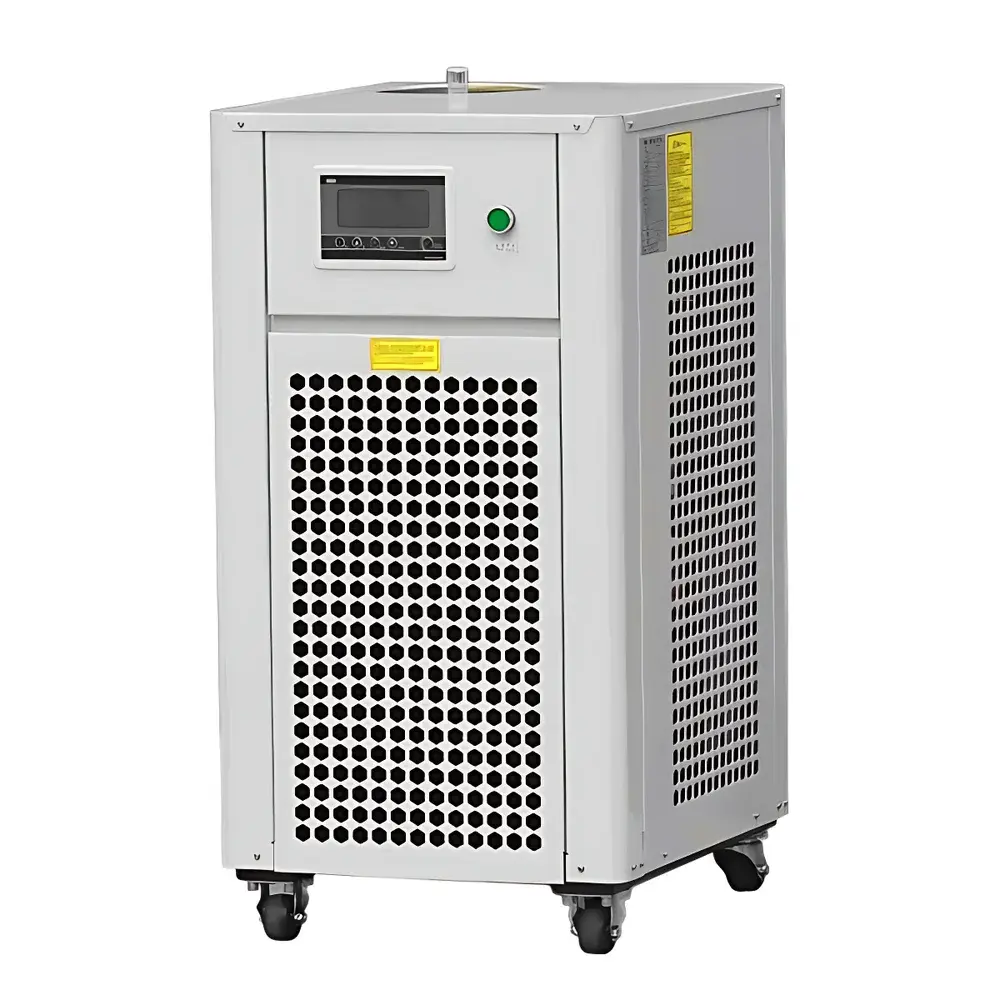
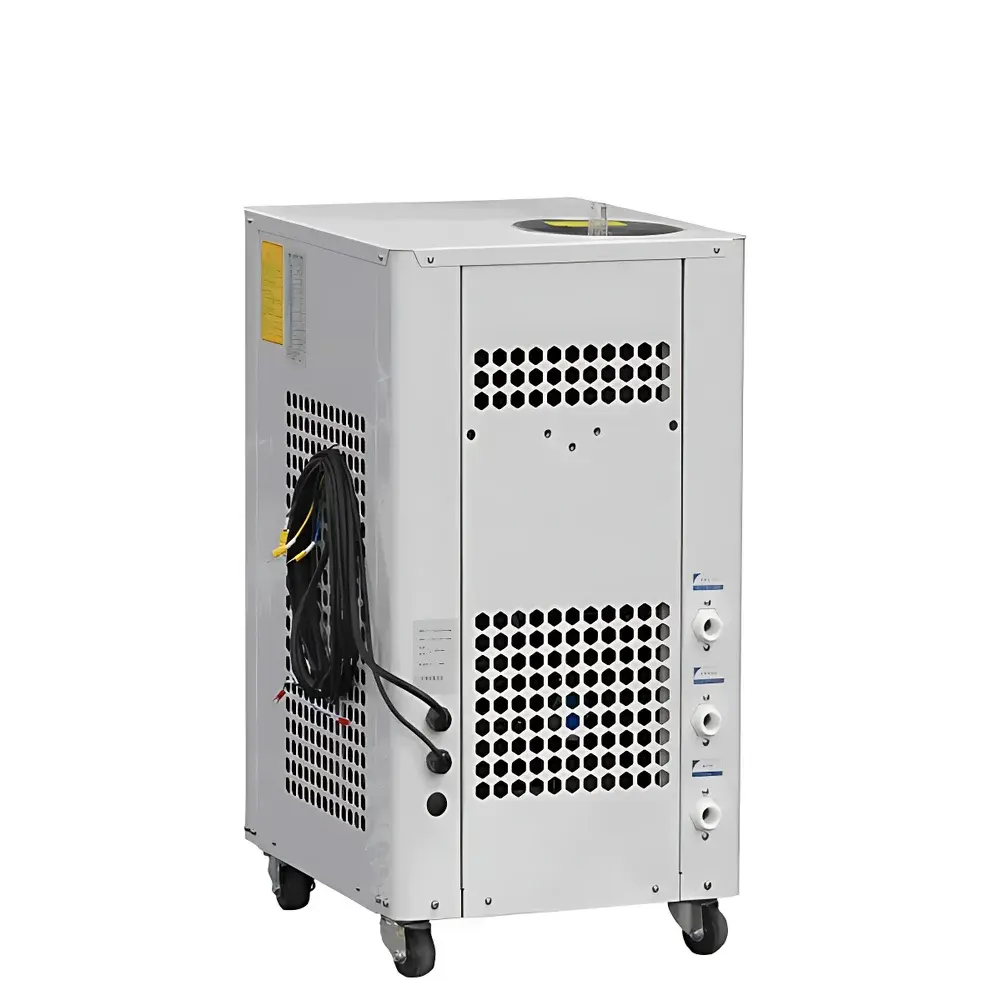
HTCY LX-S45 Integrated Circulating Chiller
| Brand | HTCY |
|---|---|
| Origin | Beijing, China |
| Model | LX-S45 |
| Cooling Type | Air-cooled |
| Temperature Range | 8–30 °C |
| Temperature Stability | ±0.3 °C |
| Refrigeration Capacity | 4500 W |
| Circulating Pump Pressure | 2.7 bar |
| Flow Rate | 30 L/min |
| Reservoir Volume | 15.5 L |
| Power Supply | 1φ, 220 V, 50 Hz |
| Refrigerant | R22 |
| Compressor Power | 2 HP |
| Pump Power | 370 W |
| Pump Head | 27 m |
| Noise Level | ≤57 dBA |
| Net Weight | 98 kg |
| Dimensions (W×D×H) | 525×595×1015 mm |
| Enclosure Material | Stainless Steel Reservoir |
| Control Interface | LCD Display with Bypass Regulation |
| Flow Protection | Adjustable Flow Switch (Default: 2.0 L/min) |
| Inlet/Outlet Port | DN20 (3/4″ internal thread) |
| Drain Port | DN15 (1/2″ internal thread) |
| Operating Mode | Continuous Duty |
Overview
The HTCY LX-S45 Integrated Circulating Chiller is an air-cooled, single-unit thermal management system engineered for precision temperature control in laboratory and analytical instrumentation environments. It operates on the vapor-compression refrigeration cycle using R22 refrigerant and delivers stable cooling capacity of 4500 W across a regulated water temperature range of 8–30 °C. Designed for continuous-duty operation, the unit maintains thermal stability within ±0.3 °C—achievable through high-resolution PID control, rapid-response bypass regulation, and a thermally insulated stainless-steel reservoir (15.5 L). Its integrated architecture eliminates external piping complexity and minimizes footprint, making it suitable for benchtop or floor-mounted deployment adjacent to spectrometers, lasers, ICP-OES systems, NMR preamplifiers, or vacuum pumps requiring consistent coolant supply. The chiller’s thermodynamic design prioritizes long-term reproducibility under variable load conditions, with calibrated flow and pressure performance verified at 30 L/min at 2.7 bar—ensuring compatibility with instruments demanding high-volume, low-temperature differential circulation.
Key Features
- Stainless-steel reservoir and fluid path components resist corrosion and support use with deionized or purified water—eliminating scale formation and electrolytic degradation common in mixed-material systems.
- LCD-based controller with 0.1 °C display resolution, programmable setpoints, real-time fault diagnostics, and memory-retained operational parameters after power interruption.
- Dual-mode temperature protection: independent high- and low-temperature alarms with configurable normally open/normally closed relay outputs for integration into facility safety interlocks or instrument shutdown protocols.
- Integrated flow monitoring system with adjustable threshold (factory-set at 2.0 L/min), triggering audible/visual alerts and pump shutdown upon deviation—preventing dry-run damage and ensuring instrument coolant integrity.
- Air-cooled condensing assembly featuring dual axial fans (rated 85 W × 2) and total exhaust airflow of 3328 m³/h, optimized for ambient temperatures up to 35 °C without derating.
- Low-noise acoustic design: sound pressure level ≤57 dBA at 1 m distance, compliant with ISO 3744 measurement methodology—enabling installation in shared laboratory spaces without acoustic interference.
Sample Compatibility & Compliance
The LX-S45 is compatible with a broad spectrum of heat-generating laboratory equipment—including but not limited to UV-Vis spectrophotometers, laser Doppler vibrometers, X-ray diffractometers, electrophoresis power supplies, and rotary evaporator condensers. Its stainless-steel/PVC wetted materials meet ASTM F2217-22 requirements for non-reactive fluid contact surfaces in analytical applications. While not certified to UL 61010-1 or CE marking per EU Machinery Directive out-of-the-box, the unit conforms to IEC 60335-1 safety principles for Class II electrical appliances and incorporates overcurrent (12.5 A nominal), overtemperature, and phase-loss protections aligned with GLP-aligned operational practices. Optional documentation packages support internal validation against ISO/IEC 17025 clause 6.4.3 (equipment suitability assessment) when deployed in accredited testing laboratories.
Software & Data Management
The LX-S45 operates as a standalone hardware-controlled system with no embedded network interface or proprietary software dependency. All configuration, monitoring, and alarm logging are managed locally via the front-panel LCD interface. For integration into centralized lab infrastructure, optional analog (0–10 V / 4–20 mA) and digital (RS485 Modbus RTU) output modules enable connection to SCADA platforms, LIMS dashboards, or building management systems (BMS). Audit-trail functionality is supported through external data loggers recording temperature setpoint history, actual outlet temperature, flow status, and alarm events—satisfying FDA 21 CFR Part 11 requirements when paired with validated third-party acquisition software and electronic signature protocols.
Applications
- Thermal stabilization of high-power optical components in Raman spectroscopy setups where wavelength drift correlates directly with coolant temperature variance.
- Coolant supply for plasma generation systems (e.g., ICP sources) requiring consistent dielectric fluid temperature to maintain plasma impedance stability and signal-to-noise ratio.
- Heat extraction from cryocooler cold-finger housings in low-temperature physics experiments, minimizing thermal bridging effects during extended data acquisition cycles.
- Continuous cooling of high-throughput chromatography column ovens, preventing retention time drift caused by ambient fluctuations in non-climate-controlled labs.
- Support for vacuum system foreline pumps subject to oil overheating—extending lubricant service life and reducing maintenance frequency in mass spectrometry suites.
FAQ
What is the maximum allowable ambient temperature for continuous operation?
The LX-S45 is rated for uninterrupted duty at ambient temperatures up to 35 °C, provided minimum clearance of 30 cm is maintained around all ventilation grilles.
Can this chiller be used with ethylene glycol/water mixtures?
No—its refrigeration circuit and pump seals are validated exclusively for pure water, deionized water, or ASTM D1193 Type II/IV water; glycol-based coolants may compromise seal integrity and reduce heat transfer efficiency.
Is remote monitoring possible without third-party hardware?
Not natively—the unit lacks Ethernet, Wi-Fi, or USB connectivity; remote oversight requires external analog/digital signal interfacing via optional I/O modules.
Does the flow protection system support calibration verification?
Yes—flow switch sensitivity is field-adjustable using the front-panel menu; verification can be performed using a calibrated inline flow meter traceable to NIST standards.
What maintenance intervals are recommended for optimal longevity?
Compressor oil inspection every 24 months; condenser coil cleaning every 6 months in dusty environments; reservoir disinfection with 70% ethanol quarterly if used with biological media.



