
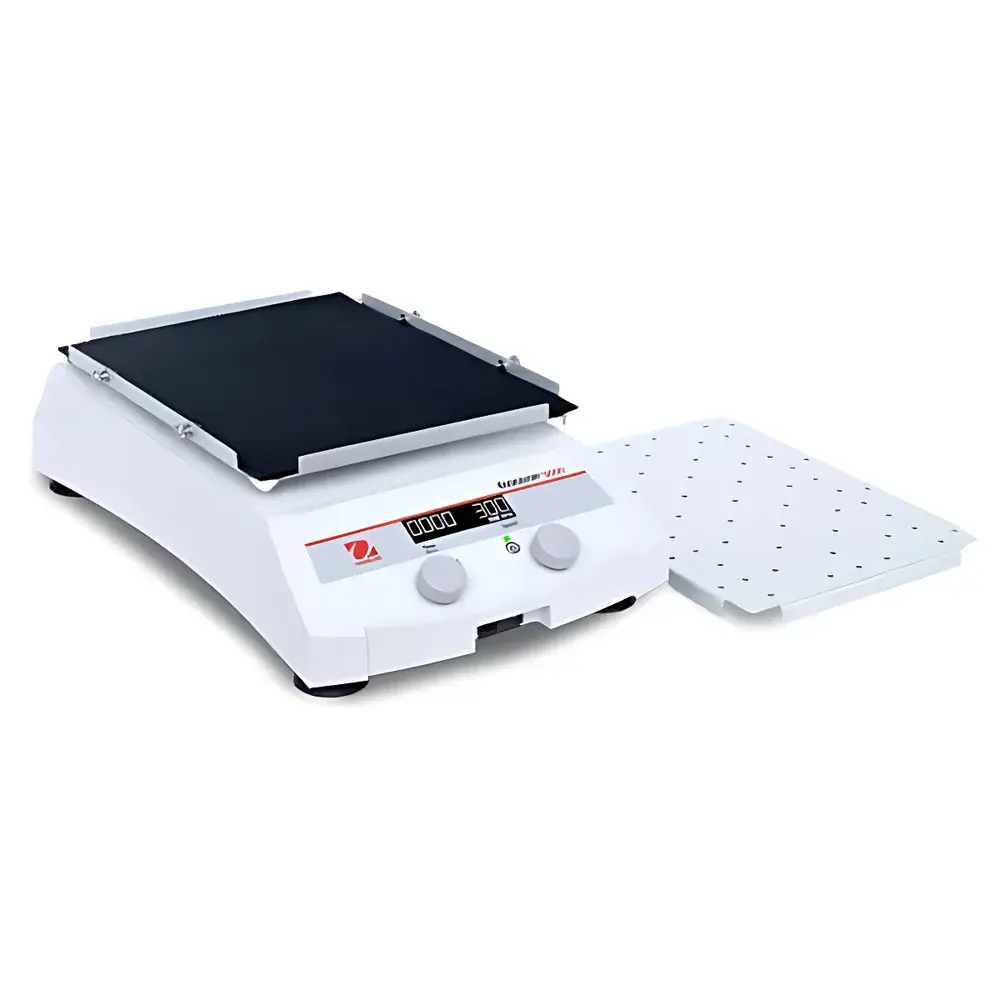
OHAUS e-E51LD0420 De-staining Shaker
| Brand | OHAUS |
|---|---|
| Origin | Jiangsu, China |
| Manufacturer Type | Manufacturer |
| Product Category | Domestic |
| Model | e-E51LD0420 |
| Instrument Type | Orbital Shaker |
| Timer Range | 1 min – 99 h 59 min |
| Oscillation Speed | 50 – 300 rpm |
| Orbit Diameter | 20 mm |
| Max Load Capacity | 4.0 kg (up to three 1 L Erlenmeyer flasks) |
| Tray Dimensions | 300 mm × 222 mm |
| Speed Accuracy | ±2% of setpoint above 100 rpm |
| Drive System | Triple-eccentric-axis balanced drive with brushless DC motor |
| Control Interface | Backlit LCD display (digital control model) |
| Communication | RS232 interface |
| Protection Rating | IP21 |
| Operating Environment | −10°C to 40°C, ≤80% RH non-condensing |
| Power Supply | 24 V DC, 1.25 A |
| Net Weight | 7.9 kg |
| Safety Certification | TUV |
Overview
The OHAUS e-E51LD0420 De-staining Shaker is an orbital shaker engineered for precision mixing, gentle agitation, and reproducible sample processing in life science laboratories. Designed specifically for de-staining applications—such as post-electrophoresis membrane washing, antibody incubation, and blotting buffer exchange—the instrument employs a consistent 20 mm circular orbit driven by a brushless DC motor and triple-eccentric-axis mechanical architecture. This drive system minimizes vibration transmission, ensures uniform motion distribution across the entire tray surface, and supports extended unattended operation without drift or speed decay. Its compact footprint (420 × 119 × 262 mm) and low-profile aluminum tray facilitate integration into biosafety cabinets, cold rooms, and multi-instrument workbenches. The device operates within a controlled environmental envelope (−10°C to 40°C, ≤80% RH), making it suitable for both ambient and temperature-modulated workflows when placed inside climate-controlled enclosures.
Key Features
- Orbital motion with precisely calibrated 20 mm diameter orbit—optimized for uniform suspension of gels, membranes, and microtiter plates during de-staining and hybridization steps.
- Brushless DC motor and triple-eccentric-axis drive mechanism delivering high mechanical stability, minimal heat generation, and long service life (>20,000 hours MTBF).
- Dual-parameter digital control via backlit LCD: simultaneous real-time display of speed (rpm) and remaining timer duration (hh:mm:ss), enabling rapid protocol verification without menu navigation.
- Wide operational range: 50–300 rpm with speed accuracy of ±2 rpm (<100 rpm) or ±2% of setpoint (≥100 rpm), validated per ISO 17025 traceable calibration procedures.
- IP21-rated enclosure and TUV-certified electrical safety compliance—meets IEC 61010-1 requirements for laboratory equipment used in non-hazardous environments.
- RS232 serial interface supporting bidirectional communication: remote parameter setting, real-time speed logging, and audit-trail-capable data export compatible with LIMS integration frameworks.
- Aluminum tray with integrated anti-slip rubber mat and standardized flask clamp mounting points—designed for rapid reconfiguration between standard conical flasks (up to 3 × 1 L), microplate carriers, and custom fixtures.
Sample Compatibility & Compliance
The e-E51LD0420 accommodates a broad spectrum of life science consumables, including polypropylene and glass Erlenmeyer flasks (50 mL–1 L), 96-well microplates, blotting cassettes, gel trays, and centrifuge tube racks. Its 4.0 kg load capacity and 300 × 222 mm tray surface support heterogeneous loading configurations without compromising motion fidelity. The device complies with ISO/IEC 17025-aligned quality assurance practices and supports GLP/GMP documentation workflows through timestamped RS232 data logs. While not intrinsically rated for Class II biological safety cabinets, its low electromagnetic emissions and absence of internal fans permit safe installation under laminar flow hoods when operated at ≤200 rpm. All structural materials meet RoHS Directive 2011/65/EU restrictions on hazardous substances.
Software & Data Management
No proprietary software is required for basic operation; however, the RS232 interface enables interoperability with third-party laboratory automation platforms (e.g., LabVIEW, Python-based PySerial scripts, or enterprise LIMS). Command syntax follows ASCII-based SCPI-like structure (e.g., “SPEED?”, “TIMER=3600”, “START”). Logged data includes timestamp, set speed, actual speed (sampled at 1 Hz), elapsed time, and fault codes (e.g., overload, thermal shutdown). Audit trails generated via RS232 output satisfy FDA 21 CFR Part 11 requirements when paired with validated data acquisition software and user-access controls. Firmware updates are performed via terminal emulator using XMODEM protocol.
Applications
- Western/Northern/Southern blot de-staining and antibody incubation cycles
- Post-electrophoretic gel washing and transfer buffer equilibration
- ELISA plate agitation during antigen-antibody binding and wash steps
- Cell suspension maintenance in low-shear culture formats (e.g., suspension CHO lines)
- DNA/RNA probe hybridization kinetics studies requiring precise orbital consistency
- Environmental microbiology: bacterial enrichment in liquid media prior to plating
- Food safety testing: pathogen recovery in buffered peptone water or selective broths
FAQ
Is the e-E51LD0420 compatible with 1 L Erlenmeyer flasks mounted in triplicate?
Yes—the 4.0 kg maximum load rating and 300 × 222 mm tray geometry accommodate three standard 1 L flasks with clamps installed.
Does the shaker support programmable multi-step protocols?
No—this model implements single-stage timing only; sequential ramping or multi-phase programs require external controller integration via RS232.
Can the device be operated inside a 4°C cold room?
Yes—its specified operating range extends down to −10°C; condensation management requires non-condensing humidity conditions (<80% RH) and avoidance of direct airflow exposure.
What maintenance is required for long-term reliability?
Annual inspection of eccentric bearing preload and tray mounting screws is recommended; no lubrication is required due to sealed brushless motor and maintenance-free drive train design.
Is the RS232 interface optically isolated?
No—it is electrically coupled but conforms to EIA/TIA-232-F signaling standards with ±15 V tolerance; use of industrial-grade USB-to-RS232 adapters with surge protection is advised in shared lab networks.



