
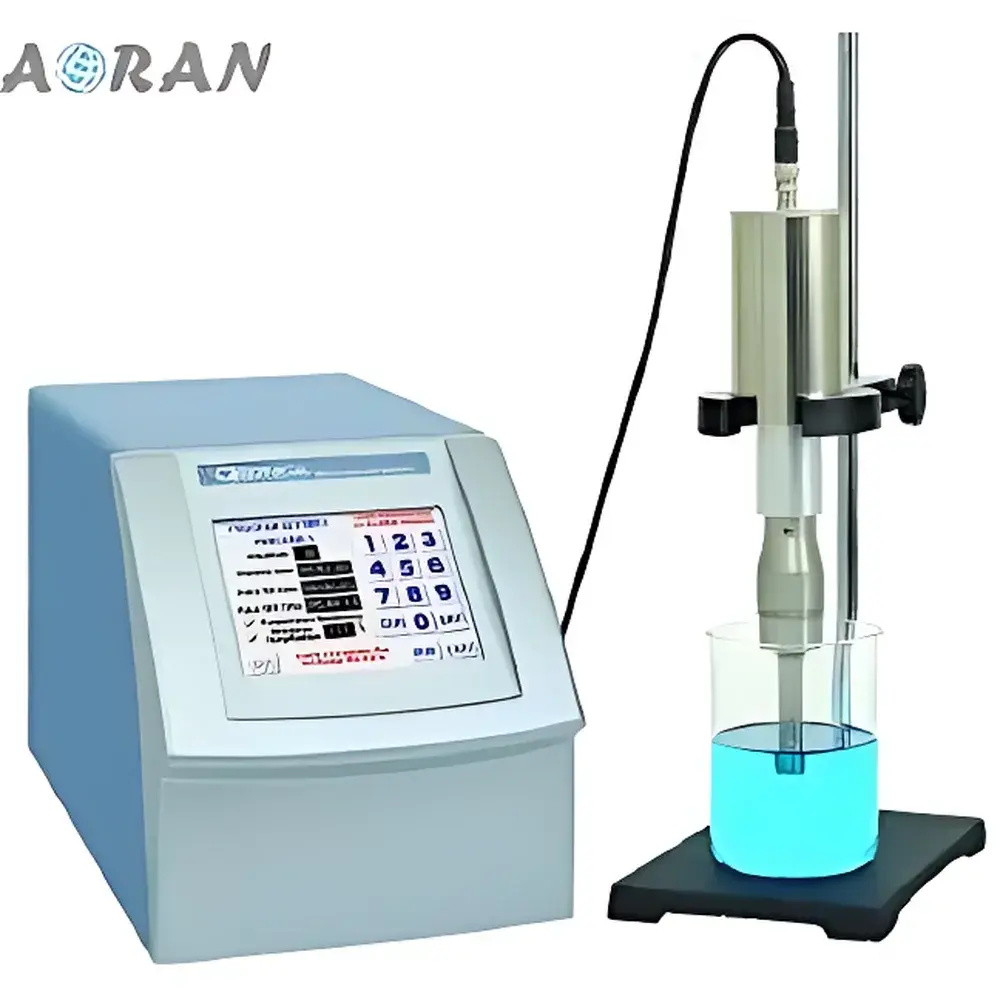
Qsonica Misonix Sonicator 4000 Ultrasonic Homogenizer
| Brand | Misonix |
|---|---|
| Origin | USA |
| Manufacturer Type | Authorized Distributor |
| Origin Category | Imported |
| Model | Sonicator 4000 |
| Price | USD $8,800 |
| Instrument Type | Ultrasonic Probe Homogenizer |
| Dimensions (W×D×H) | 200×390×220 mm |
| Sample Volume Range | 0.1–1000 mL |
Overview
The Qsonica Misonix Sonicator 4000 is a high-performance, microprocessor-controlled ultrasonic homogenizer engineered for precise, reproducible cell disruption, nucleic acid shearing, protein extraction, and nanoparticle dispersion in life science, pharmaceutical, and materials research laboratories. Based on piezoelectric transduction at a nominal frequency of 20 kHz, the system delivers controlled acoustic energy directly into liquid samples via interchangeable titanium alloy probes (horns), generating intense cavitation—localized pressure differentials that induce shear forces, microstreaming, and transient hotspots (~5,000 K, ~1,000 atm). Unlike bath-based or cup-horn systems, probe-type sonication ensures direct energy coupling, enabling higher power density, superior process control, and scalability from microliter to liter volumes. The Sonicator 4000 inherits core architecture from the Q700 platform—including digital amplitude modulation, real-time thermal monitoring, and adaptive frequency tuning—while maintaining compliance with international safety and electromagnetic compatibility standards (UL 61010-1, CE EN 61000-6-3/6-4, CSA C22.2 No. 61010-1, RoHS Directive 2011/65/EU).
Key Features
- Digital touchscreen interface (7-inch capacitive display) with intuitive navigation, multilingual support, and context-sensitive help menus
- Adjustable amplitude output from 0% to 100% in 1% increments, enabling fine-tuned optimization for sensitive biomolecules or viscous suspensions
- Real-time monitoring of critical parameters: delivered power (W), cumulative energy (J), probe tip temperature (°C), elapsed time, and program progress
- Programmable multi-step protocols (up to 10 segments per method), supporting variable amplitude, pulse-on/pulse-off timing (1 s–24 hr), and automatic ramping
- Automatic frequency tracking and impedance compensation ensure consistent resonance across probe types and sample conditions
- Integrated thermal protection circuitry prevents overheating of transducer and electronics; overcurrent and overload shutdown safeguards hardware integrity
- Modular probe architecture compatible with >20 standardized horn configurations—including microtip, standard, heavy-duty, and flow-through variants
- Optional accessories include dual- and quad-probe holders, precision motorized lift stands, calibrated temperature probes (stainless steel or PTFE-sheathed), and footswitch controls for hands-free operation
Sample Compatibility & Compliance
The Sonicator 4000 accommodates diverse sample matrices—from low-viscosity aqueous buffers to high-concentration protein lysates, lipid emulsions, and ceramic nanoparticle dispersions—without requiring solvent modification or pre-dilution. Its probe-based design eliminates cross-contamination risks inherent in shared-bath systems and supports biosafety Level 2 (BSL-2) workflows when used with sealed tube adapters (e.g., 431C2, 431MPX) and certified acoustic enclosures (432B2). All probe contact surfaces are machined from ASTM F136-grade Ti-6Al-4V ELI titanium alloy, ensuring corrosion resistance, non-reactivity with biological reagents, and compatibility with common sterilization methods (autoclaving, ethanol wiping, UV irradiation). The instrument meets GLP/GMP documentation requirements through audit-trail-capable software (Q-Soft v5.x) and supports 21 CFR Part 11-compliant user authentication, electronic signatures, and immutable data logging when paired with validated networked configurations.
Software & Data Management
Q-Soft v5.x, the proprietary control and analysis suite, runs natively on Windows-based PCs and communicates with the Sonicator 4000 via USB 2.0 or Ethernet. It enables remote method deployment, batch protocol scheduling, and export of timestamped CSV reports containing full parameter histories (amplitude, power, temperature, energy, cycle count). Raw data files retain metadata including operator ID, instrument serial number, probe calibration ID, and environmental ambient readings. For regulated environments, optional IQ/OQ/PQ documentation packages are available, aligned with ISO/IEC 17025 and ASTM E2500-15 guidance for analytical instrument qualification. Data encryption, role-based access control, and configurable retention policies ensure alignment with institutional IT security policies and HIPAA/FDA data integrity expectations.
Applications
- Cell lysis and subcellular fractionation (bacterial, yeast, mammalian, plant)
- Chromatin immunoprecipitation (ChIP) and ATAC-seq sample preparation
- Shearing genomic DNA to 100–1,000 bp fragments for NGS library construction
- Preparation of liposomes, polymeric nanoparticles, and exosome isolates
- Rapid dispersion of carbon nanotubes, graphene oxide, and metal-organic frameworks (MOFs)
- Homogenization of tissue biopsies for proteomics and metabolomics workflows
- Catalyst activation in sonochemical synthesis (e.g., Suzuki coupling, ester hydrolysis)
- Emulsification of pharmaceutical nanoemulsions and cosmetic formulations
FAQ
What is the maximum continuous operating time?
The Sonicator 4000 supports uninterrupted operation for up to 72 hours under thermally managed conditions (e.g., with external cooling or pulsed duty cycles).
Can I use the same probe for both aqueous and organic solvents?
Standard titanium probes are chemically inert in water, alcohols, and most polar solvents; however, prolonged exposure to strong acids (e.g., concentrated HCl), halogenated organics (e.g., chloroform), or fluorinated compounds requires verification of material compatibility per ASTM G155 guidelines.
Is probe calibration traceable to NIST standards?
Yes—each probe is supplied with a certificate of conformance listing its resonant frequency, mechanical Q-factor, and amplitude calibration curve, traceable to NIST-traceable laser interferometry measurements.
How does the system handle temperature-sensitive samples?
Real-time probe-tip temperature sensing (±0.5 °C accuracy) triggers automatic power reduction if thresholds exceed user-defined limits; optional recirculating chillers (e.g., Neslab RTE-7) integrate seamlessly via analog I/O.
What regulatory documentation is provided for installation qualification?
Qsonica supplies comprehensive IQ/OQ documentation kits—including equipment specification sheets, wiring diagrams, alarm log definitions, and test protocols—validated per ASTM E2500-15 and aligned with EU Annex 15 and FDA Process Validation Guidance.



