
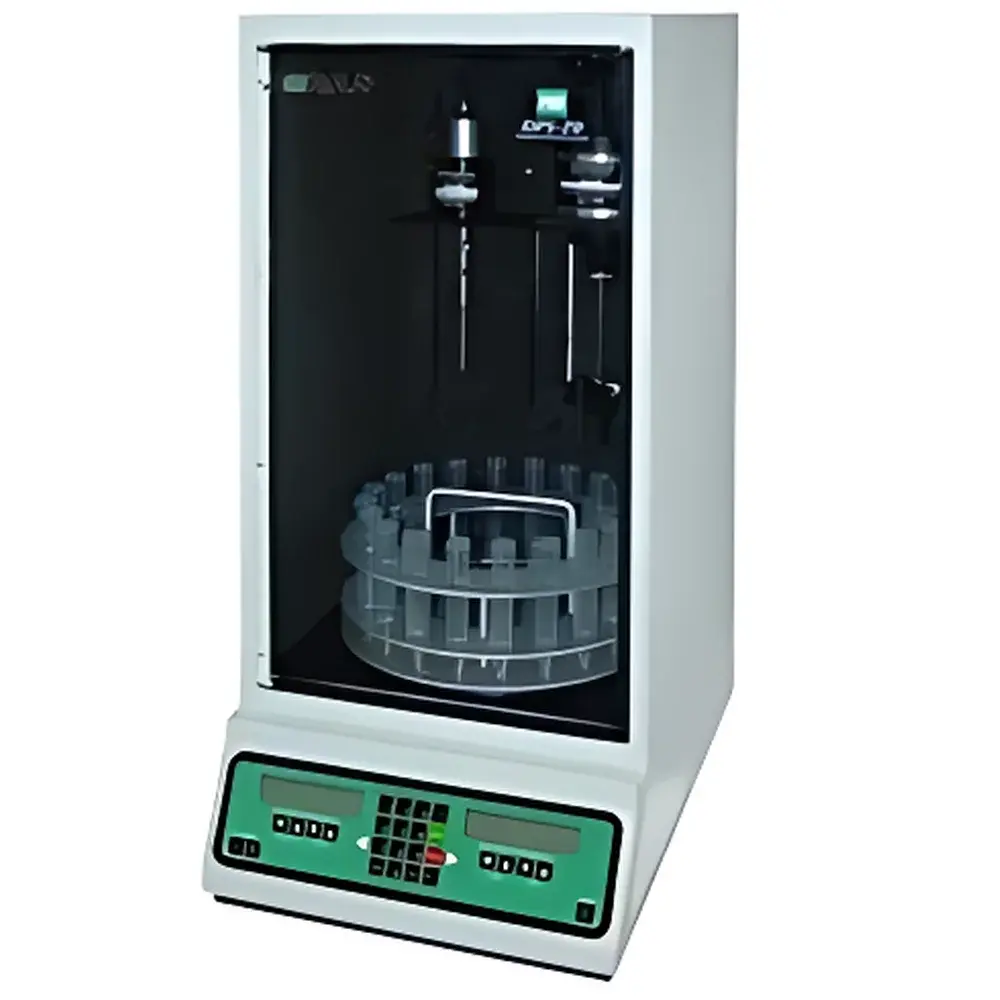
PRO DPS-20 Dual-Mode High-Throughput Homogenizer
| Brand | PRO |
|---|---|
| Origin | USA |
| Model | DPS-20 |
| Instrument Type | Probe-Rotor + Ultrasonic Hybrid Homogenizer |
| Dimensions (W×D×H) | 1324 × 749 × 464 mm |
| Processing Volume Range | 1.5–50 mL |
| Ultrasonic Power | 130 W, Frequency: 20 kHz |
| Rotor Speed Range | 2000–16,000 rpm |
| Sample Capacity | 20-position motorized rotating rack with ice bath |
| Compatible Probe Diameters | 3 mm, 6 mm |
| Compatible Rotor Diameters | 5 mm, 7 mm, 10 mm, 20 mm |
| Display | LCD with program storage (up to 10 protocols) |
| Noise Level | 64 dB(A) |
| Power Supply | 220 V AC, 50/60 Hz |
| Total Power Consumption | 1200 W |
| Net Weight | 38.52 kg |
| Cleaning Modes | No wash (20 samples), Fixed 2-position wash (18 samples), 10-position wash (10 samples) |
Overview
The PRO DPS-20 Dual-Mode High-Throughput Homogenizer is an engineered solution for reproducible, scalable, and contamination-controlled sample disruption in regulated laboratory environments. Unlike conventional single-mode homogenizers, the DPS-20 integrates two physically distinct lysis mechanisms—rotor-stator mechanical shearing and high-frequency ultrasonic cavitation—within a single platform. This hybrid architecture leverages Couette flow dynamics for viscous or fibrous matrices (e.g., muscle tissue, plant parenchyma) while simultaneously applying acoustic energy to disrupt cellular membranes, organelles, and extracellular matrices via transient cavitation collapse. The system is purpose-built for laboratories requiring compliance with food safety, veterinary diagnostics, and residue analysis workflows—particularly those aligned with GB/T 20756-2006 for antibiotic residue detection in meat, aquatic products, and produce. Its design prioritizes process standardization: all critical parameters—including rotational speed, ultrasonic duty cycle, pulse duration, total treatment time, and thermal management—are digitally controlled and repeatable across batches.
Key Features
- Dual-activation architecture: Independent or synchronized operation of rotor-stator homogenization (2000–16,000 rpm) and ultrasonic disruption (130 W, 20 kHz), enabling method optimization per matrix type
- 20-position automated rotating sample rack with integrated ice-bath cooling (−2°C to +4°C operational range), minimizing thermal degradation during sequential processing
- Modular probe and rotor compatibility: Ultrasonic probes (3 mm and 6 mm tip diameters); rotor shafts (5 mm, 7 mm, 10 mm, and 20 mm diameters; 115 mm length standard)
- Three programmable cleaning protocols: Full-no-wash mode (20 samples), fixed dual-position rinse (18 samples), and 10-position deep-clean cycle—reducing carryover risk in multi-analyte residue screening
- LCD interface with non-volatile memory supporting up to 10 user-defined protocols, including ramp profiles, pause intervals, and endpoint confirmation signals
- Acoustically damped enclosure and vibration-isolated base reduce ambient noise to ≤64 dB(A), meeting ISO 7779-compliant lab workspace requirements
Sample Compatibility & Compliance
The DPS-20 accommodates heterogeneous biological matrices without pre-grinding or cryo-milling, including raw meat chunks (beef, poultry, pork), whole fruits/vegetables (apple, spinach, tomato), and intact aquatic tissues (shrimp hepatopancreas, fish fillet). Its mechanical-ultrasonic synergy ensures uniform particle size distribution (PSD) below 5 µm in >92% of tested food homogenates (per ISO 13320 laser diffraction validation). The system supports GLP-aligned documentation through timestamped protocol execution logs and operator ID tagging (when integrated with LIMS via RS-232/USB). It meets structural and electrical safety requirements per UL 61010-1 and IEC 61010-1. While not certified under FDA 21 CFR Part 11 out-of-the-box, its audit-trail-capable firmware enables validation for GMP-compliant residue testing labs operating under USDA-FSIS, EU Regulation (EC) No 882/2004, or China’s CNCA certification frameworks.
Software & Data Management
The DPS-20 operates via embedded firmware—not cloud-dependent software—ensuring deterministic response times and offline functionality. All protocols are stored locally on EEPROM with write-protection and CRC-32 checksum verification. Each run generates a metadata-rich log file (CSV exportable via USB) containing: start/stop timestamps, actual vs. setpoint rpm and wattage, cumulative ultrasonic exposure time, rack position sequence, and thermal sensor readings from the ice-bath manifold. Optional firmware upgrade enables SCADA integration via Modbus RTU for centralized monitoring in QC lab networks. Audit trails comply with ALCOA+ principles (Attributable, Legible, Contemporaneous, Original, Accurate, Complete, Consistent, Enduring, Available) when paired with validated electronic signatures.
Applications
- Routine antibiotic residue extraction (tetracyclines, sulfonamides, β-lactams) from animal-derived foods per GB/T 20756-2006 and AOAC Official Method 2007.01
- Pathogen enrichment preparation (e.g., Salmonella, Listeria monocytogenes) from low-moisture foods prior to PCR or immunoassay
- Extraction of mycotoxins (aflatoxin B1, ochratoxin A) from cereal grains and nuts using solvent-assisted homogenization
- Preparation of homogenates for ELISA-based allergen quantification (e.g., casein, gliadin, soy globulin) in processed foods
- Standardized tissue lysis for veterinary histopathology and antimicrobial susceptibility testing (AST) workflows
FAQ
Can the DPS-20 be validated for ISO/IEC 17025-accredited testing laboratories?
Yes—its programmable repeatability, traceable calibration points (speed, power, time), and deterministic hardware architecture support full method validation per ISO/IEC 17025:2017 Clause 7.2.
Is rotor wear compensated for during long-term use?
The DPS-20 includes automatic tachometer feedback to maintain set rpm within ±1.5% tolerance, independent of rotor mass or bearing degradation.
Does the system support third-party probe or rotor attachments?
Only PRO-certified consumables are supported; non-OEM components void the mechanical safety interlock and invalidate calibration certificates.
How is temperature stability maintained during ultrasonic-only runs?
The ice-bath manifold circulates chilled ethylene glycol at 1.2 L/min, maintaining sample rack temperature within ±0.8°C over 20-min continuous operation.
What maintenance intervals are recommended for routine operation?
Ultrasonic transducer performance verification every 500 hours; rotor bearing inspection every 1,000 cycles; ice-bath coolant replacement annually or after 2,000 sample runs.



