
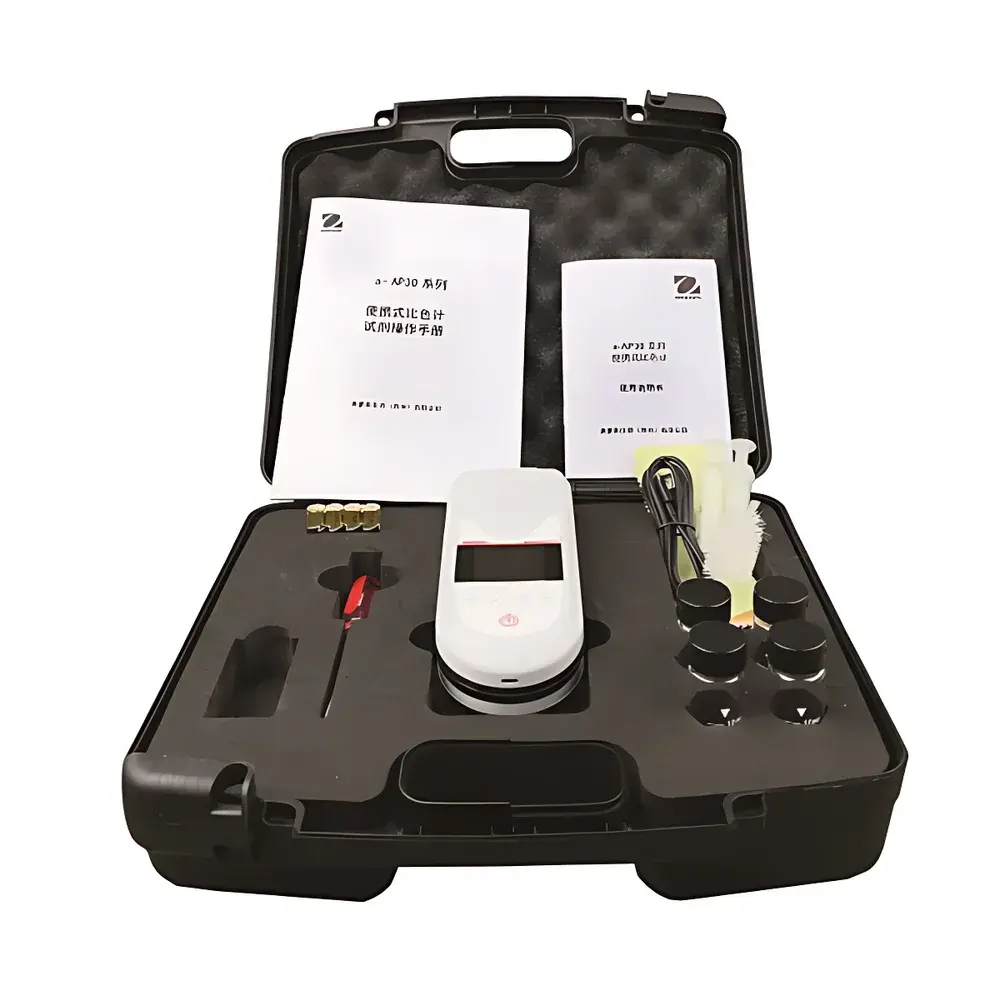
OHAUS AP30CLL Portable Photometric Water Quality Analyzer
| Brand | OHAUS |
|---|---|
| Origin | Shanghai, China |
| Manufacturer Type | Direct Manufacturer |
| Regional Classification | Domestic (China) |
| Model | AP30CLL |
| Instrument Type | Portable / Handheld Water Quality Analyzer |
| Measured Parameters | Free Chlorine & Total Chlorine |
| Light Source | Multi-wavelength LEDs (525 nm, 610 nm) |
| Detection Principle | Absorption Photometry (Beer-Lambert Law) |
| Data Storage | 5,000 measurement records with timestamp and sample ID |
| Power Supply | 4 × AAA alkaline batteries (typical runtime: >2,000 measurements per set) |
| Display | High-brightness monochrome OLED (128 × 64 pixels) |
| Enclosure Rating | IP67 (dust-tight and submersible up to 1 m for 30 min) |
| Interface | Micro-USB (for data export and firmware update) |
| Compliance | Designed to support ASTM D1253, ISO 7393-2, and EPA Method 334.0 workflows |
| Dimensions | 165 × 78 × 42 mm |
| Weight | 220 g (without batteries) |
Overview
The OHAUS AP30CLL Portable Photometric Water Quality Analyzer is a field-deployable, LED-based photometer engineered for rapid, on-site quantification of free chlorine and total chlorine in aqueous matrices. It operates on the fundamental principle of absorption photometry—applying the Beer-Lambert law—to measure the attenuation of specific wavelengths of light (525 nm and 610 nm) as they pass through a chemically reacted sample. The instrument utilizes pre-calibrated, stable solid-state LEDs and a precision optical path optimized for minimal stray light and high signal-to-noise ratio. Unlike broad-spectrum colorimeters, the AP30CLL’s dual-wavelength design enables selective detection while compensating for turbidity and background interference, ensuring analytical robustness across variable water conditions—from clear drinking water to moderately turbid wastewater effluents. Its compact form factor, extended battery life, and IP67-rated enclosure make it suitable for routine monitoring in municipal water distribution, swimming pool maintenance, industrial cooling circuits, boiler feedwater control, and emergency response scenarios.
Key Features
- Optimized optical architecture with fixed-wavelength LEDs (525 nm for DPD-based free chlorine; 610 nm for total chlorine), eliminating mechanical filter wheels and enhancing long-term wavelength stability.
- Low reagent consumption design: each test requires ≤1.0 mL sample volume and standardized DPD tablet or liquid reagent kits—reducing operational cost and minimizing chemical waste.
- High-contrast monochrome OLED display with automatic brightness adjustment, readable under direct sunlight or low-light field conditions.
- Integrated micro-USB interface enabling direct connection to Windows/macOS systems for bulk data export in CSV format—no proprietary software required.
- Automatic power-off after 10 minutes of inactivity, configurable via settings menu; supports manual override during active measurement sequences.
- Ruggedized housing with over-molded rubber grip and sealed membrane keypad—designed for repeated handling in humid, chlorinated, or dusty environments.
Sample Compatibility & Compliance
The AP30CLL is validated for use with standard DPD (N,N-diethyl-p-phenylenediamine) chemistry, compatible with commercially available reagent tablets or liquid formulations meeting APHA Standard Methods 4500-Cl G and ISO 7393-2 specifications. It accommodates sample containers with 10–25 mm pathlength cuvettes (included) and tolerates suspended solids up to 50 NTU without filtration when using total chlorine protocol. The device supports documentation traceability requirements aligned with GLP practices: each stored record includes date/time stamp, operator ID (user-definable), measurement mode (free/total), and raw absorbance values. While not certified for FDA 21 CFR Part 11 compliance out-of-the-box, audit-ready data export enables integration into validated laboratory information management systems (LIMS) where electronic records are governed by organizational SOPs.
Software & Data Management
Data handling is streamlined through native USB mass-storage emulation—no driver installation needed. When connected, the AP30CLL appears as a removable drive containing a single “AP30_DATA.CSV” file updated in real time. Each row includes: Sample ID, Test Date (YYYY-MM-DD), Test Time (HH:MM:SS), Parameter (Free Cl₂ or Total Cl₂), Result (mg/L as Cl₂), Unit, and Instrument Serial Number. Firmware updates are delivered via signed .BIN files distributed through OHAUS technical support portals. The embedded memory retains all 5,000 records even during battery replacement, with first-in-first-out (FIFO) overwrite logic upon capacity exhaustion.
Applications
- Municipal drinking water distribution: verification of residual disinfectant levels at entry points, storage tanks, and endpoint taps per WHO Guidelines for Drinking-water Quality.
- Recreational water facilities: daily compliance checks for swimming pools and spas per CDC Model Aquatic Health Code (MAHC) thresholds.
- Industrial process water: monitoring of chlorine residuals in cooling tower make-up water and closed-loop systems to prevent biofilm formation.
- Wastewater treatment: post-disinfection validation prior to environmental discharge, supporting NPDES permit reporting.
- Emergency response & field epidemiology: rapid screening during waterborne outbreak investigations or post-disaster infrastructure assessments.
FAQ
What calibration standards are supported?
The AP30CLL uses factory-applied, non-user-adjustable calibration curves traceable to NIST-traceable chlorine standards. Field verification is performed using certified reference solutions (e.g., 0.5 mg/L and 2.0 mg/L Cl₂); no user calibration is required under normal operation.
Can the instrument measure combined chlorine independently?
No—the AP30CLL reports free chlorine and total chlorine only. Combined chlorine is derived mathematically (Total − Free) and displayed as a calculated value when both measurements are completed sequentially.
Is the device suitable for seawater or brackish water analysis?
Yes, provided samples are filtered to <5 µm and measured within 30 seconds of reagent addition to minimize iodine interference from bromide oxidation; method validation data for salinities up to 35 ppt is available upon request.
How is firmware updated?
Via micro-USB connection using OHAUS-provided firmware binaries and a simple drag-and-drop procedure—no command-line tools or external programmers required.
Does the AP30CLL meet ISO/IEC 17025 requirements for accredited testing?
While the instrument itself is not accredited, its performance characteristics (repeatability ±0.02 mg/L Cl₂ at 1.0 mg/L level, linearity R² ≥0.999) align with ISO/IEC 17025 clause 5.5.2 for equipment suitability when used within a documented quality system.
Related Products







