
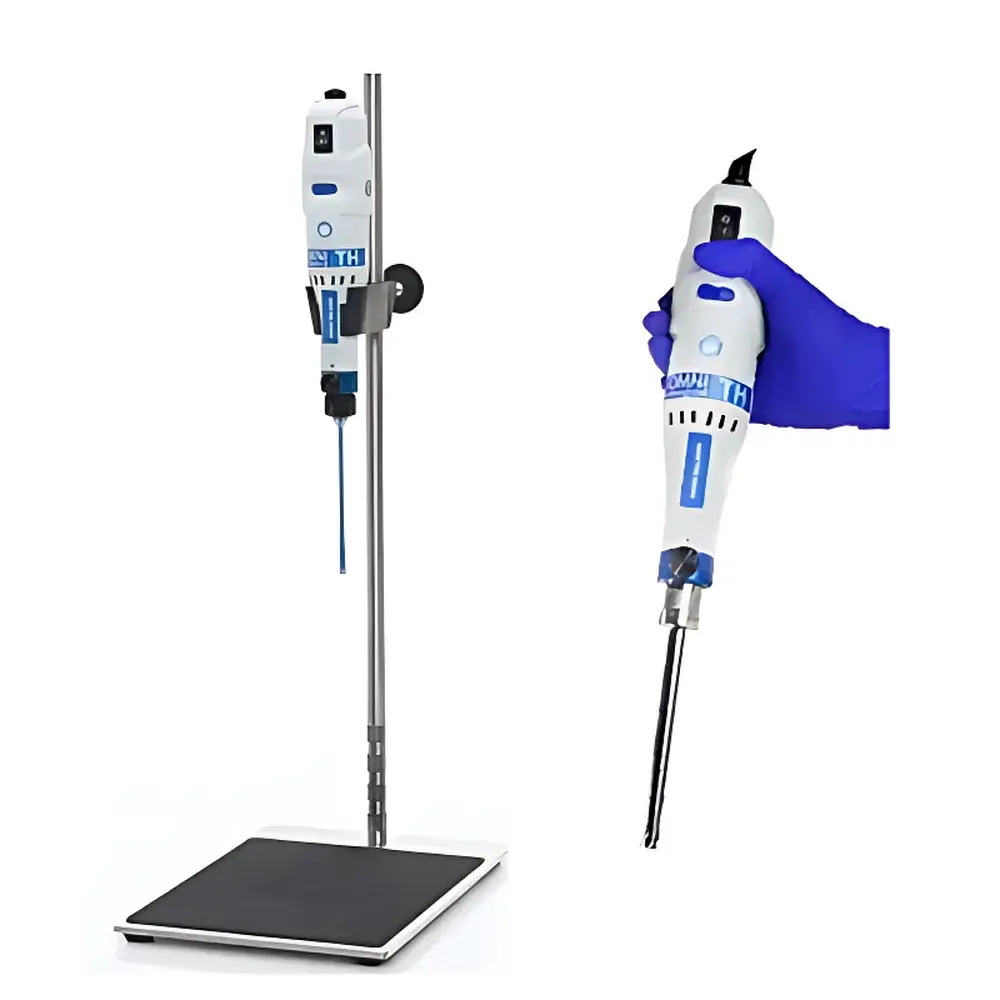
Omni International TH Handheld and Benchtop Homogenizer
| Brand | OMNI International |
|---|---|
| Origin | USA |
| Model | TH |
| Instrument Type | Probe-type Rotor-Stator Homogenizer |
| Dimensions (W×D×H) | 23 × 23 × 64 mm |
| Processing Volume | 0.25–100 mL |
| Power | 125 W |
| Speed Range | 5,000–35,000 rpm |
| Noise Level | <72 dB(A) |
| Probe Options | Stainless Steel Probes (5 mm, 7 mm, 10 mm diameters) |
Overview
The OMNI International TH Handheld and Benchtop Homogenizer is a compact, high-performance rotor-stator homogenization system engineered for reproducible mechanical disruption of biological and chemical samples across research, clinical, and quality control laboratories. Operating on the principle of high-shear fluid dynamics—where rapid rotation of a precision-machined probe within a fixed stator generates intense localized turbulence, cavitation, and hydraulic shear—the TH delivers consistent cell lysis, emulsification, dispersion, and homogenization in as little as 30 seconds. Its dual-mode configuration supports both handheld operation for rapid, low-volume processing and benchtop mounting with optional stand and clamp for hands-free, repeatable protocols. Designed and manufactured in the United States, the TH meets stringent engineering tolerances for thermal stability, motor longevity, and mechanical balance across its full speed range (5,000–35,000 rpm), ensuring minimal sample heating and maximal process fidelity.
Key Features
- 125 W brushless motor delivering high torque at low speeds and stable rotational control at maximum 35,000 rpm
- Compact footprint (23 × 23 × 64 mm) enabling integration into biosafety cabinets, cold rooms, or crowded benchtop workflows
- Low-noise design (<72 dB(A) at 1 m distance) compliant with ISO 7779 and ANSI S12.2-2020 laboratory acoustic standards
- Interchangeable probe system supporting stainless steel, polymer, and hybrid configurations for application-specific optimization
- Ergonomic handheld grip with non-slip texture and integrated speed control dial for intuitive manual operation
- Benchtop compatibility via optional universal mounting bracket (sold separately), supporting GLP-aligned documentation of positioning and orientation
- Thermal overload protection and automatic shutdown to prevent motor damage during extended or high-viscosity operation
Sample Compatibility & Compliance
The TH accommodates aqueous, viscous, and semi-solid samples—including mammalian tissues, bacterial cultures, plant extracts, nanoparticle suspensions, and pharmaceutical formulations—within a validated volume range of 0.25 to 100 mL. Stainless steel probes (G5-, G7-, G10-series) are autoclavable (121°C, 20 min, 15 psi) and certified to ASTM F1827 for biocompatibility and corrosion resistance. Omni Tip polymer probes meet USP Class VI requirements and are available sterile-packed for single-use applications or gamma-irradiated for multi-cycle reuse after cleaning per ISO 15883-1. The system supports compliance with FDA 21 CFR Part 11 when paired with validated LIMS or ELN platforms, and all probe geometries are documented in internal SOPs traceable to NIST-traceable calibration records.
Software & Data Management
While the TH operates as a standalone analog-controlled instrument, its speed profile, run duration, and probe selection can be logged manually or integrated into digital lab notebooks via external timers or programmable power supplies. For regulated environments, OMNI provides a companion validation package—including Installation Qualification (IQ), Operational Qualification (OQ), and Performance Qualification (PQ) templates aligned with ISO/IEC 17025 and ASTM E2500. Audit trails for probe usage, maintenance intervals, and calibration events are maintained per GLP Annex 11 and GMP Annex 11 guidelines. Firmware updates (if applicable) follow IEC 62304 software lifecycle requirements.
Applications
- Cell lysis for nucleic acid and protein extraction from adherent and suspension cultures
- Homogenization of liver, brain, muscle, and tumor tissues for metabolomic and proteomic profiling
- Preparation of stable oil-in-water and water-in-oil emulsions for formulation development
- Dispersion of carbon nanotubes, graphene oxide, and metal oxide nanoparticles in polymer matrices
- Routine QC testing of viscosity, particle size distribution, and phase stability in pharmaceutical suspensions
- Microbial disruption for enzyme release and endotoxin quantification in bioprocess monitoring
FAQ
What is the recommended maintenance schedule for the TH homogenizer?
Perform visual inspection of the probe shaft and stator tip before each use; clean stainless steel probes immediately post-use with 70% ethanol followed by deionized water rinse and air-drying. Lubricate O-rings quarterly using medical-grade silicone grease. Motor service interval is 5,000 operational hours or every 24 months, whichever occurs first.
Can Omni Tip probes be sterilized using ethylene oxide (EtO)?
Yes—Omni Tip polymer probes are compatible with EtO sterilization per ISO 11135. Validation must include residual gas analysis per ISO 10993-7 and functional integrity testing post-cycle.
Is the TH suitable for use with hazardous or infectious samples?
When operated inside a certified Class II biosafety cabinet and equipped with sealed, single-use Omni Tip probes, the TH meets BMBL 5th Edition containment recommendations for BSL-2 agents. For BSL-3 applications, consult OMNI’s Biosafety Integration Guide prior to deployment.
How does probe diameter affect shear rate and sample temperature rise?
Shear rate scales inversely with probe radius; thus, 5 mm probes generate ~2.8× higher local shear than 10 mm equivalents at identical rpm. Temperature rise correlates with both probe size and duration—empirical data shows ≤2.3°C increase in 1 mL buffer over 30 s at 30,000 rpm with a 7 mm probe under ambient conditions.
Does OMNI provide IQ/OQ documentation for regulated laboratories?
Yes—OMNI offers a complete qualification toolkit including pre-executed templates, calibration certificates traceable to NIST, and risk-based test protocols aligned with ASTM E2500 and EU GMP Annex 15.
Related Products



