
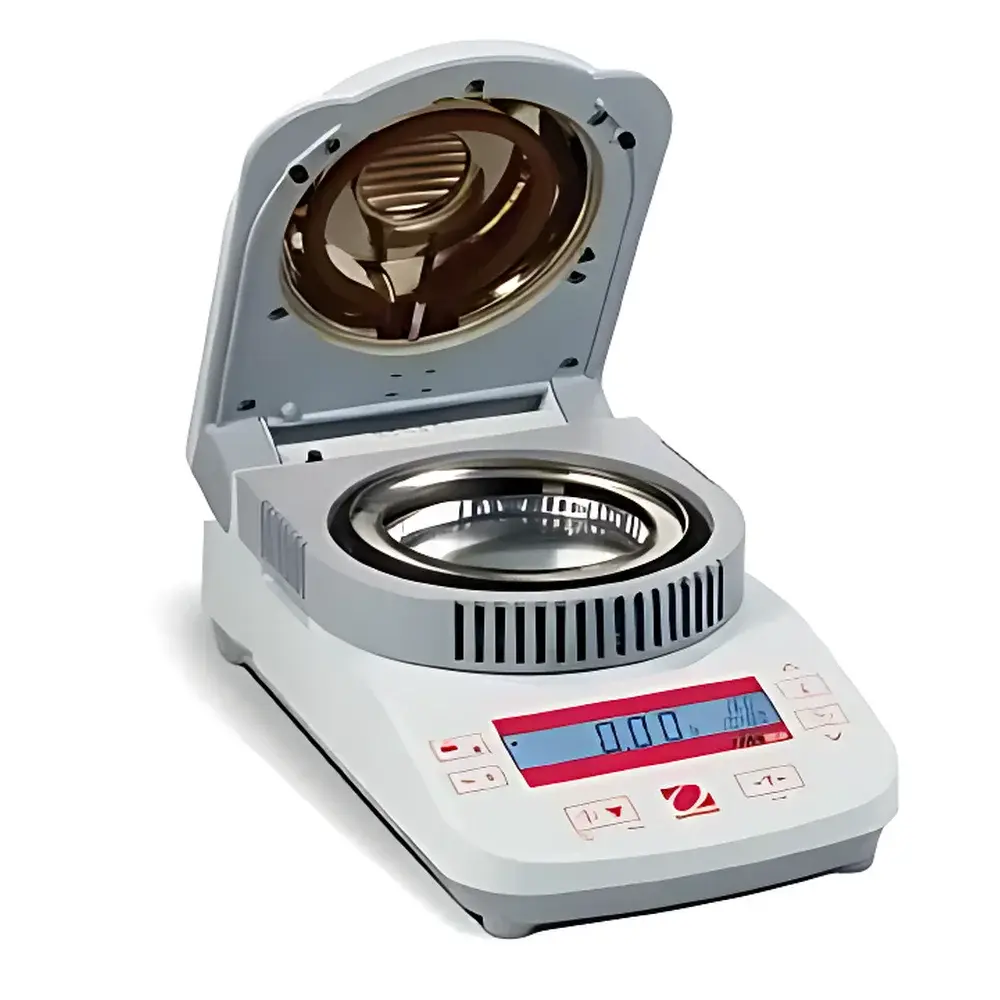
OHAUS MB23 Infrared Moisture Analyzer
| Brand | OHAUS |
|---|---|
| Model | MB23 |
| Heating Source | Infrared |
| Capacity | 110 g |
| Readability | 0.01 g |
| Moisture Readability (for >10 g sample) | 0.1% |
| Repeatability (3 g sample) | 0.3% |
| Repeatability (10 g sample) | 0.2% |
| Minimum Sample Mass | 0.5 g |
| Recommended Sample Mass | 3–20 g |
| Pan Diameter | 90 mm |
| Temperature Range | 50–160 °C (in 5 °C increments) |
| Heating Time | 1–60 min (30 s increments), 60–90 min (1 min increments) |
| End-Point Detection | Timed & Automatic |
| Display | Moisture %, Solid %, Weight, Time, Temperature |
| Communication | Bidirectional RS232 |
| Operating Ambient | 10–30 °C |
| Dimensions (W×H×D) | 165 × 127 × 280 mm |
| Net Weight | 2.1 kg |
| Gross Weight | 4.15 kg |
| Pan Handle | Standard |
Overview
The OHAUS MB23 Infrared Moisture Analyzer is a precision laboratory instrument engineered for rapid, reliable quantification of moisture content in solid and semi-solid samples using infrared (IR) heating technology. Unlike halogen-based systems, the MB23 employs a focused infrared emitter optimized for gentle, uniform thermal energy delivery—minimizing surface charring and thermal degradation in heat-sensitive materials such as high-sugar foods, pharmaceutical excipients, botanical extracts, and polymer blends. Its operation follows the loss-on-drying (LOD) principle: sample mass is recorded before and after controlled IR heating; moisture content is calculated gravimetrically as the percentage mass loss relative to initial weight. Designed for routine QC labs, R&D environments, and production floor testing, the MB23 delivers traceable, repeatable results aligned with standard methodologies including ASTM D4442, ISO 712, and AOAC 952.08.
Key Features
- Infrared heating system: Provides low-intensity, broad-spectrum radiant heat ideal for thermally labile or caramelization-prone matrices—reducing crust formation and improving measurement fidelity for sugar-rich, dairy, or starch-based samples.
- Isolated weighing sensor architecture: Features a thermally decoupled load cell housed within an insulated chamber, mitigating drift induced by thermal expansion during prolonged heating cycles—ensuring consistent readability of 0.01 g across full 110 g capacity.
- Backlit LCD interface: High-contrast 128 × 64 pixel display presents real-time moisture %, solid %, current weight, elapsed time, and chamber temperature without menu navigation overhead.
- Six-key intuitive operation: Dedicated function keys for start/stop, tare, settings, print, and mode selection eliminate hierarchical menu structures—reducing operator training time and minimizing procedural errors.
- Dual endpoint detection: Supports both fixed-duration drying (1–90 min, programmable in 30 s or 1 min steps) and automatic termination based on mass stabilization thresholds (±0.005 g over 60 s), enhancing method robustness.
- Bidirectional RS232 interface: Enables direct communication with label printers, LIMS, or PC-based data logging software—supporting audit-ready export of raw mass readings, timestamps, and calculation metadata.
Sample Compatibility & Compliance
The MB23 accommodates heterogeneous solids ranging from granular powders (e.g., lactose, cellulose), viscous pastes (e.g., fruit purees, hydrogels), and thin films (e.g., coated tablets, dried films). Its 90 mm diameter stainless steel pan and included ergonomic handle facilitate safe handling of hot samples. The instrument complies with electromagnetic compatibility (EMC) requirements per IEC 61326-1 and safety standards under IEC 61010-1. While not inherently 21 CFR Part 11 compliant, its RS232 output supports integration into validated systems where electronic records are generated and archived externally with appropriate audit trail controls. Method validation documentation—including repeatability (≤0.2% RSD at 10 g), linearity, and intermediate precision—is supported per ICH Q2(R2) guidelines for analytical procedure verification.
Software & Data Management
No proprietary software is bundled with the MB23; however, its ASCII-formatted RS232 output is compatible with widely deployed laboratory data acquisition tools—including OHAUS ACU-1000 terminal emulation software, Microsoft Excel via serial-to-USB adapters, and enterprise LIMS platforms configured for delimited text ingestion. All transmitted data packets include sample ID (user-defined), start/end timestamps, initial/final mass, moisture %, and active heating parameters—enabling retrospective analysis, SPC charting, and GLP/GMP-aligned record retention. Optional thermal printer connectivity allows hard-copy generation of test reports meeting internal SOP requirements for raw material release or batch documentation.
Applications
- Food & Beverage: Moisture profiling of confectionery, cereals, coffee beans, and dehydrated fruits where Maillard reactions compromise halogen-based assays.
- Pharmaceuticals: Quantification of residual solvent and water in active pharmaceutical ingredients (APIs) and excipients prior to tableting or lyophilization.
- Agriculture & Feed: Rapid field-adjacent analysis of grain, silage, and pet food pellets per AOAC official methods.
- Chemicals & Polymers: Monitoring moisture in hygroscopic resins (e.g., polyamide, PET) and catalyst carriers to prevent processing defects.
- Academic Research: Teaching LOD fundamentals and comparative thermal stability studies across biomaterial classes.
FAQ
What types of samples are best suited for the MB23 versus the MB25?
The MB23’s infrared heating is optimal for samples prone to surface browning or decomposition—such as sucrose-rich foods, maltodextrins, or gelatinized starches—where slower, more uniform energy transfer preserves sample integrity. The MB25’s halogen lamp enables faster ramp rates and higher peak power, making it preferable for inert, high-thermal-conductivity materials like minerals or metal oxides.
Can the MB23 be calibrated for traceable moisture measurements?
Yes—internal calibration uses certified weights traceable to NIST or equivalent national metrology institutes. External verification may be performed using standardized reference materials (e.g., sodium tartrate dihydrate, ~15.66% moisture) to confirm accuracy across the operating temperature range.
Is the MB23 suitable for regulated GMP environments?
It serves as a qualified analytical tool when integrated into documented procedures, with periodic performance verification, operator training records, and RS232 data capture configured to meet ALCOA+ principles (Attributable, Legible, Contemporaneous, Original, Accurate, Complete, Consistent, Enduring, Available).
Related Products





