
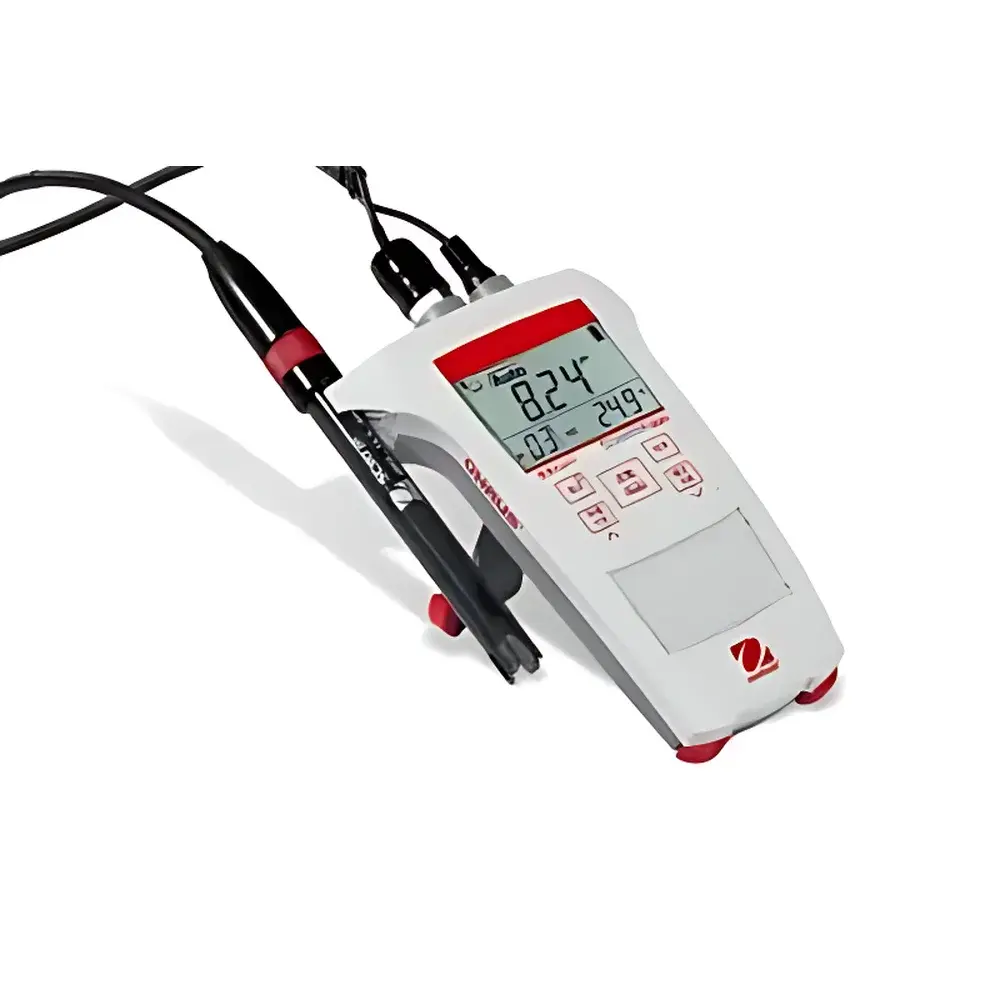
OHAUS STARTER 300 Portable pH Meter
| Brand | OHAUS |
|---|---|
| Origin | Imported (Manufactured Outside China) |
| Manufacturer Type | Original Equipment Manufacturer (OEM) |
| Instrument Type | Portable pH Meter |
| Parameter Types | pH / mV / Temperature |
| pH Measurement Range | 0.00–14.00 pH |
| pH Resolution & Accuracy | ±0.01 pH |
| mV Range | −1999 to +1999 mV |
| mV Accuracy | ±1 mV |
| Temperature Range | 0.0–100.0 °C |
| Temperature Accuracy | ±0.5 °C |
| Calibration | Customizable buffer recognition (2-/3-point, auto-buffer identification) |
| IP Rating | IP54 |
| Data Storage | 30 measurement records |
| Electrode Status Indication | Visual emoticon feedback (smile/neutral/frown) |
| Enclosure Design | Textured anti-slip housing with foldable stand |
| User Interface | Intuitive menu navigation with self-diagnostic error prompts |
| Compliance | Designed for GLP-compliant field and lab use |
Overview
The OHAUS STARTER 300 Portable pH Meter is a rugged, entry-level electrochemical instrument engineered for reliable field and benchtop pH, mV, and temperature measurements in diverse non-regulated and semi-regulated environments. It operates on the fundamental principle of potentiometric measurement: detecting the potential difference between a glass pH electrode and a reference electrode immersed in an aqueous sample, converting this voltage into a pH value using the Nernst equation. Its compact form factor, IP54-rated enclosure, and ergonomic textured housing enable consistent operation in industrial process zones, food production lines, educational laboratories, and environmental sampling sites—where dust exposure, incidental splashes, or one-handed handling are routine. Unlike benchtop analyzers with advanced connectivity or regulatory-grade data integrity features, the STARTER 300 prioritizes operational simplicity, tactile feedback, and visual status cues—making it especially suitable for technicians, students, and QA personnel requiring rapid, repeatable spot checks without software dependency.
Key Features
- Visual electrode health feedback via emoticon-based display (smiling face = optimal calibration; neutral face = marginal response; frowning face = recalibration or cleaning required)
- Textured, anti-slip polymer housing with integrated foldable stand—enabling stable upright placement or flat-lid operation on uneven surfaces
- Intuitive single-button navigation and context-sensitive menu structure minimizing training time and operator error
- Integrated self-diagnostic system that identifies common faults—including open-circuit electrodes, low battery, out-of-range signals, and temperature sensor anomalies—and displays actionable error codes
- Customizable calibration protocol supporting two- or three-point calibration with user-defined buffer values (e.g., pH 4.01, 7.00, 10.01), including automatic buffer recognition when standard buffers are used
- IP54 ingress protection rating ensures resistance to dust accumulation and water splashes from any direction—meeting IEC 60529 requirements for portable instrumentation deployed in light industrial settings
Sample Compatibility & Compliance
The STARTER 300 is compatible with standard BNC-connectable combination pH electrodes (e.g., OHAUS RE-011 or equivalent), as well as separate pH and reference electrodes configured for general-purpose aqueous solutions. It is not intended for non-aqueous solvents, highly viscous slurries, or aggressive hydrofluoric acid applications. While not certified for FDA 21 CFR Part 11 compliance due to lack of electronic audit trail or user authentication, its design aligns with foundational Good Laboratory Practice (GLP) principles: traceable calibration logs, stable measurement conditions, and clear operator feedback. Users performing routine QC checks in food safety (e.g., HACCP monitoring), academic instruction, or municipal water screening may document results manually in bound logbooks meeting ISO/IEC 17025 documentation expectations for non-accredited testing.
Software & Data Management
The STARTER 300 operates independently of external software or drivers. All measurements—including pH, mV, and temperature—are displayed in real time on its high-contrast LCD screen. The device stores up to 30 sequential readings with timestamps (date/time not retained across power cycles), accessible via scroll navigation. Data export is manual: users transcribe values into spreadsheets, LIMS templates, or paper-based QA forms. No Bluetooth, USB, or RS-232 interface is included—intentionally omitting complexity to preserve battery life (4 × AA alkaline, ~200 hours continuous use) and mechanical robustness. This architecture suits environments where wireless connectivity poses interference risks (e.g., near variable-frequency drives) or where IT policy restricts peripheral device pairing.
Applications
- Food & Beverage: Monitoring pH during fermentation, brining, dairy processing, and post-cook holding to verify critical control points per USDA-FSIS or Codex Alimentarius guidelines
- Education: Undergraduate chemistry labs conducting acid-base titration verification, buffer preparation validation, and electrode theory demonstrations
- Environmental Fieldwork: Rapid assessment of surface water, wastewater effluent, or soil leachate pH prior to laboratory analysis per ASTM D1293 or EPA Method 150.1
- Industrial Maintenance: Spot-checking cooling tower water, boiler feedwater, or rinse bath chemistry to support preventive maintenance schedules
- Hydroponics & Agriculture: Verifying nutrient solution pH stability across greenhouse growing cycles
FAQ
Does the STARTER 300 support automatic temperature compensation (ATC)?
Yes—it accepts input from a built-in temperature sensor or optional external ATC probe (sold separately) to adjust pH readings based on sample temperature per the Nernst slope correction algorithm.
Can I use non-OHAUS electrodes with this meter?
Yes, provided they feature a standard BNC connector and operate within the meter’s input impedance and voltage range specifications (≥10¹² Ω input impedance; ±2000 mV max signal).
Is calibration data retained after battery replacement?
No—calibration coefficients are stored in volatile memory and must be repeated after full power loss. Users are advised to maintain a physical calibration log.
What does the IP54 rating mean for daily use?
It certifies protection against limited dust ingress (no harmful deposit) and water sprayed from any direction at low pressure—suitable for humid labs or outdoor shade but not submersion or hose-down cleaning.
How often should the pH electrode be cleaned and stored?
Rinse with deionized water after each use; store hydrated in 3 M KCl solution. Clean weekly with mild detergent or electrode-specific cleaning solution if measuring proteins, oils, or suspended solids.






