
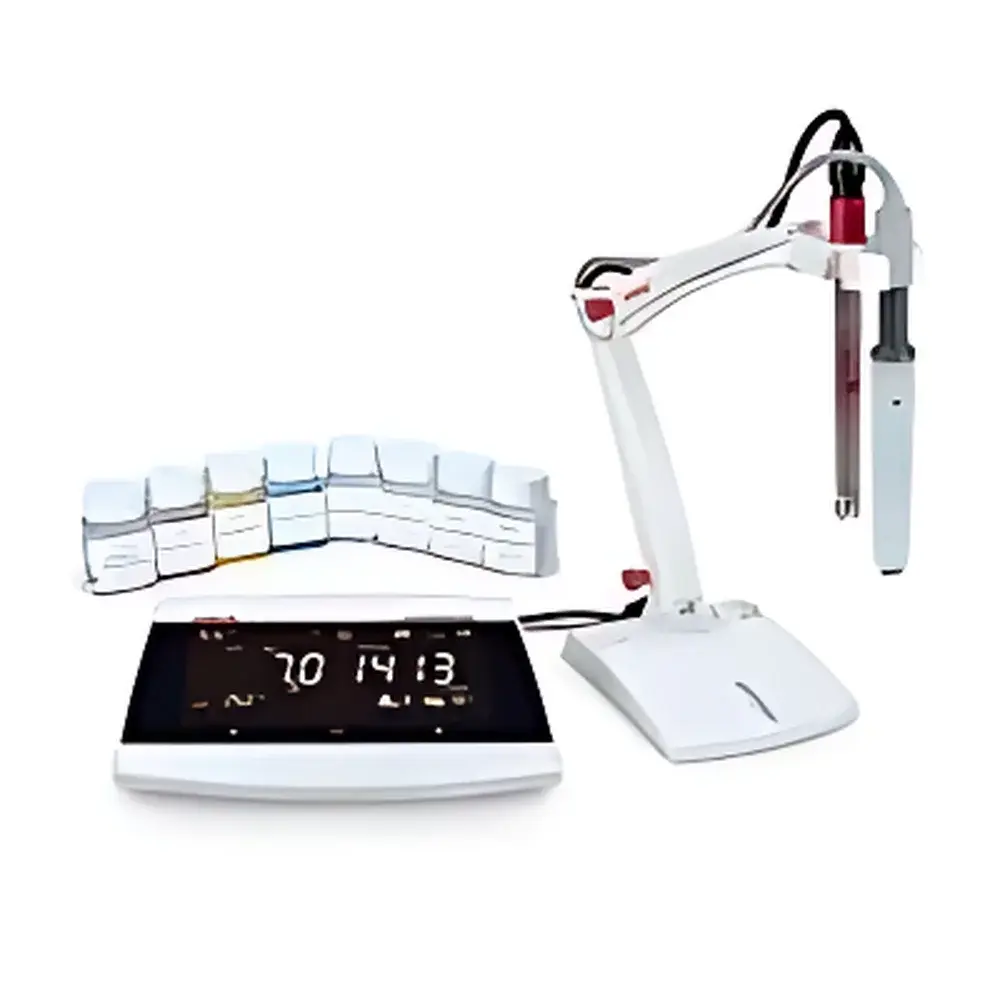
OHAUS AQUASEARCHER™ AB33M1 Benchtop Multiparameter Meter
| Brand | OHAUS |
|---|---|
| Origin | Jiangsu, China |
| Manufacturer Type | Original Equipment Manufacturer (OEM) |
| Regional Classification | Domestic (China) |
| Model | AB33M1-F |
| Instrument Type | Benchtop |
| Parameter Types | pH, ORP, Conductivity, TDS, Salinity, Resistivity, Temperature |
| Measurement Accuracy | ±0.01 pH |
| pH Range | −2.00 to 20.00 |
| Resolution | 0.01 pH / 1 mV / 0.1 °C |
| Temperature Accuracy | ±0.3 °C |
| Calibration Solution Standard | China-specific buffer set |
| Display | 6.5-inch backlit segmented & dot-matrix LCD with capacitive touch keys |
| Data Storage | 1000 records |
| Connectivity | RS232 and USB |
| Power Supply | AC adapter |
| Dimensions (H×L×W) | 51 × 210 × 142 mm |
| Net Weight | 0.5 kg |
| Included Electrodes | ST310 pH electrode, STCON3 conductivity electrode |
| Key Features | i-Steward intelligent calibration management, dual independent measurement channels, calibration expiry alert, ABS housing with integrated electrode stand |
Overview
The OHAUS AQUASEARCHER™ AB33M1 Benchtop Multiparameter Meter is a rigorously engineered electrochemical platform designed for routine and quality-critical aqueous analysis in academic laboratories, industrial QC/QA environments, and municipal water testing facilities. Built upon OHAUS’ STARTER series architecture, the AB33M1 implements potentiometric (pH/ORP), conductimetric (conductivity/TDS/salinity/resistivity), and thermometric measurement principles in a single, unified instrument. Its dual-channel design enables simultaneous or sequential measurement of two distinct parameters—such as pH and conductivity—without cross-interference, supporting standardized workflows under ISO 5725 (accuracy and precision of measurement methods) and ASTM D1125 (standard test methods for electrical conductivity and resistivity of water). The meter operates on a stable, low-drift analog front-end coupled with high-resolution 24-bit ADC conversion, ensuring traceable performance across its full pH range (−2.00 to 20.00) and temperature span (−5 °C to 110 °C).
Key Features
- i-Steward intelligent calibration assistant: Automates slope/offset validation, detects electrode drift, and issues proactive calibration expiry warnings based on user-defined intervals and measured stability thresholds.
- Dual independent measurement channels: Supports concurrent pH/ORP and conductivity/resistivity/TDS/salinity acquisition using separate sensor inputs and signal conditioning paths—eliminating crosstalk and enabling true multi-parameter correlation studies.
- 6.5-inch capacitive touch interface: Features a hybrid segmented + dot-matrix LCD with adjustable backlighting; optimized for gloved operation and low-ambient-light environments common in production labs and field deployment scenarios.
- Robust mechanical architecture: Injection-molded ABS housing with integrated electrode stand, IP20-rated enclosure, and vibration-dampened internal mounting—engineered for long-term stability on benchtops subject to mechanical perturbation.
- Regulatory-ready data handling: All measurements include timestamp, operator ID (via optional login), electrode serial number, calibration history, and environmental conditions—structured for GLP/GMP-compliant audit trails per FDA 21 CFR Part 11 requirements.
Sample Compatibility & Compliance
The AB33M1 is validated for use with standard aqueous matrices including purified water (ASTM D1193 Type II/III), process streams, wastewater effluents, and pharmaceutical buffers (USP ). It supports NIST-traceable calibration using China-certified pH buffer sets (GB/T 27502–2011), and conductivity standards conforming to ISO 7888. Electrode compatibility includes OHAUS ST310 (glass-body pH electrode with Ag/AgCl reference and gel-filled junction) and STCON3 (platinum-cell conductivity probe with automatic temperature compensation). The instrument meets IEC 61010-1 safety standards for laboratory electrical equipment and complies with EMC directive 2014/30/EU.
Software & Data Management
Data export is supported via RS232 (ASCII protocol) and USB virtual COM port, enabling direct integration with LIMS platforms, Excel-based QA templates, or custom Python/MATLAB scripts. Internal memory stores up to 1000 measurement records with full metadata: date/time stamp, parameter value, uncertainty estimate, electrode ID, calibration status, and ambient temperature/humidity (if external sensor connected). No proprietary software is required—raw CSV output is generated on demand. Audit log entries are immutable and time-stamped at firmware level, satisfying documentation requirements for ISO/IEC 17025 accredited laboratories.
Applications
- Pharmaceutical water system monitoring (PW, WFI, PW-Feed) per USP and EU Annex 1.
- Environmental compliance testing of surface water, groundwater, and effluent discharge per EPA Method 150.1 and GB 3838–2002.
- Food & beverage process control: titratable acidity verification, brine salinity checks, and cleaning-in-place (CIP) rinse water conductivity validation.
- Academic teaching labs: Multi-parameter kinetics experiments (e.g., acid hydrolysis rate vs. pH/conductivity), electrode characterization, and sensor response time benchmarking.
- Electroplating bath management: Real-time monitoring of pH and conductivity to maintain plating uniformity and minimize reject rates.
FAQ
Does the AB33M1 support automatic temperature compensation (ATC) for all parameters?
Yes—ATC is applied in real time to pH, conductivity, TDS, salinity, and resistivity measurements using either the built-in temperature sensor or an external Pt1000 probe.
Can the instrument store calibration curves for multiple electrodes?
It retains up to three independent calibration profiles per parameter type (e.g., three pH calibrations), each tagged with electrode ID, date, and buffer lot numbers.
Is the RS232 interface optically isolated?
No—RS232 is electrically isolated via onboard DC-DC converters to prevent ground-loop interference, but optical isolation is not implemented.
What is the maximum allowable input impedance for external pH electrodes?
The input impedance exceeds 1013 Ω, compatible with high-impedance glass electrodes, including double-junction and refillable reference configurations.
Does the AB33M1 meet requirements for GMP-regulated environments?
Yes—when deployed with documented SOPs, controlled access, and periodic verification per ISO/IEC 17025, it fulfills functional requirements for Category B instruments under EU GMP Annex 15.




