
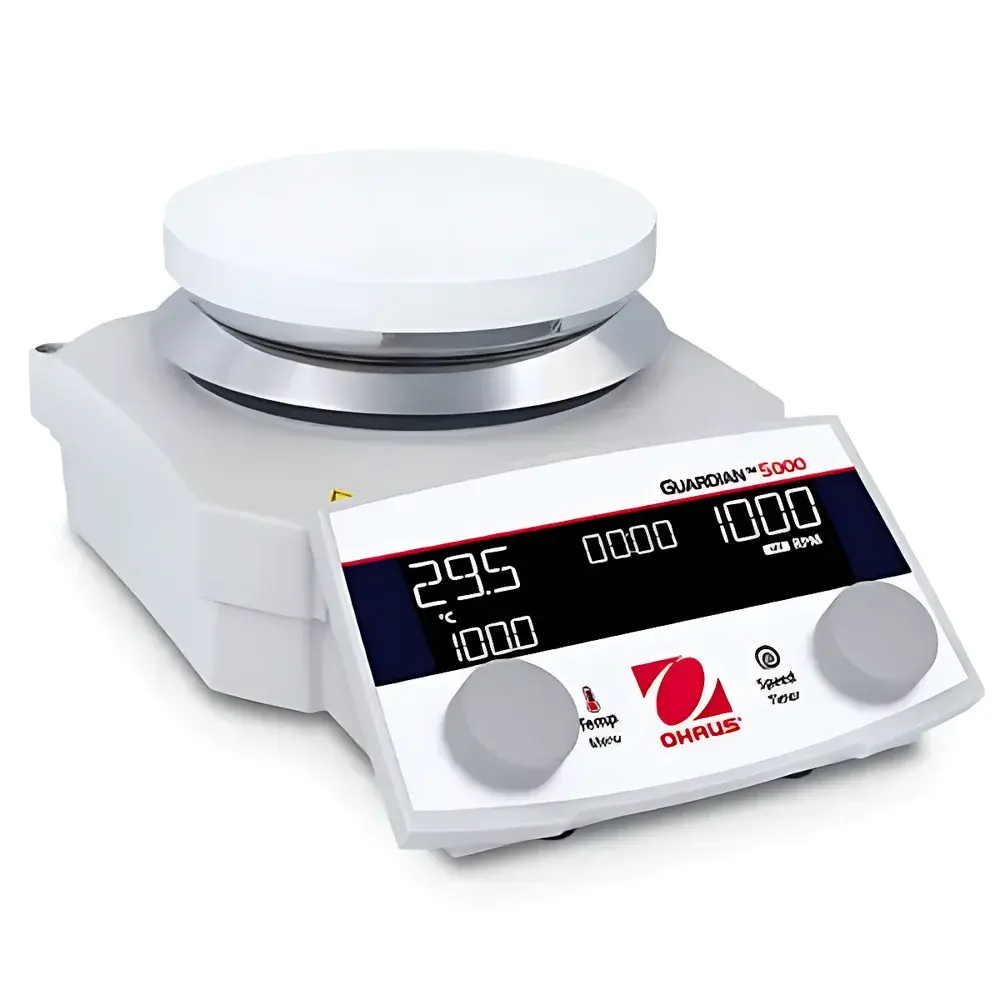
OHAUS GUARDIAN™5000 Advanced Heating Magnetic Stirrer
| Brand | OHAUS |
|---|---|
| Origin | Jiangsu, China |
| Manufacturer Type | Direct Manufacturer |
| Regional Classification | Domestic (China) |
| Model | e-G52HSRDA |
| Instrument Type | Heating Magnetic Stirrer |
| Max Stirring Volume | 20 L |
| Speed Range | 50–1,800 rpm |
| Temperature Range | 5 °C to 360 °C (above ambient) |
| Heating Plate Material | Ceramic-coated aluminum |
| Plate Dimensions | 13.5 cm (square equivalent) |
| Display | Backlit LCD with high-contrast white characters |
| Temp Control Modes | Ramp, Hold, and Programmed Profile |
| Calibration | Independent 3-point calibration for both plate and external Pt100/Pt1000 probe |
| Temp Stability | ±1 % (±1 °C <100 °C) for plate |
| Speed Stability | ±2 % |
| Timer Range | 1 min – 99 h 59 min |
| Housing | All-metal robust chassis |
| Safety Certifications | CE, TÜV |
| Power Supply | 220–240 V~, 4 A, 50/60 Hz |
| Operating Environment | 5–40 °C, ≤80 % RH non-condensing |
| Communication Interface | RS232 port for remote control and data logging |
| Weight | 2.6 kg |
| Dimensions (L×H×W) | 259 × 108 × 175 mm |
Overview
The OHAUS GUARDIAN™5000 Advanced Heating Magnetic Stirrer is an engineered solution for precise thermal and mechanical control in demanding laboratory workflows. Utilizing a closed-loop feedback system with dual-sensor architecture—integrating both integrated heating plate thermistors and optional external Pt100 or Pt1000 temperature probes—the instrument delivers reproducible thermal profiles across a wide operational envelope (5 °C to 360 °C above ambient). Its magnetic drive employs high-energy samarium-cobalt (SmCo) permanent magnets, ensuring consistent torque transmission even at elevated temperatures and with viscous or dense media. Designed for compliance-critical environments—including academic research labs, pharmaceutical QC/QA suites, and industrial process development—the GUARDIAN™5000 supports GLP/GMP-aligned documentation through its RS232 interface, enabling traceable parameter logging and remote command execution. The all-metal housing and ceramic-coated aluminum heating surface provide mechanical durability and chemical resistance, while the front-panel tilt design enhances ergonomic visibility and operator safety during extended operation.
Key Features
- High-capacity stirring: Stable agitation of up to 20 L aqueous or low-viscosity organic solutions under controlled thermal conditions.
- Dual-mode temperature control: Selectable ramp-to-target, hold-at-setpoint, or multi-segment programmed profiles—enabling optimization of endothermic reactions, sterilization cycles, or buffer equilibration without overshoot.
- Independent 3-point calibration: Separate calibration routines for internal plate sensor and external probe inputs ensure metrological traceability per ISO/IEC 17025 guidelines when used with accredited reference standards.
- RS232 serial interface: Supports bidirectional communication with LIMS or custom SCADA systems; enables automated start/stop, real-time parameter readback, and timestamped event logging compliant with FDA 21 CFR Part 11 requirements when paired with validated software.
- Enhanced safety architecture: Visual status indicators (green operational LED, amber high-temp warning), automatic overtemperature cutoff, and non-condensing environmental rating (5–40 °C, ≤80 % RH) meet IEC 61010-1 safety standards for laboratory equipment.
- Ergonomic front-tilt panel: Optimized viewing angle for backlit LCD display with white-on-black contrast, reducing parallax error during manual parameter entry or monitoring.
Sample Compatibility & Compliance
The GUARDIAN™5000 accommodates standard laboratory glassware including beakers (up to 5 L), cylindrical reactors (up to 20 L), and jacketed vessels with compatible stir bars. Its ceramic-coated aluminum plate resists corrosion from common solvents (e.g., ethanol, acetone, dilute acids/bases) and withstands repeated thermal cycling without delamination. For applications requiring regulatory adherence—including USP , ASTM E2912 (thermal validation), or ISO 13485 manufacturing support—the instrument’s calibrated temperature output and audit-trail-capable RS232 interface facilitate integration into quality management systems. CE and TÜV certifications confirm conformity with EN 61010-1 (electrical safety) and EN 61326-1 (EMC) directives.
Software & Data Management
While the GUARDIAN™5000 operates autonomously via its intuitive rotary encoder and membrane keypad, its RS232 port enables seamless integration with third-party data acquisition platforms. Users may configure automated logging intervals, define alarm thresholds (e.g., deviation >±2 °C from setpoint), and export comma-separated values (CSV) files containing time-stamped speed, temperature, and status codes. When deployed with validated PC-based software, the system supports electronic signatures, user access levels, and change-controlled configuration archives—fulfilling ALCOA+ principles (Attributable, Legible, Contemporaneous, Original, Accurate, Complete, Consistent, Enduring, Available) for regulated environments.
Applications
- Preparation of microbiological growth media requiring precise thermal dissolution and pH stabilization.
- Controlled heating and mixing during polymer synthesis, catalyst activation, or nanoparticle dispersion protocols.
- Thermal fixation of biological samples prior to histological processing.
- Buffer standardization and reagent dissolution where temperature-dependent solubility or hydrolysis kinetics must be managed.
- Validation studies for autoclave alternatives, including heat penetration testing in liquid loads.
- Process simulation for scale-up experiments in chemical engineering laboratories.
FAQ
Can the GUARDIAN™5000 be used with external temperature probes?
Yes—Pt100 and Pt1000 RTD probes are supported as optional accessories and can be calibrated independently against the internal heating plate sensor.
Is the timer function programmable for sequential operations?
The built-in timer supports single-interval countdown (1 min to 99 h 59 min); for multi-step sequences, RS232-triggered automation via external controller is recommended.
What is the maximum viscosity range supported at full 20 L volume?
Performance depends on stir bar geometry and fluid rheology; optimal results are achieved with Newtonian or near-Newtonian liquids up to ~500 mPa·s at 25 °C using standard cross-shaped stir bars.
Does the unit comply with electromagnetic compatibility (EMC) standards for shared lab environments?
Yes—certified to EN 61326-1 for industrial/scientific use, ensuring minimal interference with adjacent analytical instruments such as HPLC detectors or mass spectrometers.
How is temperature uniformity verified across the heating surface?
OHAUS recommends periodic verification using a NIST-traceable infrared thermometer or contact probe array; typical radial uniformity is ±3 °C at 200 °C across the central 80 % of the plate area.



