
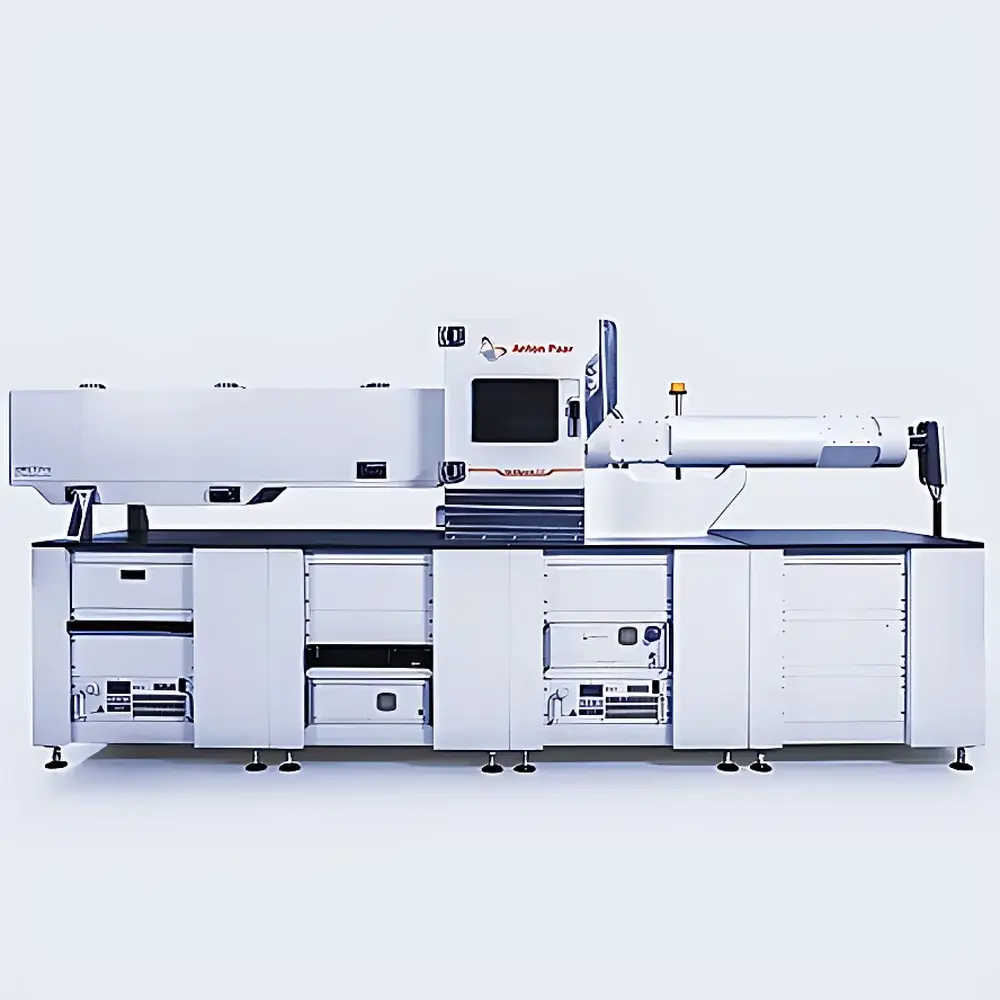
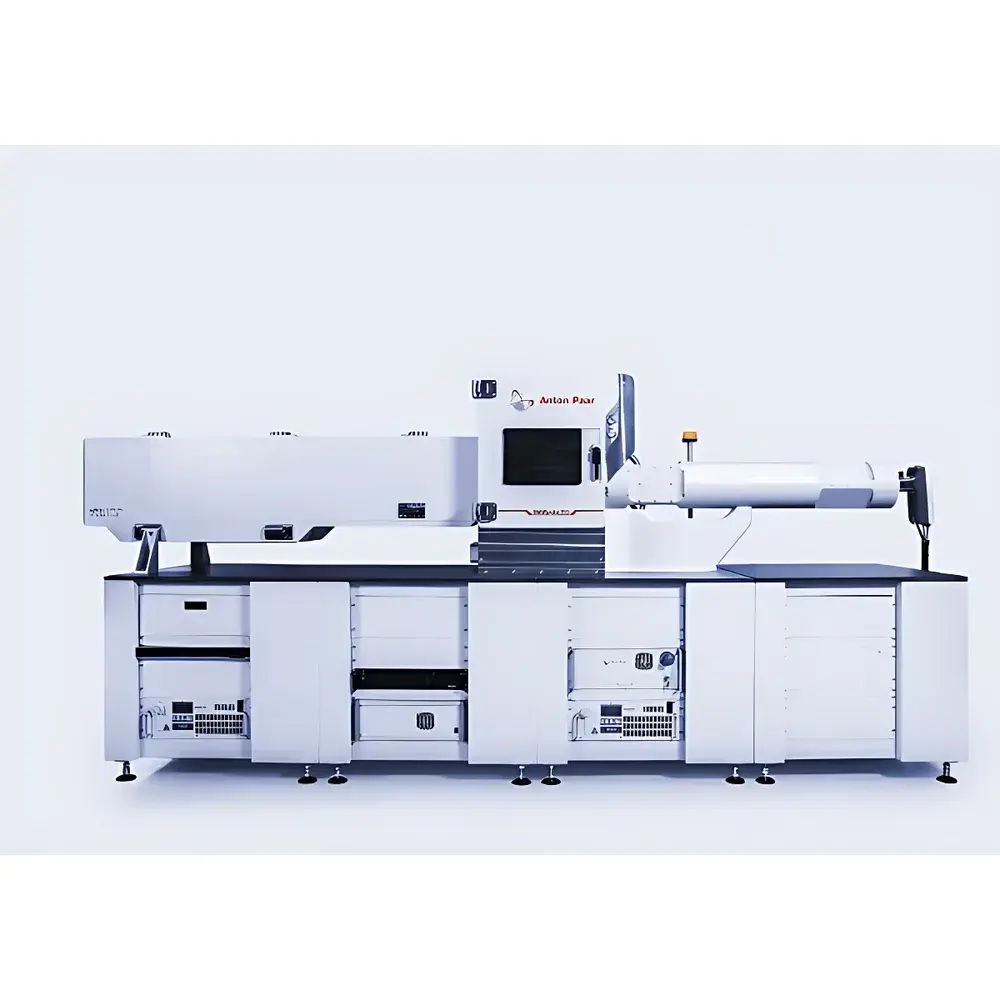
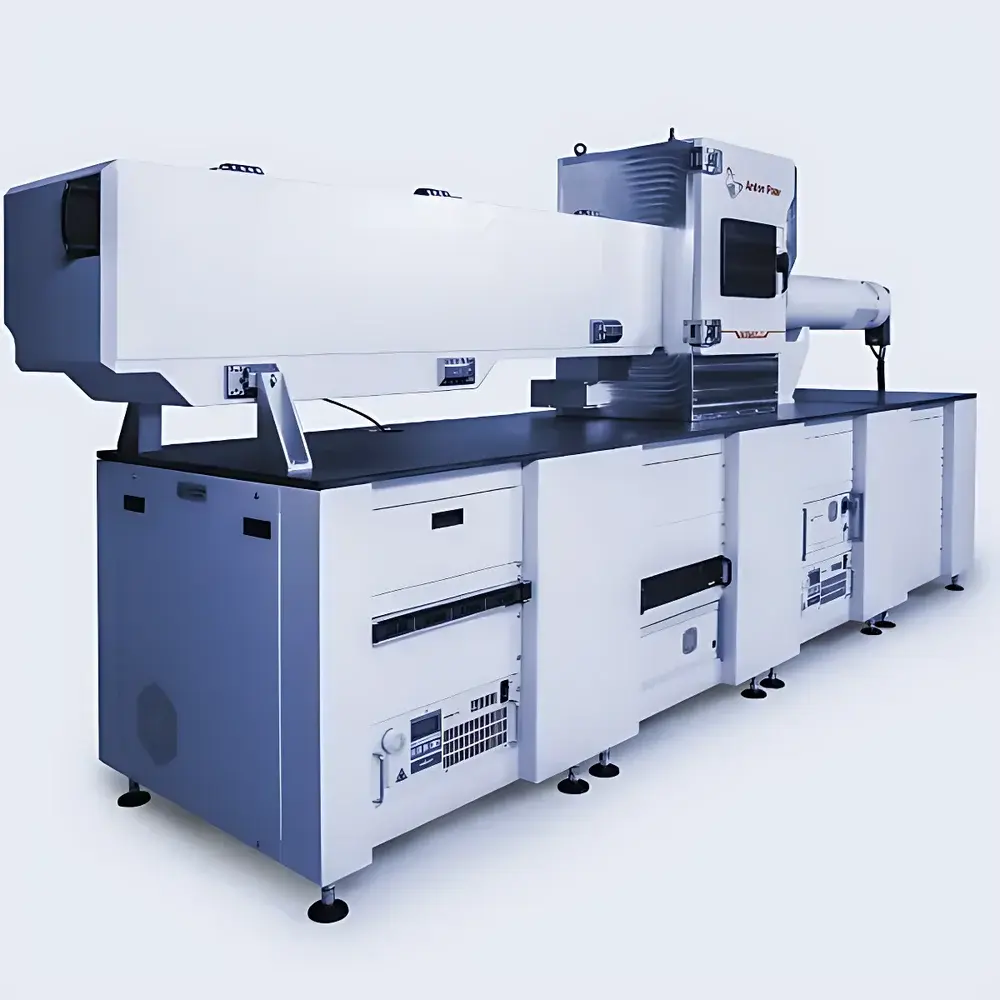
Anton Paar SAXSpoint 700 Small-Angle X-ray Scattering System
| Brand | Anton Paar |
|---|---|
| Origin | Austria |
| Manufacturer Type | Original Equipment Manufacturer (OEM) |
| Origin Category | Imported |
| Model | SAXSpoint 700 |
| Instrument Type | Small-Angle X-ray Scattering (SAXS) System |
| q-Range | 0.01 nm⁻¹ to 49.3 nm⁻¹ |
Overview
The Anton Paar SAXSpoint 700 is a laboratory-scale, high-performance small-angle X-ray scattering (SAXS) system engineered for structural characterization of nanoscale and mesoscale materials under controlled environmental conditions. Based on synchrotron-grade detector technology and optimized beam optics, it delivers quantitative scattering data across the full q-range from 0.01 nm⁻¹ to 49.3 nm⁻¹—enabling analysis of structures from ~1 nm up to ~620 nm in real space (via Fourier transform of the scattering profile). The system supports concurrent or sequential acquisition of SAXS, wide-angle X-ray scattering (WAXS), grazing-incidence SAXS (GISAXS), ultra-small-angle X-ray scattering (USAXS), and rheo-SAXS experiments—all within a single, compact footprint (3.6 m × 0.9 m for Microsource configuration). Its modular architecture integrates a high-brilliance Primux 100 microfocus X-ray source (Cu or Mo anode, optional dual-source or Ga/In MetalJet source), AXO ASTIX/ASTIX++ vacuum-compatible optics, and EIGER2 R or PILATUS4 R hybrid photon-counting detectors. Designed for reproducibility and long-term stability, the SAXSpoint 700 meets rigorous metrological requirements for materials science, polymer physics, colloidal chemistry, pharmaceutical formulation, and soft matter research.
Key Features
- Synthetic brilliance: >99.9% Cu Kα spectral purity and scatter-free beam collimation deliver synchrotron-equivalent data quality with reduced exposure times and minimal background.
- TrueSWAXS capability: Simultaneous SAXS/WAXS acquisition via Slidemaster detector translation—no recalibration required between modes.
- TrueFocus automated self-alignment: Real-time beam centering and optical alignment ensure consistent calibration across configurations and user sessions.
- Stagemaster XYZ sample stage with auto-identification: Enables seamless switching between TCStage (−150 °C to +500 °C), GISAXS, RheoSAXS, humidity, tensile, and custom stages—with full parameter inheritance.
- Integrated RheoSAXS module: Coupled shear cell and temperature-controlled flow path for in situ structural evolution studies during mechanical deformation.
- USAXS extension: Optional high-resolution USAXS module extends accessible real-space dimensions into the micrometer range (≥1 µm).
- Full environmental control: Vacuum, ambient air, inert gas (N₂, Ar), humidity (5–95% RH), and reactive atmospheres (e.g., H₂, O₂) supported via configurable sample chambers.
Sample Compatibility & Compliance
The SAXSpoint 700 accommodates diverse sample forms—including liquids (quartz capillaries, FlowCell, TubeCell), powders (PasteCell, μ-Cell), thin films (GISAXS stage), gels, polymers, nanoparticles, biological macromolecules, and composite materials. All sample environments comply with ISO/IEC 17025 guidelines for measurement traceability and are compatible with GLP/GMP workflows. Temperature accuracy of ±0.1 °C over −150 °C to +500 °C enables precise thermodynamic mapping of phase transitions, crystallization kinetics, and thermal degradation pathways. Data acquisition and processing adhere to FDA 21 CFR Part 11 requirements when configured with audit-trail-enabled SAXSdrive™ and SAXSanalysis™ software licenses.
Software & Data Management
SAXSdrive™ provides intuitive experiment setup, automated alignment routines, and real-time 2D/1D data preview with live q-calibration. SAXSanalysis™ delivers standardized reduction pipelines—including radial integration, background subtraction, absolute intensity calibration, Guinier/Rg analysis, Porod modeling, Kratky and Zimm plots, and specific surface area estimation. Both packages support batch processing of multi-sample datasets and export to HDF5, ASCII, and CIF formats for interoperability with third-party tools (e.g., ATSAS, Scatter, DAWN, Python-based scikit-beam). A documented Python API enables script-driven automation of measurement sequences, parameter sweeps, and custom fitting workflows—essential for high-throughput screening and method validation.
Applications
- Nanoparticle size distribution and polydispersity analysis in colloidal dispersions and drug delivery systems.
- Conformational changes in proteins and nucleic acids under varying pH, ionic strength, or ligand binding.
- Morphology evolution in block copolymers and thermoplastic elastomers during thermal annealing or solvent vapor exposure.
- In situ structural response of battery electrode materials to electrochemical cycling (using custom electrochemical cells).
- Film thickness, interfacial roughness, and lateral correlation length quantification in thin-film devices via GISAXS.
- Real-time monitoring of crystallite growth, lamellar spacing, and phase separation kinetics in polymer melts under shear (RheoSAXS).
- Pore size distribution and specific surface area determination in mesoporous catalysts and MOFs using USAXS/SAXS joint modeling.
FAQ
What q-range does the SAXSpoint 700 cover, and how is it achieved?
The system achieves a continuous q-range of 0.01 nm⁻¹ to 49.3 nm⁻¹ using a combination of long sample-to-detector distances (up to 4.5 m), high-resolution EIGER2 R detectors, and motorized Slidemaster positioning—enabling both ultra-low-q USAXS and high-q WAXS measurements without hardware reconfiguration.
Can the SAXSpoint 700 operate in ambient air?
Yes—unlike many SAXS systems requiring vacuum paths, the SAXSpoint 700’s fully shielded beam path and high-brilliance source allow reliable operation in air, significantly simplifying routine measurements of air-sensitive or volatile samples.
Is the system compliant with regulatory data integrity standards?
When deployed with validated software modules and enabled audit-trail functionality, the SAXSpoint 700 supports compliance with FDA 21 CFR Part 11, EU Annex 11, and ISO 13485 requirements for electronic records and signatures in regulated environments.
How is temperature control integrated with scattering measurements?
TCStage and GISAXS stages feature active PID control with ±0.1 °C accuracy and rapid thermal ramping (up to 100 °C/min), synchronized with time-resolved data acquisition to capture transient structural states during heating/cooling cycles.
What detector options are available, and how do they differ?
EIGER2 R detectors offer high dynamic range (>10⁶), zero readout noise, and frame rates up to 1 kHz—ideal for time-resolved studies; PILATUS4 R detectors provide higher spatial resolution and superior point-spread function for demanding WAXS applications.
Related Products





