
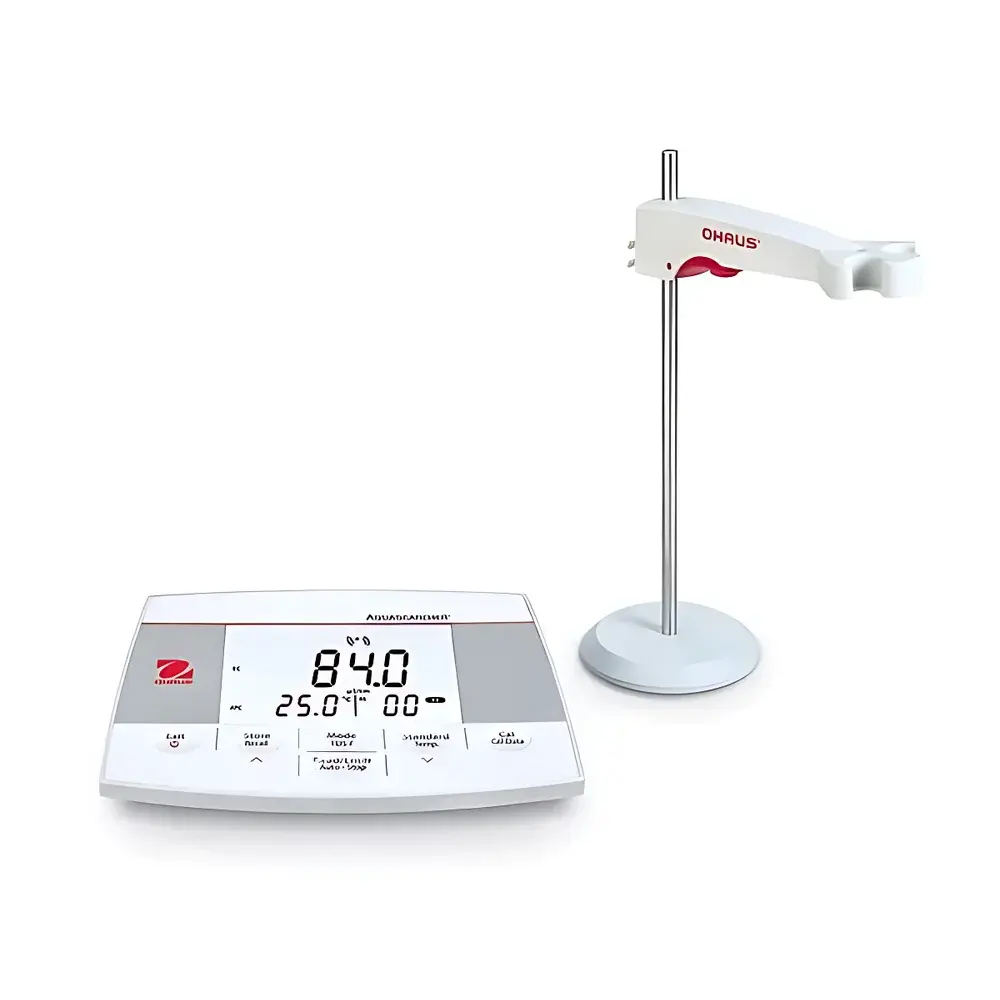
OHAUS AQUASEARCHER™ AB23EC Benchtop Conductivity Meter
| Brand | OHAUS |
|---|---|
| Origin | Jiangsu, China |
| Manufacturer Type | Manufacturer |
| Regional Category | Domestic (China) |
| Model | AB23EC-B |
| Measurement Parameters | Conductivity, TDS, Salinity, Temperature |
| Portability | Benchtop |
| Conductivity Range | 0.0 μS/cm – 199.9 mS/cm |
| TDS Range | 0.1 mg/L – 199.9 g/L |
| Salinity Range | 0.0 – 99.9 PSU |
| Temperature Range | 0.0 – 100.0 °C |
| Accuracy | ±1% of reading ±3 least significant digits |
| Minimum Resolution | 0.01 μS/cm (auto-ranging) |
| Data Storage | 99 readings |
| Display | 5-inch segmented backlit LCD |
| Housing | ABS plastic |
| Weight | 0.38 kg |
| Dimensions (H × L × W) | 51 mm × 210 mm × 142 mm |
| Power Supply | AC adapter |
| Electrode | Not included |
| Temperature Compensation | Automatic and manual |
| Calibration | Auto-buffer recognition, manual endpoint control |
| Compliance | Designed for general laboratory use per ISO 5725 (accuracy verification), compatible with GLP data integrity practices |
Overview
The OHAUS AQUASEARCHER™ AB23EC Benchtop Conductivity Meter is a precision-engineered electrochemical instrument designed for reliable, repeatable measurement of electrical conductivity, total dissolved solids (TDS), salinity, and temperature in aqueous solutions. Built upon standard two-electrode conductometric principles, the AB23EC applies an alternating current across a cell to minimize polarization effects and electrode fouling—ensuring stable readings across a wide dynamic range (0.0 μS/cm to 199.9 mS/cm). Its architecture supports automatic temperature compensation (ATC) using integrated NTC thermistors or external probe inputs, aligning measurements to standardized reference temperatures (typically 25 °C) per ASTM D1125 and ISO 7888 guidelines. As a dedicated benchtop unit, it delivers consistent performance in QC labs, environmental monitoring stations, academic teaching laboratories, and water treatment facilities where regulatory traceability and procedural repeatability are foundational.
Key Features
- 5-inch segmented backlit LCD display with high-contrast characters for optimal readability under varied ambient lighting conditions
- Six tactile mechanical keys with intuitive labeling—enabling rapid parameter selection, calibration initiation, and data navigation without menu nesting
- Auto-ranging conductivity measurement with 0.01 μS/cm minimum resolution at low ranges, ensuring sensitivity for ultrapure water analysis while maintaining linearity up to 199.9 mS/cm
- Integrated dual-mode temperature compensation: automatic (using built-in sensor or optional external probe) and manual override for method-specific protocols
- 99-point internal memory with timestamp-free storage—supporting batch-level data capture for preliminary trend assessment and audit-ready recordkeeping
- Auto-buffer recognition during calibration (for standard KCl solutions: 84 μS/cm, 1413 μS/cm, 12.88 mS/cm) and manual endpoint hold function for non-equilibrating samples
- Compact footprint (210 mm × 142 mm base) and integrated independent electrode stand—minimizing bench space requirements without compromising ergonomic access or stability
- Robust ABS housing rated for continuous operation in controlled laboratory environments; CE-marked power supply compliant with IEC 61010-1 safety standards
Sample Compatibility & Compliance
The AB23EC is optimized for aqueous liquid samples with conductivity values spanning from deionized water (sub-1 μS/cm) to concentrated brines and industrial process streams (up to 199.9 mS/cm). It accommodates standard 1-cell or 2-cell conductivity probes (e.g., OHAUS COND-1 or equivalent DIN/ISO-compliant sensors) via universal BNC input. While not intrinsically certified for hazardous locations, its design adheres to general-purpose laboratory safety norms outlined in ISO/IEC 17025:2017 for equipment suitability. The instrument supports documentation practices aligned with Good Laboratory Practice (GLP) and basic GMP workflows—including manual annotation of calibration dates, operator IDs, and sample identifiers in external logbooks. Though lacking native 21 CFR Part 11 electronic signature capability, its deterministic output and uneditable memory structure facilitate manual transcription into validated systems.
Software & Data Management
The AB23EC operates as a standalone analytical endpoint with no embedded Bluetooth, USB, or RS-232 connectivity—intentionally prioritizing operational simplicity, electromagnetic immunity, and long-term hardware stability over digital integration. All stored readings (99 max) remain accessible via front-panel navigation and can be manually transcribed into LIMS, Excel, or ELN platforms. For laboratories requiring automated data flow, third-party analog-to-digital interfaces (e.g., USB-based analog voltage loggers) may be deployed to capture real-time output signals—though such configurations fall outside OHAUS’s factory validation scope. Firmware updates are not supported; calibration constants and system settings are retained through power cycles via non-volatile memory.
Applications
- Quality control of purified water systems (PW, WFI pre-testing) per USP conductivity specifications
- Salinity profiling in marine biology and aquaculture studies (0–99.9 PSU range covers estuarine to hypersaline conditions)
- TDS estimation in wastewater effluent screening and drinking water compliance checks (0.1 mg/L–199.9 g/L, linearly derived from conductivity using NaCl equivalence factor)
- Educational demonstrations of ionic strength relationships, electrolyte dissociation, and temperature-dependent conductance behavior
- Process monitoring of cleaning-in-place (CIP) rinse endpoints and boiler feedwater purity verification
- Environmental field lab support for surface water characterization where portability is secondary to measurement robustness
FAQ
Does the AB23EC include a conductivity probe?
No—the instrument does not ship with an electrode. Users must select and purchase a compatible two-electrode or four-electrode probe separately, based on required cell constant (e.g., K = 0.1 cm⁻¹ for low-conductivity applications or K = 10 cm⁻¹ for high-salinity media).
Is temperature compensation mandatory during measurement?
No—temperature compensation can be disabled manually to report raw, uncorrected conductivity values, which may be required for certain method validations or comparative studies.
Can the AB23EC be used for resistivity measurements?
While resistivity (Ω·cm) is mathematically the inverse of conductivity, the AB23EC does not compute or display resistivity directly; users must perform this conversion externally using recorded conductivity and cell constant values.
What calibration buffers are recognized automatically?
The meter auto-identifies standard KCl solutions at nominal conductivities of 84 μS/cm (0.001 M), 1413 μS/cm (0.01 M), and 12.88 mS/cm (0.1 M), reducing setup time and minimizing input error.
How is data integrity ensured during power loss?
All calibration settings and stored measurements reside in non-volatile memory and persist through AC power interruption or adapter disconnection.





