
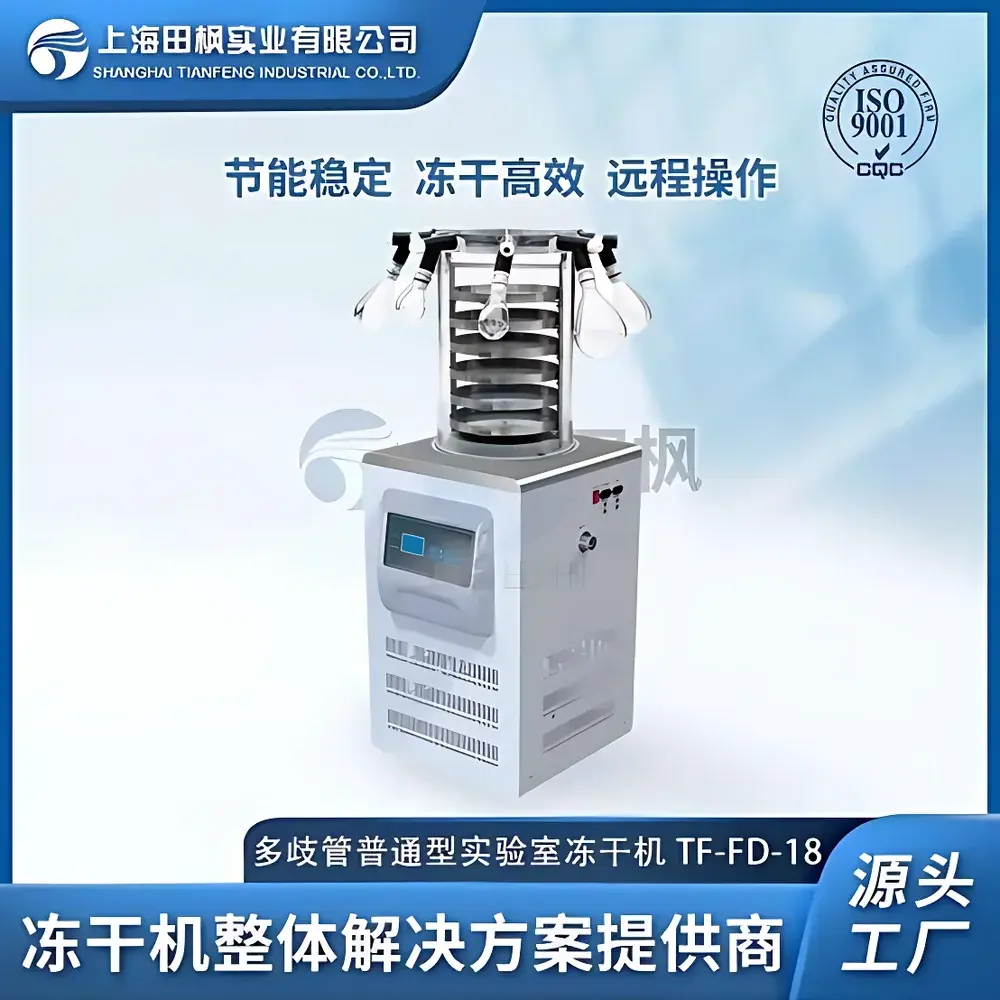
Tianfeng TF-FD-18 Multi-Manifold Laboratory Freeze Dryer
| Brand | Tianfeng |
|---|---|
| Origin | Shanghai, China |
| Manufacturer Type | Direct Manufacturer |
| Instrument Type | Multi-Manifold Freeze Dryer |
| Application Scope | Laboratory R&D and Small-Batch Production |
| Shelf Area | 0.18 m² |
| Ultimate Vacuum | <15 Pa (empty chamber) |
| Condenser Temperature | ≤−60 °C |
| Ice Capacity | 6 kg/24 h |
| Dimensions (main unit only) | 550 mm × 550 mm × 960 mm |
| Power Supply | 220 V, 50 Hz |
| Rated Power | 1500 W |
| Chamber Material | 304 Stainless Steel + High-Transparency Acrylic Door |
| Condenser Type | Air-Cooled Dual-Stage Refrigeration System |
| Optional Accessories | Temperature Data Logger, Eutectic Point Tester, Inert Gas Purge Valve, Manual Stoppering Kit |
Overview
The Tianfeng TF-FD-18 Multi-Manifold Laboratory Freeze Dryer is a purpose-engineered lyophilization system designed for reproducible, scalable freeze drying of heat-sensitive biologicals, pharmaceutical intermediates, cosmetic actives, and immunotherapeutic cell preparations. It operates on the fundamental principle of sublimation: aqueous samples are first frozen solid at cryogenic temperatures (≤−60 °C), then subjected to high vacuum (<15 Pa), enabling ice to transition directly from solid to vapor phase without passing through liquid—thereby preserving structural integrity, enzymatic activity, conformational stability, and reconstitution fidelity. Unlike conventional thermal drying methods that induce denaturation, oxidation, or collapse, this process maintains the native morphology of labile biomolecules and cellular architectures. The TF-FD-18 is optimized for benchtop laboratory environments where precise control over freezing kinetics, primary drying rate, and secondary drying conditions is essential for method development, formulation screening, and GMP-aligned process validation.
Key Features
- Multi-manifold configuration with eight independent ports accommodating standard flasks (50–1000 mL) for parallel sample processing under identical vacuum and temperature conditions;
- Air-cooled dual-stage refrigeration system delivering stable condenser performance at ≤−60 °C, ensuring efficient water vapor capture and minimizing thermal load during extended cycles;
- 0.18 m² shelf area with four-tier stainless steel trays (Φ240 mm), engineered for uniform heat transfer and mechanical stability during freeze-drying of vials, ampoules, or bulk samples;
- High-transparency acrylic observation door integrated into the drying chamber, enabling real-time visual monitoring of ice sublimation, cake formation, and potential collapse events;
- Touchscreen HMI with embedded PID temperature and vacuum control algorithms, supporting graphical display of time-resolved pressure, condenser temperature, and shelf temperature profiles;
- 304 stainless steel interior surfaces and corrosion-resistant components compliant with ISO 14644-1 Class 7 cleanroom compatibility requirements;
- Optional inert gas purge valve (N₂ or Ar) for oxygen-sensitive formulations; optional eutectic point measurement module for rational cycle design;
- CE-compliant electrical architecture with overload protection, emergency stop, and interlocked safety circuits per IEC 61010-1.
Sample Compatibility & Compliance
The TF-FD-18 supports lyophilization of diverse sample classes including monoclonal antibodies, recombinant proteins, live attenuated vaccines, dendritic cell suspensions, platelet-rich plasma, hyaluronic acid gels, botanical extracts, and peptide-based cosmetic serums. Its ≤−60 °C condenser enables reliable trapping of water and low-volatility solvents (e.g., tert-butanol, ethanol/water mixtures), making it suitable for formulations containing co-solvents. The system meets core functional requirements outlined in USP , Ph. Eur. 2.9.40, and ISO 22042 for laboratory-scale lyophilizer qualification. While not pre-certified for FDA 21 CFR Part 11, its optional data logger provides ALCOA+ compliant audit trails (time-stamped, user-identified, immutable records) when configured with password-protected access and electronic signature capability—supporting GLP and early-phase GMP documentation needs.
Software & Data Management
The onboard controller logs all critical process parameters—including chamber pressure, condenser temperature, shelf temperature (if equipped with external probe), and elapsed time—at user-defined intervals (1–60 s). Exportable CSV files facilitate post-run analysis in MATLAB, Python, or commercial statistical software. Optional USB-connected temperature data loggers provide independent verification of thermal history across multiple vial positions, satisfying ICH Q5C stability study guidelines. All firmware updates are delivered via secure encrypted firmware packages; no cloud connectivity is implemented, preserving data sovereignty and eliminating cybersecurity exposure vectors common in IoT-enabled instruments.
Applications
- Pharmaceutical R&D: Cycle development for injectables, stability testing of lyophilized reference standards, and small-batch production of clinical trial materials;
- Cell Therapy: Cryopreservation-grade lyophilization of immune effector cells (e.g., NK cells, TILs) using trehalose-based stabilizers to retain membrane fluidity and cytotoxic function post-reconstitution;
- Cosmetic Science: Stabilization of probiotic lysates, growth factors (EGF, FGF), and enzyme complexes (superoxide dismutase, catalase) without thermal degradation;
- Academic Research: Structural biology sample preparation (cryo-EM grids), preservation of microbial cultures, and long-term archiving of rare tissue biopsies;
- Diagnostic Reagents: Manufacture of lyophilized ELISA controls, lateral flow assay conjugates, and PCR master mix components with extended room-temperature shelf life.
FAQ
What types of samples are compatible with the TF-FD-18 multi-manifold configuration?
It accommodates standard round-bottom flasks (50–1000 mL) and serum bottles with O-ring-sealed stopcocks. Samples must be pre-frozen prior to manifold attachment; direct in-chamber freezing is not supported on this model.
Does the system support in-situ temperature monitoring during primary drying?
Yes—optional PT100 probes can be inserted into representative vials or flasks to record product temperature in real time, enabling accurate determination of collapse temperature and optimization of shelf setpoints.
Is the condenser capable of capturing organic solvents?
The ≤−60 °C condenser effectively traps water and moderately volatile solvents (e.g., ethanol, acetone, tert-butanol) but is not rated for highly volatile solvents such as diethyl ether or chloroform.
Can the TF-FD-18 be integrated into a regulated quality system?
With optional data logging, user access control, and electronic signature modules, it supports IQ/OQ documentation and satisfies foundational elements of Annex 11 and 21 CFR Part 11 for non-critical process steps in early development.
What maintenance intervals are recommended for sustained vacuum integrity?
Vacuum pump oil should be changed every 500 operating hours; silicone oil in the refrigeration circuit requires replacement only after 10,000 hours or if condenser performance degrades beyond ±2 °C tolerance.



