
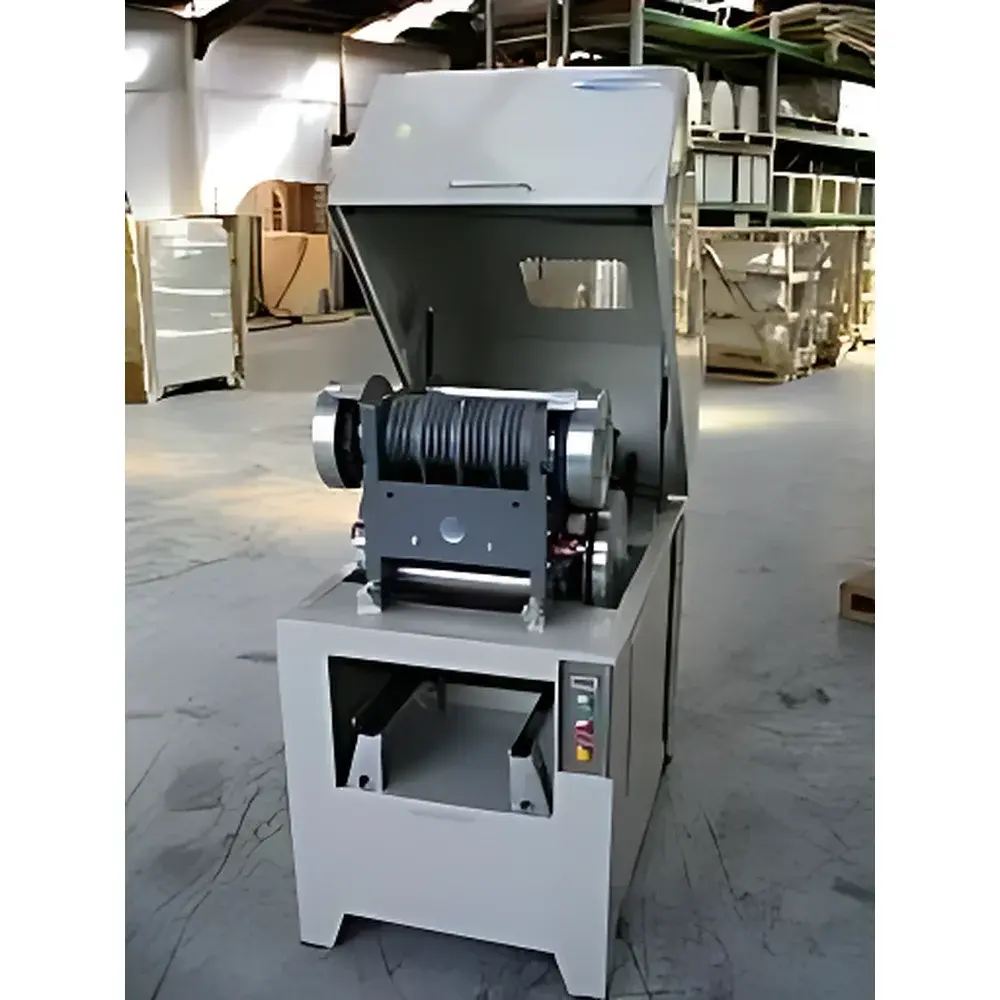
Rocklabs Boyd Crusher – Dual-Action Laboratory Jaw Crusher
| Brand | Rocklabs |
|---|---|
| Origin | New Zealand |
| Model | Boyd Crusher |
| Maximum Feed Size | 50 mm |
| Final Particle Size | ≤ 2 mm |
| Capacity | Up to 5 kg per batch |
| Dimensions (D×W×H) | 680 × 1160 × 1240 mm |
| Weight | 560 kg |
| Crushing Mechanism | Dual-action eccentric jaw motion with top and bottom driven jaws |
| Safety Features | Interlocked safety switch, enclosed dust extraction ducting |
| Jaw Plate Configurability | Reversible top/bottom plates for extended service life |
| Feed Opening | 300 mm wide flat feed hopper |
Overview
The Rocklabs Boyd Crusher is a precision-engineered, dual-action laboratory jaw crusher designed for high-reproducibility primary size reduction of geological, metallurgical, and environmental samples. Unlike conventional single-eccentric jaw crushers, the Boyd employs a patented dual-eccentric drive system—simultaneously actuating both the top and bottom jaw plates—to generate repeated compressive and shearing forces as material cascades through the crushing chamber. This mechanism enables a single-pass size reduction ratio of up to 25:1 (e.g., 50 mm → ≤ 2 mm), significantly minimizing downstream processing steps and mitigating sample heterogeneity risks associated with multi-stage crushing. Its robust cast-iron frame, industrial-grade bearing assemblies, and hardened manganese steel jaw plates ensure long-term dimensional stability and resistance to abrasive wear—critical for laboratories performing routine geochemical assay preparation, exploration core splitting, or certified reference material (CRM) homogenization.
Key Features
- Dual-action jaw motion: Independent eccentric drives on both upper and lower jaw plates deliver enhanced particle attrition and uniform size distribution without over-grinding.
- High-capacity flat-feed hopper: 300 mm wide, zero-angle entry facilitates rapid manual loading of irregularly shaped rocks, drill cores, or slag specimens—reducing operator fatigue and spillage risk.
- Reversible jaw plates: Top and bottom plates are fully interchangeable, effectively doubling service life and maintaining consistent crush geometry across maintenance cycles.
- Integrated dust management: Internal air ducting connects directly to optional lab exhaust or central vacuum systems, meeting OSHA and EU Directive 2004/37/EC (carcinogens and mutagens) exposure control requirements.
- Fail-safe interlock system: Mechanical and electrical safety switches automatically de-energize the motor when the front access panel is opened, compliant with IEC 60204-1 machinery safety standards.
- Benchtop-compatible footprint: Despite its 560 kg mass and structural rigidity, the unit’s compact depth (680 mm) allows integration into standard laboratory fume hood bays or dedicated prep rooms with reinforced flooring.
Sample Compatibility & Compliance
The Boyd Crusher accepts feed materials with Mohs hardness up to 7 (e.g., quartzite, basalt, limestone, bauxite, coal, and ferrous/non-ferrous ores). It is routinely deployed in ISO/IEC 17025-accredited geochemistry labs for preparation of samples prior to XRF, ICP-MS, or fire assay analysis. The design conforms to ASTM D2974 (standard test methods for moisture, ash, and organic matter in peat and other organic soils) and supports GLP-compliant workflows via documented maintenance logs and calibration traceability. Jaw plate wear profiles can be monitored using Rocklabs’ optional wear gauge kit, ensuring consistent performance validation between CRM batches.
Software & Data Management
While the Boyd Crusher operates as a standalone electromechanical instrument, its operational parameters—including total run time, cumulative batch count, and maintenance intervals—are logged manually in lab notebooks or integrated into LIMS platforms via Rocklabs’ optional digital interface module (sold separately). This module provides RS-485 Modbus RTU output for timestamped event logging, supporting audit readiness under FDA 21 CFR Part 11 where electronic records are required. No proprietary software installation is needed; configuration is performed via DIP-switch settings aligned with site-specific electrical supply (220–240 V AC, 50/60 Hz, 3-phase).
Applications
- Primary crushing of exploration drill core and chip samples for gold, copper, and rare earth element assays.
- Preparation of homogeneous sub-samples from bulk geological reference materials (e.g., NIST SRM, CANMET, or USGS standards).
- Size reduction of construction aggregates, recycled concrete, and municipal solid waste fractions for leaching studies (TCLP, SPLP).
- Routine feed preparation for downstream equipment including ring mills, disc grinders, and riffle splitters in mineral processing pilot plants.
- Quality control crushing in cement and lime manufacturing facilities adhering to EN 196-3 and ASTM C114 standards.
FAQ
What is the maximum recommended feed size for optimal throughput and jaw longevity?
The nominal maximum feed size is 50 mm; however, consistent feeding of material >40 mm requires pre-screening to avoid bridging and uneven jaw loading.
Can the Boyd Crusher be used for wet or sticky samples?
No—it is strictly designed for dry, free-flowing materials. Moisture content above 5% may cause adhesion, clogging, and accelerated wear; drying or freeze-milling is advised prior to crushing.
Is third-party calibration certification available?
Yes—Rocklabs Authorised Service Centres provide UKAS-accredited calibration reports verifying crush consistency, dwell time repeatability, and safety interlock response latency.
How often should jaw plates be reversed or replaced?
Under typical geochemical lab usage (2–3 batches/day), reversal is recommended every 200 operating hours; full replacement interval ranges from 800–1,200 hours depending on sample abrasivity and feed size distribution.
Does the unit comply with CE marking requirements for laboratory machinery?
Yes—the current production series carries CE marking under Machinery Directive 2006/42/EC and EMC Directive 2014/30/EU, with full technical documentation available upon request.
Related Products



