
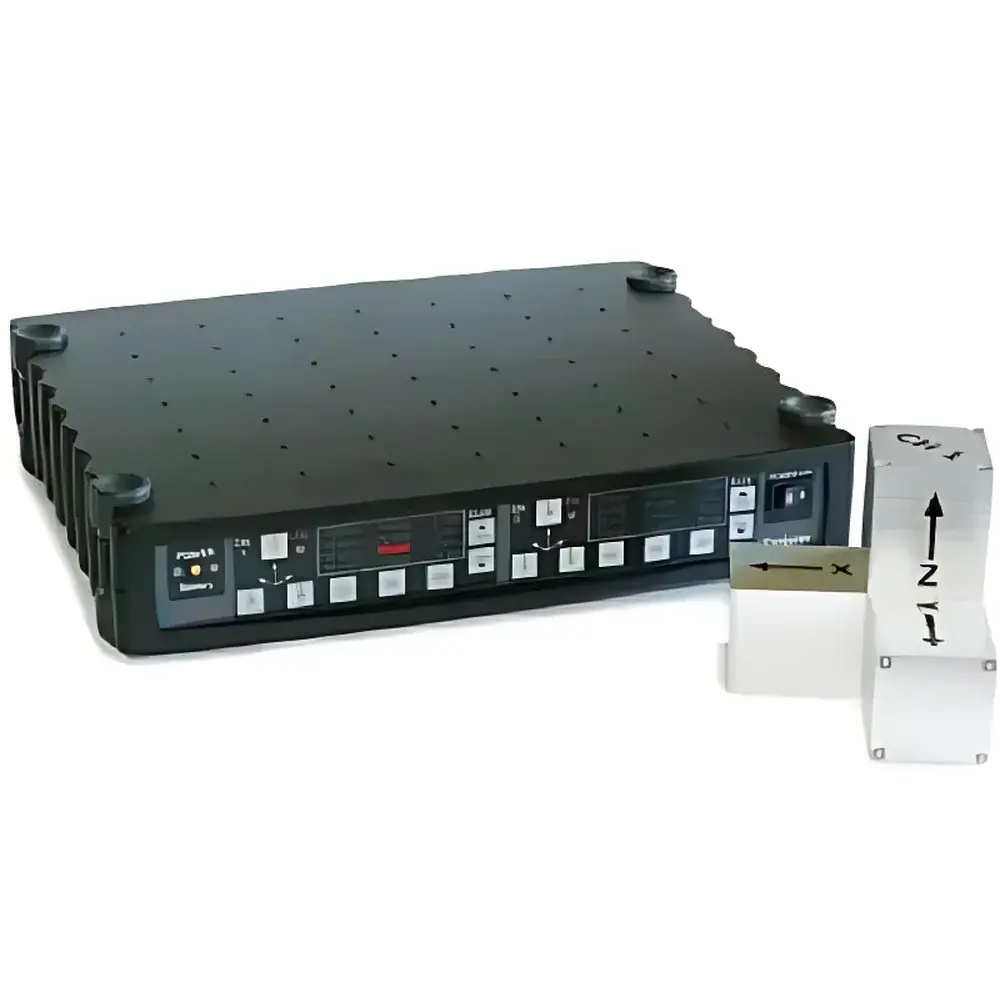
Halcyonics Explorer Triaxial Non-Contact Vibration Analyzer
| Brand | Accurion |
|---|---|
| Origin | Germany |
| Model | Halcyonics Explorer |
| Sensor Technology | Piezoelectric Ceramic |
| Axes | X, Y, Z (Triaxial) |
| Detection Principle | Non-contact Capacitive / Laser Doppler (Configurable) |
| Power Supply | Independent AC Input |
| Dual-Sensor Capability | Yes |
| Compliance | CE, RoHS, ISO 10816-1 (Vibration Evaluation of Machines) |
Overview
The Halcyonics Explorer Triaxial Non-Contact Vibration Analyzer is a high-fidelity, benchtop-grade instrumentation system engineered for precision dynamic motion characterization in research laboratories, precision manufacturing environments, and metrology facilities. Unlike conventional accelerometers requiring mechanical coupling, the Explorer employs a hybrid sensing architecture—optionally integrating non-contact capacitive displacement sensing or laser Doppler vibrometry (LDV)—to resolve sub-micron vibrational amplitudes across three orthogonal axes (X, Y, Z) without mass-loading or surface interference. Its core measurement principle relies on real-time phase-resolved velocity and displacement reconstruction from high-bandwidth analog sensor outputs, enabling time-domain waveform capture, frequency spectrum analysis (FFT), and modal parameter extraction up to 20 kHz bandwidth (dependent on configuration). Designed for traceable vibration diagnostics per ISO 10816-1 and ISO 20816 series standards, the system delivers repeatable, low-noise data essential for structural health monitoring, optical table stability assessment, semiconductor equipment qualification, and ultra-precision motion stage validation.
Key Features
- Triaxial non-contact sensing with independent X/Y/Z axis resolution—eliminates mounting-induced resonance artifacts and enables true 3D vibration vector mapping.
- Piezoelectric ceramic transduction elements with broadband frequency response (1 Hz – 20 kHz typical), optimized for high signal-to-noise ratio (SNR > 85 dB) and thermal drift compensation.
- Dual-sensor configuration support: simultaneous acquisition from two spatially separated points, facilitating differential vibration analysis, coherence estimation, and transfer function derivation.
- Integrated AC-powered electronics module with galvanically isolated analog outputs (±10 V), USB 3.0 digital interface, and embedded FPGA-based real-time preprocessing (filtering, decimation, trigger synchronization).
- Ruggedized aluminum housing (IP54-rated enclosure), compact footprint (240 × 180 × 85 mm), and tool-free sensor head mounting—optimized for rapid deployment in cleanrooms, metrology labs, and production line environments.
Sample Compatibility & Compliance
The Halcyonics Explorer interfaces with rigid, semi-rigid, and compliant surfaces—including optical mirrors, silicon wafers, ceramic substrates, and active damping platforms—without requiring surface preparation or adhesive bonding. It supports vibration amplitude ranges from 10 nm to 5 mm peak-to-peak (configurable via gain selection), with displacement resolution down to 0.5 nm RMS (at 1 kHz bandwidth). The system complies with EU directives CE and RoHS, meets electromagnetic compatibility requirements per EN 61326-1, and adheres to mechanical vibration evaluation standards including ISO 10816-1 (machinery), ISO 20816-2 (reciprocating machines), and ISO 20816-5 (non-rotating machinery). Audit-ready calibration documentation (traceable to PTB/NIST standards) is provided with each unit; optional GLP-compliant calibration certificates are available upon request.
Software & Data Management
The Explorer is operated via Halcyonics Control Suite v4.x—a Windows-based application supporting real-time FFT, waterfall plots, orbit diagrams, and time-history logging at up to 1 MS/s sample rate. The software includes built-in compliance reporting templates aligned with ISO 10816 pass/fail thresholds, automated report generation (PDF/CSV/XLSX), and metadata tagging for sample ID, operator, timestamp, and environmental conditions (temperature/humidity logged via optional external sensors). All raw datasets are stored in HDF5 format for long-term archival integrity and third-party interoperability (MATLAB, Python, LabVIEW). For regulated environments, optional 21 CFR Part 11-compliant modules provide electronic signatures, audit trails, role-based access control, and data immutability enforcement.
Applications
- Characterization of vibration transmission paths in optical interferometry setups and laser alignment systems.
- Qualification of active and passive vibration isolation platforms (e.g., pneumatic, magnetic, or piezoelectric isolators).
- Dynamic stability testing of electron microscope stages, beamline components, and nano-positioning systems.
- Root-cause analysis of micro-vibrations affecting lithography tool performance and wafer overlay accuracy.
- Modal analysis of MEMS devices, thin-film actuators, and micro-opto-electro-mechanical systems (MOEMS).
- Baseline vibration profiling for ISO Class 5–8 cleanroom certification and facility acceptance testing (FAT).
FAQ
Is the Halcyonics Explorer compatible with vacuum or inert-gas environments?
The standard unit is rated for ambient air operation only; vacuum-compatible sensor heads and feedthrough options are available under custom configuration (lead time: 12–14 weeks).
Can I integrate the Explorer’s output into my existing SCADA or PLC system?
Yes—via analog voltage outputs (±10 V, 0–10 kHz bandwidth) or Modbus TCP over Ethernet (optional firmware upgrade). SDKs for C/C++, Python, and .NET are included.
Does the system require periodic recalibration?
Annual recalibration is recommended per ISO/IEC 17025 guidelines; field verification using NIST-traceable shaker tables is supported through the Control Suite’s built-in calibration wizard.
What is the maximum cable length between sensor head and controller?
Standard shielded coaxial cables support up to 10 m; fiber-optic extension kits (for LDV configurations) extend operational distance to 50 m without SNR degradation.
Is training provided with purchase?
Yes—Accurion-certified remote and on-site technical training (8 hours) is included, covering measurement methodology, uncertainty budgeting, ISO compliance workflows, and troubleshooting protocols.



