
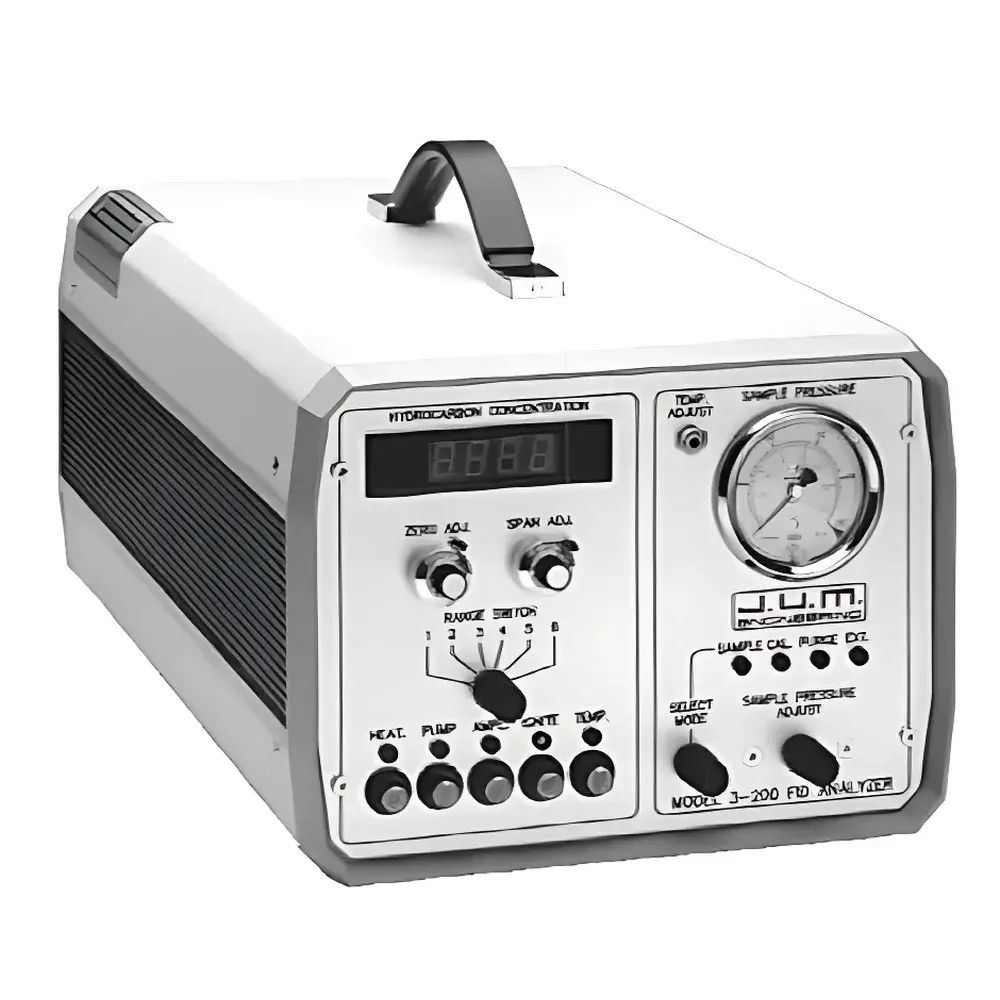
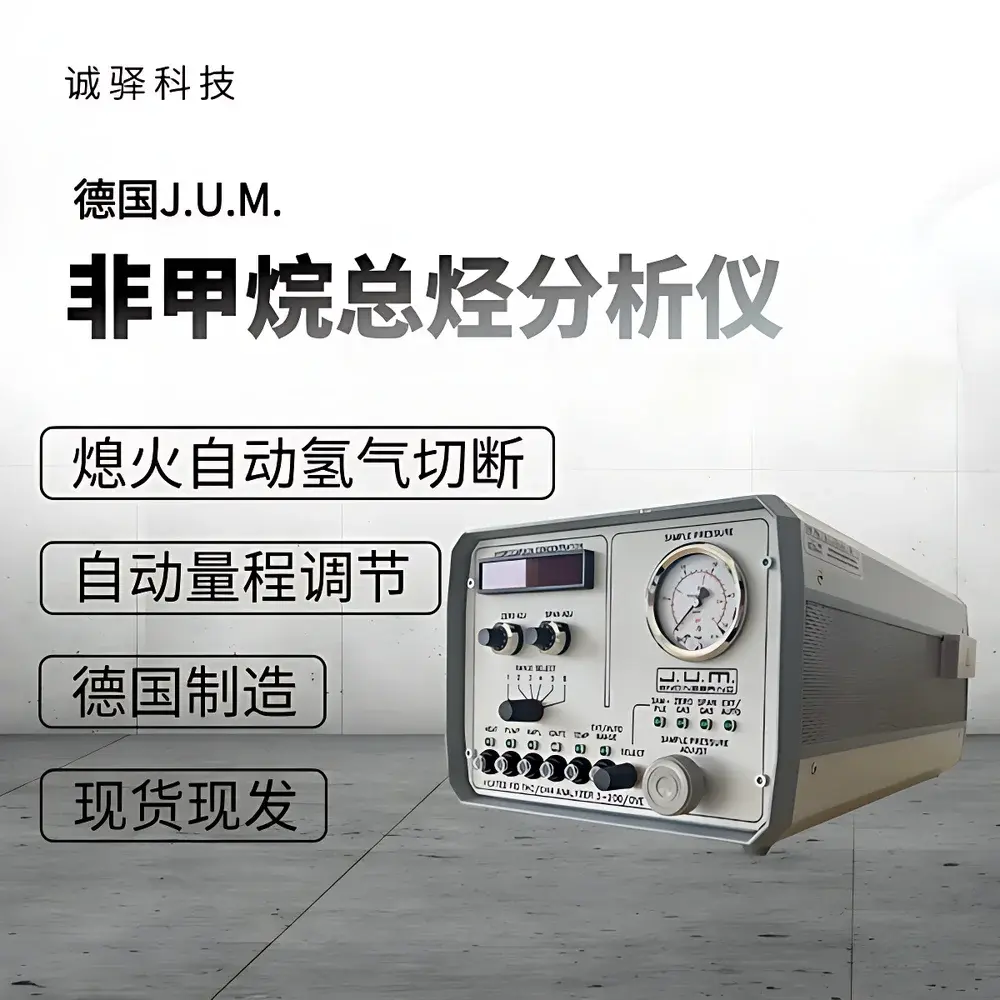
J.U.M. 3-200-a Portable Total Hydrocarbons Analyzer with FID
| Brand | J.U.M. |
|---|---|
| Origin | Germany |
| Model | 3-200-a |
| Detection Principle | Flame Ionization Detection (FID) |
| Instrument Type | Portable Online Analyzer |
| Configuration | TVOC Analyzer |
| Measurement Range | 0–1000 ppm |
| Resolution | 0.1 ppm |
| Accuracy | ±5% of reading |
| Response Time | <60 s |
| Detector Temperature | 190 °C |
| Carrier/Air Supply | Integrated zero-air generator |
| Sensitivity (CH₄) | 1 ppm full-scale |
| Flow Stability | Precision back-pressure regulation |
Overview
The J.U.M. 3-200-a Portable Total Hydrocarbons Analyzer is a field-deployable, flame ionization detector (FID)-based instrument engineered for quantitative measurement of total hydrocarbons (THC) and volatile organic compounds (VOCs) in gas streams. Unlike photoionization detectors (PID) or metal oxide sensors, the FID provides universal, carbon-mass-sensitive detection with linear response across C₁–C₁₂+ hydrocarbons—making it the reference method for regulatory-compliant THC quantification. The analyzer operates on the principle of pyrolytic ionization: sample gas is mixed with hydrogen fuel and combusted in a hydrogen–air flame; organic molecules produce ions proportional to their carbon content, which are collected and measured as current. Its compact, ruggedized chassis—designed for operation in industrial perimeters, stack testing sites, and mobile laboratories—integrates all critical subsystems: heated sample path, temperature-controlled FID chamber, precision mass-flow-regulated combustion air supply, and embedded zero-air generation. This eliminates dependency on external compressed air cylinders or calibration gas manifolds, significantly enhancing operational autonomy during unattended or extended-duration field campaigns.
Key Features
- Integrated zero-air generation system: Eliminates need for external compressed air sources; ensures consistent, hydrocarbon-free combustion air at regulated flow and pressure.
- Heated FID chamber maintained at 190 °C: Prevents condensation and adsorption of high-boiling-point hydrocarbons (e.g., C₈–C₁₂), preserving measurement integrity across diverse VOC matrices.
- Proprietary high-stability back-pressure regulator: Delivers ±0.1% flow repeatability over time, minimizing drift and extending calibration intervals—critical for long-term boundary monitoring or leak detection surveys.
- Real-time response with <60 s T₉₀: Enables rapid screening of fugitive emissions, process upsets, or transient plumes without sacrificing quantitative fidelity.
- Multi-range measurement capability: Factory-configurable full-scale ranges include 0–10, 0–100, 0–1000, 0–10 000, and 0–100 000 ppm (as methane equivalent); resolution remains 0.1 ppm across all spans.
- Robust mechanical architecture: IP54-rated enclosure, shock-absorbing internal mounting, and wide ambient operating range (−10 °C to +50 °C) support deployment in demanding outdoor and industrial environments.
Sample Compatibility & Compliance
The 3-200-a is validated for direct analysis of undiluted stack gases, ambient air, soil vapor, and process off-gases—with no sample conditioning required for most applications. It meets the instrumental performance criteria specified in EPA Method 25A (for total gaseous organic concentration), EPA Method 503 (for VOC emission source testing), EN 12619 (automated continuous emission monitoring systems), EN 13526 (performance requirements for portable analyzers), and German regulatory frameworks including 13. BImSchV (Ordinance on Large Combustion Plants) and 17. BImSchV (Ordinance on Industrial Emissions). Its FID design inherently satisfies ISO 8573-5 (purity class verification for compressed gases) and ASTM D6348 (standard test method for determining total hydrocarbons in gaseous samples). Data output supports GLP/GMP-aligned audit trails when integrated with compliant data acquisition systems.
Software & Data Management
The analyzer communicates via RS-232, RS-485, and optional Ethernet (Modbus TCP/RTU) protocols. J.U.M.’s proprietary PC software enables real-time parameter configuration, trend logging, alarm thresholding, and report generation in PDF/CSV formats. All measurements include timestamp, instrument ID, range setting, and status flags (e.g., flame status, temperature deviation, flow error). Raw analog outputs (4–20 mA, 0–10 V) allow integration into SCADA or DCS platforms. Firmware supports configurable data averaging (1–60 s), automatic zero/span validation scheduling, and event-triggered data capture—essential for compliance reporting under EU IED and U.S. NSPS Subpart OOOOa.
Applications
- Continuous emission monitoring (CEM) at combustion sources, incinerators, and chemical reactors
- Fugitive emission detection and quantification (LDAR programs)
- Boundary air monitoring around refineries, petrochemical facilities, and solvent-handling zones
- Engine exhaust characterization (diesel, natural gas, biogas) for R&D and certification testing
- Catalytic converter efficiency evaluation via upstream/downstream THC delta analysis
- Carbon adsorption bed breakthrough detection and regeneration control
- Ultra-high-purity gas qualification in semiconductor fabrication (ppb-level THC screening via dilution mode)
- LEL (Lower Explosive Limit) estimation in solvent recovery units and paint booths
FAQ
Is the 3-200-a certified for use in hazardous areas?
No—this model is rated for general-purpose use (non-ATEX). For Zone 1/2 applications, consult J.U.M.’s intrinsically safe variant (3-200-ex series).
Does it require external hydrogen supply?
Yes—hydrogen fuel (≥99.999% purity, 30–50 mL/min) must be supplied from a cylinder or electrolytic generator; the unit does not generate H₂ internally.
Can it measure individual VOCs, or only total hydrocarbons?
It measures total hydrocarbon concentration as methane-equivalent (ppm C₁H₄); speciation requires coupling with a GC-FID system.
What maintenance intervals are recommended?
FID jet cleaning every 200 operating hours; ceramic igniter inspection every 6 months; annual calibration verification against certified CH₄ standards per ISO/IEC 17025 procedures.
Is remote firmware update supported?
Yes—via secure USB or Ethernet connection using J.U.M.’s signed firmware package and configuration utility.







