
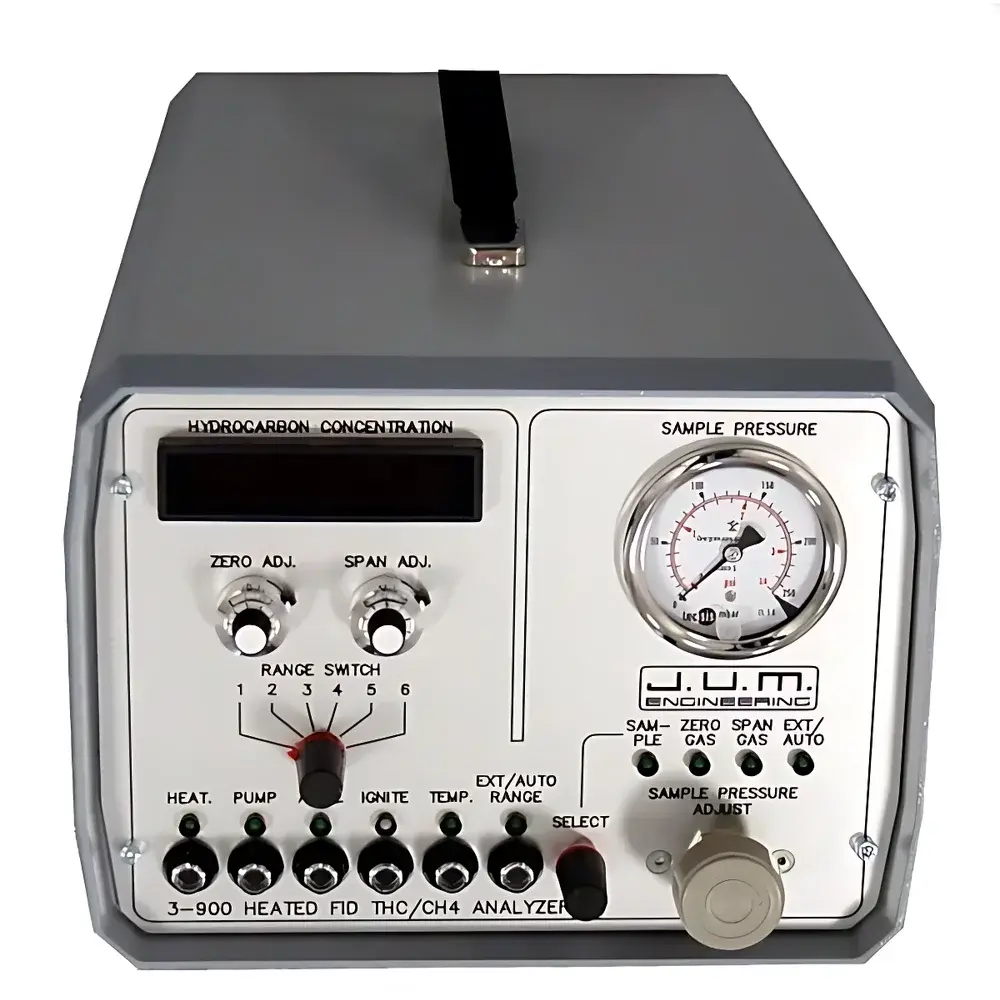
J.U.M. 3-900-1 Portable Total Hydrocarbons & Methane Analyzer with FID
| Brand | J.U.M. |
|---|---|
| Origin | Germany |
| Model | 3-900-1 |
| Detection Principle | Flame Ionization Detection (FID) |
| Instrument Type | Portable Online Analyzer |
| Typical Configuration | TVOC Analyzer |
| Measurement Range | 0–1000 ppm |
| Resolution | 0.1 ppm |
| Accuracy | ±5% of reading |
| Response Time | <60 s |
| Heating Chamber Temperature | 190 °C |
| Sensitivity (CH₄) | Up to 1 ppm full scale |
| Burner Air Supply | Integrated compressed air generator |
Overview
The J.U.M. 3-900-1 Portable Total Hydrocarbons & Methane Analyzer is a field-deployable, thermally stabilized gas chromatography–free instrument engineered for real-time quantification of total hydrocarbons (THC) and methane (CH₄) in ambient air, stack emissions, and process streams. It employs a flame ionization detector (FID), a universally accepted reference method for hydrocarbon measurement due to its linear response across six orders of magnitude, high sensitivity to organic compounds containing C–H bonds, and minimal dependence on molecular structure. Unlike catalytic bead or PID-based sensors, the FID provides stoichiometric response proportional to carbon mass flow—making it suitable for regulatory compliance, emission verification, and process control where compound-independent quantification is required. The analyzer integrates J.U.M.’s proprietary whole-unit thermal management system, maintaining the entire optical and detection path—including sample line, burner, and collector electrode—at a precisely controlled 190 °C. This eliminates condensation of higher-molecular-weight VOCs (e.g., C₈–C₁₂ aliphatics and aromatics), ensuring measurement integrity under variable humidity and low-temperature field conditions.
Key Features
- Integrated heated sample pathway and FID combustion chamber (190 °C) preventing hydrocarbon condensation and wall adsorption
- Self-contained compressed air supply for FID operation—no external gas cylinders required
- Multi-range auto-scaling capability: selectable full-scale ranges from 0–10 ppm up to 0–100,000 ppm THC (as methane equivalent)
- Ruggedized portable housing with IP54-rated enclosure for outdoor and industrial site deployment
- Real-time analog output (4–20 mA) and digital interface (RS-232/RS-485) compatible with SCADA and DCS systems
- Calibration traceable to NIST-certified methane standards; optional integrated zero/span validation port
Sample Compatibility & Compliance
The 3-900-1 is validated for continuous analysis of gaseous matrices including ambient air, flue gas (with particulate filtration), compressed air, nitrogen, argon, and hydrogen carrier streams. It complies with multiple international regulatory frameworks governing hydrocarbon emissions monitoring: German BImSchV Ordinances (13th and 17th TA Luft revisions), European Standards EN 12619 (continuous monitoring of gaseous emissions) and EN 13526 (performance requirements for FID-based analyzers), and U.S. EPA Methods 25A (total gaseous organic concentration) and Method 503 (calibration and validation procedures for FID systems). Its design supports GLP-compliant data acquisition when paired with audit-trail-enabled software, and meets essential requirements for ISO 17025-accredited laboratories performing environmental emission testing.
Software & Data Management
The analyzer operates with J.U.M.’s WinControl 3-900 software suite, providing configuration, calibration logging, real-time trend visualization, and automated report generation (PDF/CSV). All calibration events, zero/span checks, and parameter changes are time-stamped and stored with user ID attribution—supporting 21 CFR Part 11-compliant electronic records when deployed in regulated manufacturing environments (e.g., semiconductor fab cleanrooms or pharmaceutical HVAC monitoring). Data export includes raw FID current values, temperature logs, pressure-compensated concentration outputs, and diagnostic flags (e.g., flame-out, low air pressure, heater fault). Optional Modbus TCP integration enables seamless connection to enterprise-level environmental information systems (EIS) and predictive maintenance platforms.
Applications
- Regulatory stack testing for industrial VOC abatement systems (e.g., RTOs, carbon adsorbers, catalytic oxidizers)
- In-line monitoring of hydrocarbon breakthrough in activated carbon beds during solvent recovery operations
- LEL (Lower Explosive Limit) safety surveillance in paint booths, printing facilities, and chemical storage areas
- Engine exhaust characterization during development of low-emission internal combustion powertrains
- Purity assurance of ultra-high-purity (UHP) gases used in semiconductor photolithography and CVD processes
- Baseline ambient air quality surveys near petrochemical complexes, landfills, and wastewater treatment plants
- Verification of catalytic converter efficiency in vehicle emissions certification labs
FAQ
Does the 3-900-1 require hydrogen fuel gas for the FID?
No. It uses ambient air as the combustion oxidant and does not require external H₂ supply—eliminating explosion hazards and simplifying field logistics.
Can the instrument measure individual VOC species?
No. It reports total hydrocarbon concentration expressed as methane-equivalent ppm (ppm C₁), per EPA 25A and EN 12619 conventions. Speciation requires GC-FID or GC-MS instrumentation.
What maintenance intervals are recommended for field operation?
FID nozzle cleaning every 250 operating hours; annual replacement of the ceramic igniter and burner assembly; biannual verification of thermal stability and span drift using certified calibration gas.
Is the analyzer suitable for humid or particulate-laden sample streams?
Yes—provided inlet gas is pre-filtered (≤0.3 µm particulate filter) and dew point is maintained below 10 °C upstream of the heated inlet. Optional Nafion™ dryer integration is available for high-humidity applications.
How is accuracy verified during routine use?
Through daily or shift-based zero-and-span checks using certified CH₄-in-air standards traceable to NIST SRM 1662a; deviation beyond ±5% triggers automatic alarm and calibration recommendation.
Related Products







