
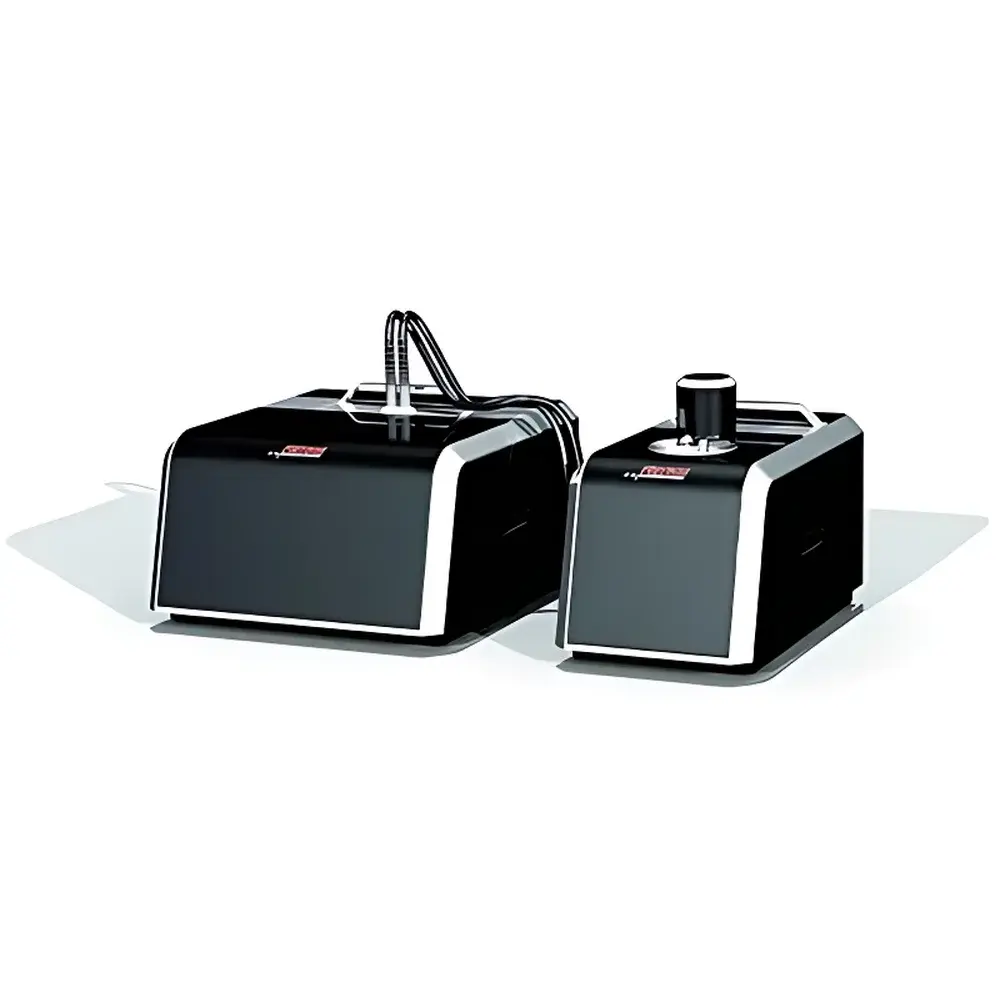
Fritsch ANALYSETTE 22 Micro Tec Plus Laser Particle Size Analyzer
| Brand | Fritsch |
|---|---|
| Origin | Germany |
| Model | ANALYSETTE 22 Micro Tec Plus |
| Measurement Range | 0.08–2000 µm |
| Laser Sources | Dual-laser system (green: λ = 532 nm, 7 mW |
| IR | λ = 940 nm, 9 mW), Class 1 safety certified per EN 60825-1 |
| Optical Design | Inverse Fourier configuration with motorized sample cell positioning |
| Detector Array | 57-channel dual-axis (vertical & horizontal polarization) sensor |
| Dispersion Options | Modular dry and wet dispersion units (optional) |
| Compliance | ISO 13320 compliant |
| SOP Architecture | Modular, parameter-independent workflow design |
| Cleaning | Automated rinse cycle |
| Environmental Rating | Dry dispersion compatible with ISO Class 5 (Grade A) cleanroom environments |
| Software | Fully configurable reporting, background subtraction algorithm, tap-water-compatible measurement protocol |
Overview
The Fritsch ANALYSETTE 22 Micro Tec Plus Laser Particle Size Analyzer is an ISO 13320-compliant instrument engineered for precise, reproducible particle size distribution (PSD) analysis of dry powders, aqueous suspensions, and emulsions. It operates on the principle of laser diffraction, where particles in a dispersed phase scatter incident light at angles inversely proportional to their size. The system employs an inverse Fourier optical arrangement—patented by Fritsch—to maximize detection efficiency across the full angular scattering spectrum. This design ensures that even low-intensity forward-scattered light from submicron particles is captured by the primary detector array, significantly enhancing resolution in the 0.08–10 µm range without compromising upper-range sensitivity up to 2000 µm. Two independently stabilized laser sources (532 nm green and 940 nm infrared) provide complementary scattering contrast, improving robustness for samples with varying refractive indices or absorption characteristics. All lasers conform to IEC/EN 60825-1 Class 1 safety requirements, eliminating the need for interlocks or operator training certifications under standard laboratory conditions.
Key Features
- Inverse Fourier optical path with motorized, auto-positioning sample cell—ensures optimal beam-sample interaction and eliminates manual alignment drift.
- Dual-axis 57-channel detector array utilizing orthogonal laser polarization (vertical and horizontal), enabling discrimination of particle shape effects and improved signal-to-noise ratio for polydisperse systems.
- Modular dispersion architecture: Independent dry and wet dispersion modules can be integrated or operated separately, supporting standardized ISO 13320 dispersion protocols for both aerosolized and liquid-phase measurements.
- Automated background acquisition and real-time subtraction algorithm—reduces dependency on ultrapure water; measurements remain valid using deionized or even filtered tap water.
- Self-cleaning rinse cycle with programmable duration and solvent compatibility—minimizes cross-contamination between sequential analyses and supports GMP/GLP traceability.
- Compact optical bench incorporating reflective optics (not refractive lenses), reducing footprint by ~30% versus conventional Fourier-transform designs while maintaining thermal stability and long-term calibration integrity.
Sample Compatibility & Compliance
The ANALYSETTE 22 Micro Tec Plus accommodates a broad spectrum of industrial and research-grade materials—including pharmaceutical actives, catalysts, battery cathode powders, ceramic precursors, polymer nanoparticles, and food-grade starches—without requiring method revalidation. Dry dispersion meets ISO 14644-1 Class 5 (formerly Grade A) cleanroom particulate limits when operated with optional HEPA-filtered aspiration. Wet dispersion units support flow-cell and recirculating configurations, compatible with surfactants, dispersants, and pH-adjusted media per USP and ASTM D7927 guidelines. All measurement workflows adhere to ISO 13320:2020 for laser diffraction methodology, including mandatory reporting of obscuration limits, dispersion energy input, and validation of optical model selection (Mie vs. Fraunhofer). Instrument firmware maintains full audit trail capability for 21 CFR Part 11–compliant environments when paired with Fritsch’s optional LabControl Suite.
Software & Data Management
The proprietary Fritsch ParticleSizing Software provides a modular, SOP-driven interface built around independent functional blocks—dispersion control, optical alignment, background capture, measurement execution, and report generation. Each module retains its own parameter set, allowing targeted updates (e.g., disabling ultrasonication for shear-sensitive biopolymers) without affecting other operational segments. Reports are fully customizable via drag-and-drop layout editor and export to CSV, PDF, or XML formats with embedded metadata (timestamp, operator ID, instrument serial number, calibration certificate ID). Raw scattering data is stored in HDF5 format, ensuring long-term readability and compatibility with third-party statistical analysis platforms. Database management supports hierarchical sample grouping, version-controlled SOP libraries, and automated QC flagging based on user-defined repeatability thresholds (e.g., ≤3% RSD for D50 across triplicate runs).
Applications
This analyzer serves critical functions across regulated and non-regulated sectors: in pharmaceutical development, it validates milling endpoints and granulation uniformity per ICH Q5A and Q5C; in advanced materials R&D, it quantifies agglomeration state changes during slurry aging or surface modification; in quality control labs, it verifies batch-to-batch consistency of toner particles, pigment dispersions, or metal injection molding feedstocks. Its dry-mode performance enables rapid assessment of inhalable fraction (MMAD) for dry powder inhalers (DPIs), aligning with FDA guidance documents on aerosol characterization. Academic users leverage its dual-laser capability for fundamental studies of plasmonic nanoparticle scattering anisotropy or colloidal stability under variable ionic strength.
FAQ
Does the ANALYSETTE 22 require external compressed air or vacuum sources for dry dispersion?
No—the integrated dry dispersion unit includes a self-contained, oil-free diaphragm pump and pressure-regulated aspiration system, eliminating dependency on facility utilities.
Can the software generate reports compliant with 21 CFR Part 11?
Yes, when deployed with Fritsch LabControl Suite (optional add-on), the system provides electronic signatures, audit trails, role-based access control, and data integrity safeguards meeting FDA requirements.
Is calibration verification traceable to NIST or PTB standards?
Yes—each instrument ships with a factory-issued calibration certificate traceable to PTB (Physikalisch-Technische Bundesanstalt) reference materials, and annual recalibration services include certified reference latex spheres (NIST SRM 1960) and silica standards.
What maintenance intervals are recommended for the optical path?
Detector window cleaning is recommended after every 200 dry measurements or 500 wet measurements; full optical alignment verification is scheduled annually or after transport/shock events.
How does the system handle highly absorbing or fluorescent samples?
The dual-wavelength configuration allows selection of the optimal laser (e.g., 940 nm for carbon-black dispersions, 532 nm for TiO₂) to minimize extinction artifacts and improve sizing accuracy in optically dense systems.



