
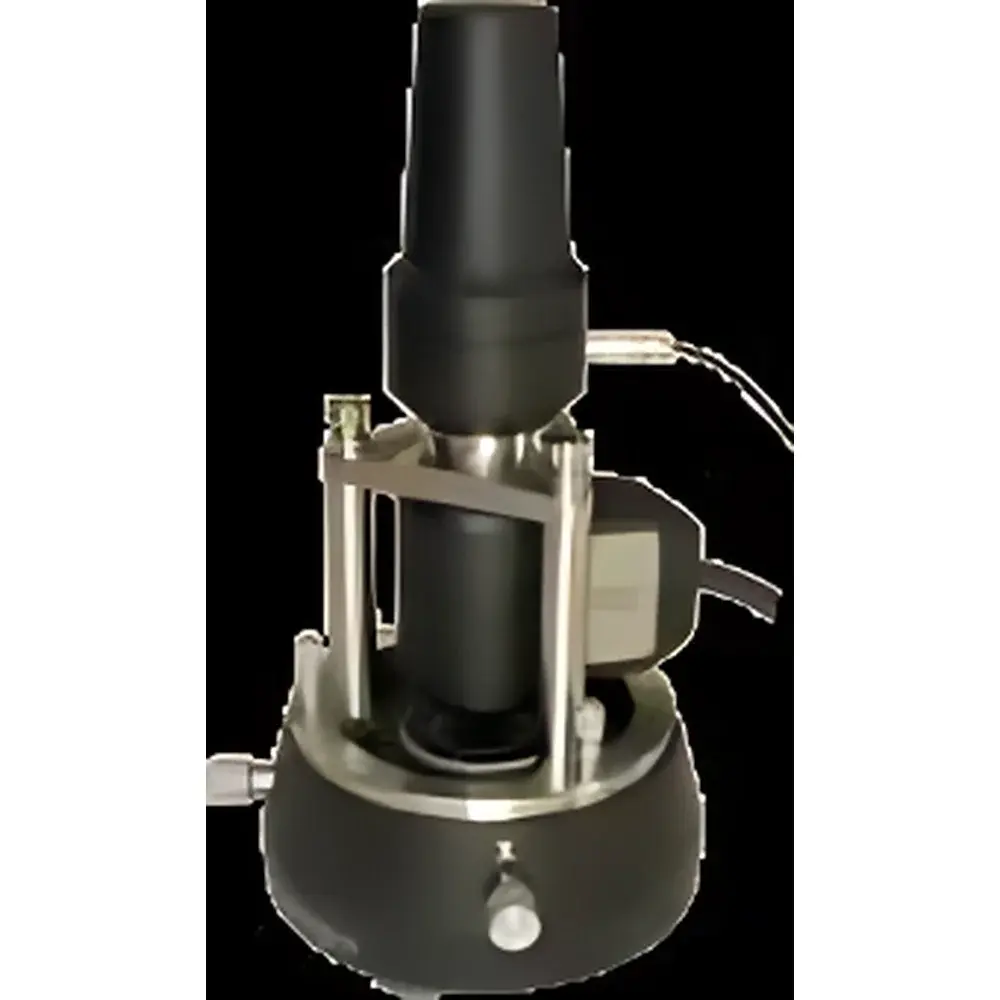
DME DS 95 SPM Atomic Force Microscope Scanner
| Brand | DME |
|---|---|
| Origin | Denmark |
| Manufacturer Type | Authorized Distributor |
| Import Status | Imported |
| Model | DME DS 95 SPM |
| Price Range | USD 68,000 – 136,000 (est.) |
| Positional Noise | X-Y < 0.15 nm RMS, Z = 35 pm RMS |
| XY Stage Travel Range | 180 nm × 180 nm |
| Scan Volume Options | 50 × 50 × 5 µm (DS95-50) or 200 × 200 × 15 µm (DS95-200) |
| Max. Scan Rate | 30 Hz |
| Z-direction Mechanical Resolution (HOPG) | 0.06 nm RMS |
| Z-direction Electronic Noise Floor | < 0.05 nm RMS |
| Cantilever Insertion | Plug-and-Play |
| SPM Modes | AC Mode (Amplitude & Phase Imaging), LFM, MFM, KPFM, EFM, SCM, STM |
| Integrated Optical Axis | Yes |
| CCD-Based Visual Navigation | Yes |
| Controller Software | DiProWa, C26ScanTool (optional) |
Overview
The DME DS 95 SPM Atomic Force Microscope Scanner is a high-stability, modular scanning probe platform engineered for precision nanoscale surface characterization in research and industrial quality control environments. Based on a robust monolithic granite or Igloo-style dome architecture, the DS 95 employs a closed-loop piezoelectric actuation system with hardware-linear Z-motion—ensuring sub-angstrom positional fidelity without software correction artifacts. Its core measurement principle relies on deflection detection of a microfabricated cantilever via optical beam bounce, enabling quantitative topographic, mechanical, electrical, and magnetic property mapping at atomic resolution. Designed as a drop-in replacement for optical microscope stages or OEM integration into nanoindenter and hybrid metrology systems, the DS 95 delivers traceable, reproducible data under ambient, liquid, or controlled-environment conditions—meeting foundational requirements for ISO/IEC 17025-compliant laboratories and GLP-aligned materials development workflows.
Key Features
- Monolithic mechanical design with ultra-low thermal drift (<0.1 nm/min) and vibration isolation optimized for benchtop operation without active damping.
- Plug-and-play cantilever holder with integrated optical alignment axis—enabling rapid, repeatable probe exchange while maintaining laser-cantilever coupling alignment within ±0.5°.
- Dual-stage XY positioning: fine piezo scanner (180 nm × 180 nm range, <0.05 nm RMS noise) nested within coarse motorized stage options (up to 200 × 150 mm travel) for seamless navigation from macro to nanoscale regions of interest.
- Integrated high-resolution CCD camera with LED-transmission/reflection illumination and selectable contrast modes (brightfield, darkfield, DIC) for real-time visual targeting and coordinate-referenced sample registration.
- On-head electronics minimize signal path length—reducing electromagnetic interference and achieving <35 pm RMS Z-noise floor in vacuum-compatible configurations.
- Modular baseplate compatibility supports co-location with nanoindenters, optical profilers, and Raman spectrometers on shared DME GraniteProberStation platforms.
- Firmware-supported automatic tip approach, setpoint recovery, and re-scan registration—critical for unattended multi-sample throughput in QC labs.
Sample Compatibility & Compliance
The DS 95 accommodates standard SEM stubs, silicon wafers, glass slides, and conductive substrates up to 15 mm in diameter and 5 mm thick. Optional liquid cells enable electrochemical AFM, biological imaging in buffer, and in-situ corrosion studies. All mechanical and electronic subsystems conform to CE marking directives (2014/30/EU EMC, 2014/35/EU LVD). Data acquisition firmware supports audit-trail logging compliant with FDA 21 CFR Part 11 when paired with validated DiProWa or C26ScanTool installations. Traceable calibration protocols align with ISO 18115-2 (surface chemical analysis) and ASTM E2531 (AFM dimensional measurement standards).
Software & Data Management
Control and analysis are performed via DiProWa—a programmable digital waveform analyzer offering real-time FFT processing, custom feedback loop tuning, and scriptable scan sequences. C26ScanTool provides extended capabilities including automated feature recognition, cross-sectional profiling, roughness parameter extraction per ISO 25178, and batch-processing pipelines exportable to HDF5 or Metrology Markup Language (MML). Raw data streams retain full bit-depth (16–24 bit) and timestamped metadata (temperature, humidity, laser power, gain settings), supporting FAIR (Findable, Accessible, Interoperable, Reusable) data principles. Export formats include Gwyddion (.gwy), WSxM (.wsxm), and industry-standard .tif/.csv for third-party statistical process control (SPC) integration.
Applications
- Atomic-resolution topography of HOPG, MoS₂, and graphene monolayers in UHV or ambient air.
- Phase imaging of polymer blends and phase-separated thin films for morphology quantification.
- Kelvin Probe Force Microscopy (KPFM) mapping of work function variations across photovoltaic absorber layers.
- Magnetic Force Microscopy (MFM) domain analysis of perpendicular magnetic recording media.
- Conductive AFM (CAFM) current mapping for failure analysis of semiconductor interconnects.
- In-situ electrochemical AFM during battery electrode cycling in liquid electrolyte cells.
- OEM integration into automated wafer inspection stations for post-CMP defect metrology.
FAQ
What environmental conditions are required for optimal Z-resolution?
Stable ambient temperature (±0.5 °C/h), low acoustic noise (<45 dB), and non-vibrating optical tables are recommended. For <35 pm RMS performance, operation in Class 1000 cleanrooms or inert-gas purged enclosures is advised.
Is the DS 95 compatible with third-party cantilevers?
Yes—it accepts standard 125 µm × 125 µm × 500 µm rectangular or triangular cantilevers with reflective coatings; no proprietary holders are required.
Can the system be upgraded to support large-area stitching?
Yes—motorized XY stages with encoder feedback (e.g., Navigator 220 or Proberstation 150) enable tile-based mosaic acquisition with sub-pixel registration accuracy using fiducial markers.
Does the controller support real-time data streaming to external DAQ systems?
Yes—via TCP/IP and LabVIEW-compatible DLLs, raw photodiode voltage, Z-piezo drive, and trigger signals are accessible at up to 10 MHz sampling rates.
What maintenance is required for long-term stability?
Annual recalibration of position sensors and optical alignment verification; no consumables or scheduled part replacements are specified under normal operating conditions.




