
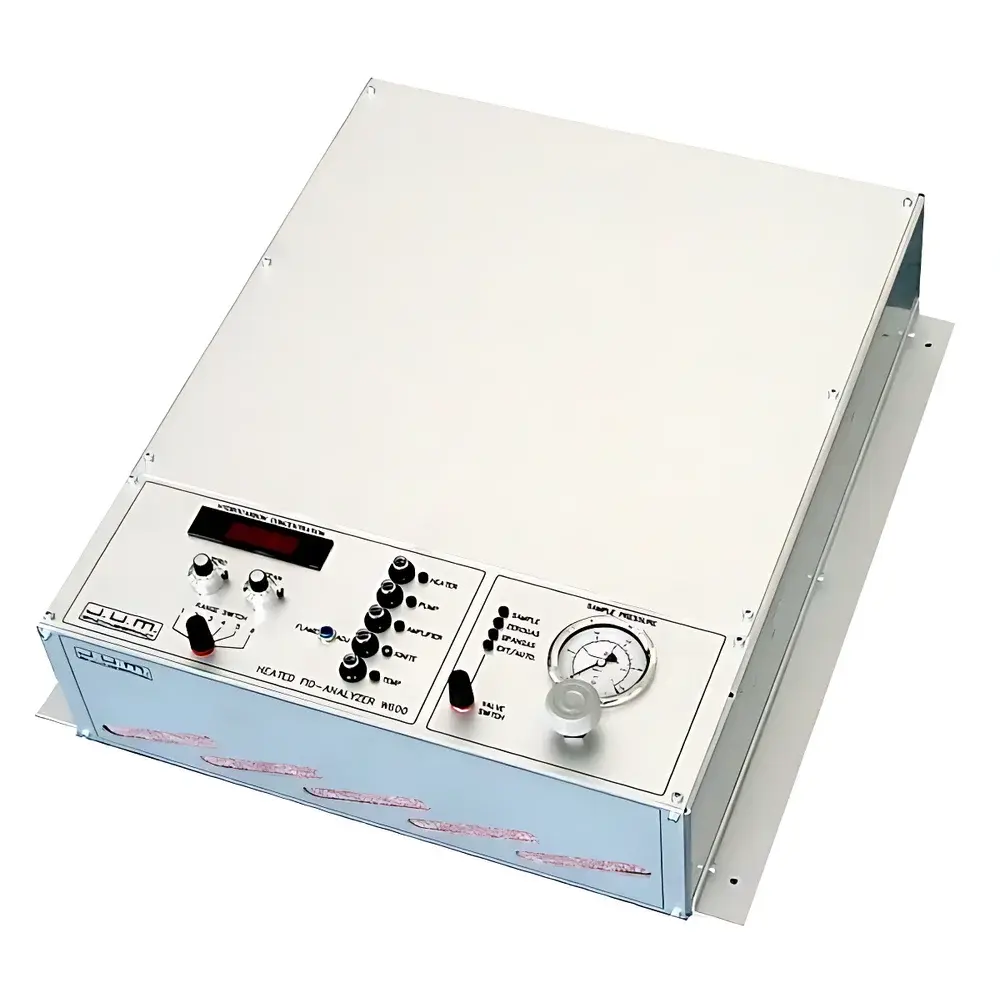
J.U.M. W600 Wall-Mounted Total Hydrocarbon (THC) & VOC Online Analyzer
| Brand | J.U.M. |
|---|---|
| Origin | Germany |
| Model | W600 |
| Instrument Type | Online Analyzer |
| Typical Configuration | TVOC Analyzer |
| Measurement Range | 0–1000 ppm |
| Resolution | 0.1 ppm |
| Accuracy | ±5% of reading |
| Response Time | <60 s |
| Detection Principle | Flame Ionization Detection (FID) |
| Full-Scale Sensitivity (CH₄) | 1 ppm |
| Heating Chamber Temperature | 190 °C |
| Dimensions (W×D×H) | 483 mm × 600 mm × 132 mm |
| Carrier/Air Supply | Integrated zero-air generator |
| Compliance | BImSchV 2nd, 13th & 17th Ordinances (Germany), EN 12619, EN 13526, EPA Method 25A, EPA Method 503 |
Overview
The J.U.M. W600 is a wall-mounted, high-temperature online total hydrocarbon (THC) and volatile organic compounds (VOC) analyzer engineered for continuous, real-time measurement in demanding industrial and regulatory emission monitoring applications. Based on flame ionization detection (FID) — the reference method for hydrocarbon quantification per EN 12619 and EPA Method 25A — the W600 delivers robust, interference-resistant detection of non-methane hydrocarbons (NMHC) and total gaseous organics across a wide dynamic range. Its heated sample path (190 °C) prevents condensation and adsorption losses, ensuring quantitative recovery of higher-boiling-point VOCs (e.g., C₆–C₁₂ aromatics, ketones, esters) that are prone to wall loss in unheated systems. Designed for permanent installation in space-constrained enclosures — including Z-purged cabinets for hazardous area compliance — the W600 integrates an internal zero-air supply, eliminating dependency on external compressed air sources and reducing system complexity and maintenance overhead.
Key Features
- True FID-based detection with CH₄-equivalent full-scale sensitivity down to 1 ppm, traceable to NIST-traceable calibration gases
- Heated measurement chamber maintained at 190 °C to prevent condensation, adsorption, or catalytic decomposition of reactive VOCs
- Compact 19-inch rack-mountable chassis (483 mm × 600 mm × 132 mm) optimized for wall mounting in control rooms, analyzer shelters, or purged enclosures
- Integrated zero-air generator with catalytic scrubbing and desiccant filtration, eliminating need for external air supply infrastructure
- Multi-range capability: factory-configurable full-scale ranges include 0–10, 0–100, 0–1,000, 0–10,000, and 0–100,000 ppm (as methane or propane equivalent)
- Response time ≤60 seconds (T₉₀) for all calibrated ranges; intrinsic detector response <0.2 s ensures minimal lag in transient emission events
- CE-marked and compliant with EMC Directive 2014/30/EU and Low Voltage Directive 2014/35/EU
Sample Compatibility & Compliance
The W600 is validated for direct analysis of hot, humid, and particulate-laden sample streams from stack ducts, process vents, and catalytic reactor effluents without external conditioning — provided inlet temperature remains below 200 °C and particulate loading is <1 mg/m³. It meets the technical requirements of German TA Luft and BImSchV regulations (2nd, 13th, and 17th Ordinances) for continuous emission monitoring systems (CEMS) used in waste incineration, chemical production, and coating facilities. Its design conforms to EN 12619 (automated FID analyzers for flue gas) and EN 13526 (performance criteria for VOC analyzers), and supports U.S. EPA Method 25A equivalency verification under 40 CFR Part 60 Appendix A. For regulated environments operating under GLP or 21 CFR Part 11, optional audit trail logging and user-access control firmware modules are available upon request.
Software & Data Management
The W600 operates with embedded firmware supporting Modbus RTU/TCP, analog 4–20 mA outputs (isolated, HART-enabled), and optional Ethernet/IP or Profibus DP interfaces. Local configuration and diagnostics are accessible via front-panel keypad and LCD display or remotely through a secure web interface (HTTPS) with role-based authentication. All measurement data, calibration logs, alarm events, and system diagnostics are timestamped and stored internally for ≥30 days. Data export is supported in CSV format via USB port or network transfer. Optional PC-based J.U.M. AnalyzeSuite software provides automated calibration scheduling, trend visualization, report generation (PDF/Excel), and alignment with EN 14181 QAL2/QAL3 validation protocols.
Applications
- Continuous emission monitoring (CEM) of THC/VOC from industrial stacks per EU IED and U.S. NSPS requirements
- Real-time monitoring of hydrocarbon slip in catalytic oxidizers, thermal oxidizers, and regenerative thermal oxidizers (RTOs)
- Process gas analysis in solvent recovery units, particularly for LEL (lower explosive limit) safety interlock support
- In-line monitoring of purge gas purity in semiconductor cleanroom nitrogen and ultra-high-purity (UHP) gas distribution systems
- Engine exhaust testing and combustion efficiency evaluation in R&D labs and certification facilities
- Monitoring of activated carbon bed breakthrough during VOC abatement operations
- Trace-level hydrocarbon contamination detection in medical oxygen, breathing air, and inert carrier gases
FAQ
Is the W600 certified for use in Zone 1 hazardous areas?
No — the standard W600 is rated for non-hazardous (Zone 2 or non-classified) environments. For Zone 1 installation, a custom ATEX/IECEx-certified variant with explosion-proof housing and intrinsically safe signal interfaces must be specified at order stage.
Can the W600 measure individual VOC species, or only total hydrocarbons?
The W600 is a non-speciated FID-based total hydrocarbon analyzer. It reports summed response as methane or propane equivalents. Speciation requires GC-FID or GC-MS coupling, which is outside its scope.
What maintenance intervals are recommended for routine operation?
Monthly zero/span verification using certified calibration gases is required. FID jet cleaning and detector electrode inspection are recommended every 6 months; burner assembly replacement is typically needed every 18–24 months under continuous operation.
Does the W600 support automatic zero calibration?
Yes — when integrated with the optional zero-air generator and programmable calibration sequence module, it performs fully automated zero and span checks at user-defined intervals (e.g., every 2, 4, or 24 hours).
How is data integrity ensured for regulatory reporting?
All calibrations, alarms, and configuration changes are logged with UTC timestamps and operator ID. Optional firmware enables electronic signatures, audit trails, and data encryption compliant with FDA 21 CFR Part 11 Annex 11 requirements.
Related Products







