
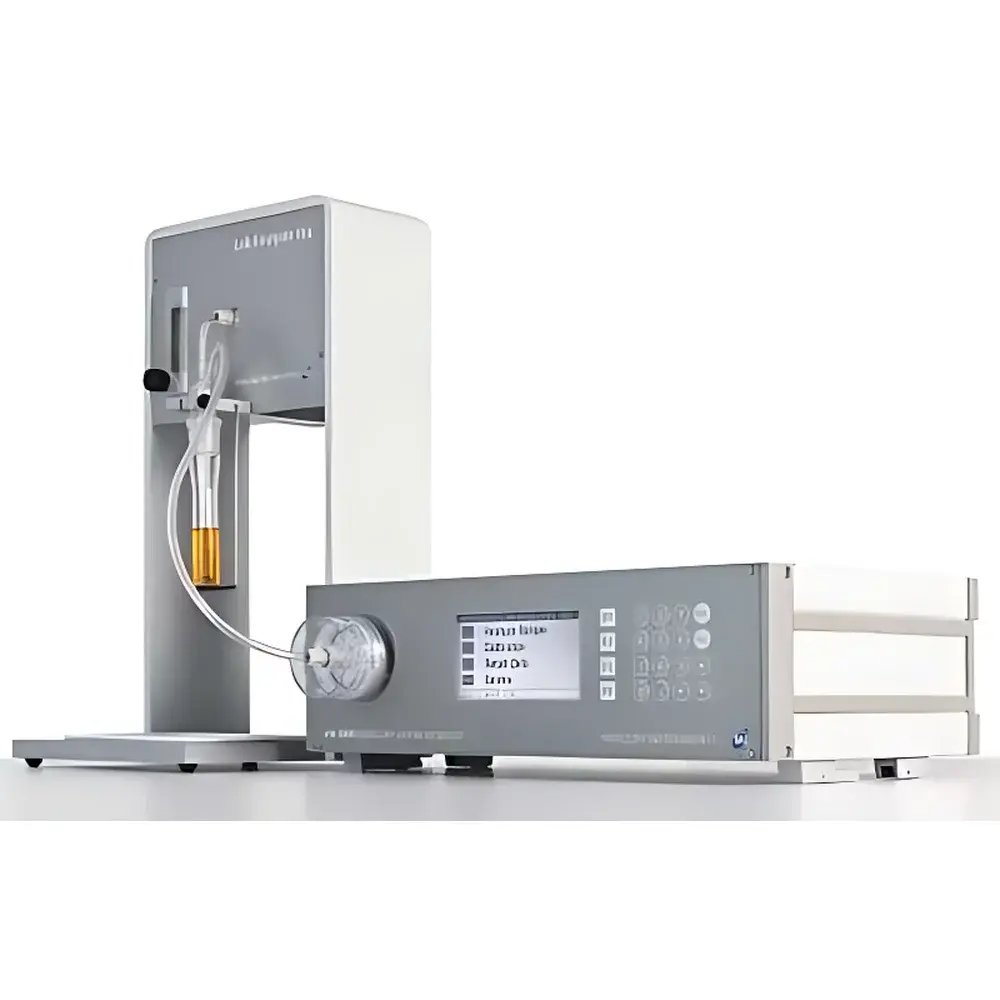
Mercury Instruments LabAnalyzer 254 Cold Vapor Atomic Absorption Mercury Analyzer
| Brand | Mercury Instruments |
|---|---|
| Origin | Germany |
| Model | LabAnalyzer 254 |
| Instrument Type | Benchtop Laboratory Analyzer |
| Measurement Principle | Cold Vapor Atomic Absorption Spectrometry (CVAAS) |
| Wavelength | 254 nm |
| Detection Limit | ≤0.1 µg/L |
| Repeatability | ≤1.0% RSD |
| Linearity Error | ±1.0% |
| Sample Volume | 2–10 mL |
| UV Source | Electrodeless Discharge Lamp (EDL), temperature-stabilized |
| Detector | Temperature-controlled UV-enhanced silicon photodiode |
| Optical Cell | Fused quartz, 23 cm path length, heated to 70 °C |
| Flow Rate | 30 L/h (adjustable) |
| Pump | Long-life diaphragm pump |
| Sensitivity | 5 ng/L (0.05 ng absolute) |
| Linear Range | 0.01–10 µg/L (10 ppt–10 ppb) for 10 mL sample |
| Output Interfaces | 4–20 mA analog, USB/RS-232, parallel printer port |
| Power Supply | 230 VAC, 50–60 Hz (optional 115 VAC) |
| Power Consumption | 35 W |
| Dimensions (main unit) | 45 × 15 × 35 cm (W × H × D) |
| Optical Module | 24 × 48 × 27 cm (W × H × D) |
| Footprint Requirement | ~70 × 50 cm (W × D) |
| Weight | ~10 kg |
| Compliance | DIN 38406-12, EPA Method 7470A & 7471A |
Overview
The Mercury Instruments LabAnalyzer 254 is a benchtop cold vapor atomic absorption spectrometer (CVAAS) engineered for rapid, precise, and trace-level quantification of total mercury in liquid matrices. It operates on the fundamental principle of atomic absorption spectroscopy at the resonant wavelength of 254 nm—where mercury atoms in the vapor phase exhibit maximum absorbance. Following chemical reduction (typically with SnCl₂ or NaBH₄), dissolved Hg²⁺ is converted to elemental mercury vapor, swept by a controlled argon or air stream into a temperature-stabilized fused quartz optical cell. The dual-beam optical architecture—featuring a reference channel—ensures long-term signal stability and minimizes drift from lamp intensity fluctuations or ambient thermal effects. Designed for compliance-driven laboratories, the system meets the performance criteria of DIN 38406-12 (German standard for water analysis), U.S. EPA Methods 7470A and 7471A, and supports GLP/GMP-aligned workflows through audit-trail-capable data handling.
Key Features
- Electrodeless discharge lamp (EDL) operating at 254 nm, thermally stabilized for spectral purity and extended lifetime
- Temperature-controlled fused quartz absorption cell (23 cm path length, maintained at 70 °C) to prevent mercury condensation and ensure consistent vapor-phase residence time
- High-sensitivity silicon photodiode detector with UV-enhanced quantum efficiency and active thermal regulation
- Integrated long-life diaphragm pump with adjustable gas flow (30 L/h, ±5%) for reproducible vapor transport kinetics
- Real-time LCD display showing dynamic absorption signal curve, peak amplitude, and calibrated concentration output
- Automatic data logging with timestamped measurement records—including baseline, peak, integration area, and RSD calculation per run
- Dual analog (4–20 mA) and digital (USB/RS-232) outputs for seamless integration into LIMS or SCADA systems
- Onboard memory stores ≥1,000 measurement results; optional export via USB or direct thermal printing
Sample Compatibility & Compliance
The LabAnalyzer 254 accepts aqueous samples directly or post-digestion solutions from solid matrices—including drinking water, wastewater, groundwater, seawater, soil leachates, sediment extracts, clinical specimens (urine, saliva), and industrial process streams (e.g., flue gas scrubber liquors per VDI 3868-2 VE). It accommodates sample volumes between 2 and 10 mL, enabling flexible dilution strategies for high-concentration samples (up to 100 mg/L upper range with internal dilution). All operational parameters—including lamp current, cell temperature, flow rate, and integration time—are user-accessible and lockable to support method validation. The instrument’s design and performance documentation align with ISO/IEC 17025 requirements for testing laboratories, and its data integrity features—including electronic signatures, audit trails, and non-editable raw signal archives—facilitate FDA 21 CFR Part 11 readiness when deployed in regulated environments.
Software & Data Management
While the LabAnalyzer 254 operates autonomously via its embedded firmware, it provides full bidirectional communication via RS-232 or USB. Third-party software (e.g., Mercury Instruments’ optional LabControl Suite) enables remote configuration, batch method scheduling, calibration curve management (linear and quadratic), and automated report generation compliant with ISO 17025 Annex A.5. All measurements include metadata: date/time stamp, operator ID (if entered), sample ID, method version, and environmental parameters (ambient temperature, pressure if externally sensed). Raw absorbance vs. time profiles are retained alongside processed results, supporting retrospective re-evaluation without reanalysis. Export formats include CSV (for Excel/Statistica), XML (for LIMS ingestion), and PDF (for QA sign-off).
Applications
This analyzer serves as a primary tool in environmental monitoring labs assessing mercury contamination across regulatory frameworks (EU Water Framework Directive, U.S. Clean Water Act). It is routinely deployed in municipal water treatment QC, hazardous waste characterization (RCRA TCLP compliance), geochemical surveying (soil and sediment core analysis), and emissions control verification (coal-fired power plant scrubber effluents). In industrial settings, it supports catalyst monitoring in petrochemical refining, quality assurance in pharmaceutical excipient testing, and occupational health surveillance (urinary mercury screening per OSHA/NIOSH guidelines). Its speed (<100 s per analysis including purge) and low solvent consumption (no organic solvents required) make it especially suitable for high-throughput routine labs where turnaround time and reagent cost are critical constraints.
FAQ
What sample preparation is required prior to analysis?
Liquid samples may be analyzed directly after acidification (e.g., 5% v/v HNO₃) and filtration (0.45 µm). Solid samples require microwave-assisted or hot-block digestion using HNO₃/H₂SO₄/HClO₄ mixtures per EPA 7471A or ISO 12846. No derivatization or extraction is needed.
Can the LabAnalyzer 254 measure methylmercury or other organomercury species?
No—it quantifies total mercury only. Speciation requires coupling with HPLC-ICP-MS or GC-CVAFS. However, total Hg data serve as essential input for speciation method validation and mass balance calculations.
Is the instrument compatible with continuous monitoring setups?
Yes. Its 4–20 mA analog output and programmable trigger interface allow integration into continuous emission monitoring systems (CEMS), particularly when paired with the VM-3000 mercury vapor monitor for ambient air or stack gas applications.
How often does the optical cell require cleaning or maintenance?
Under normal operation with filtered, digested samples, the fused quartz cell requires inspection every 500 analyses and cleaning only if visible deposits accumulate—typically with dilute HNO₃ followed by ultrapure water rinse. No lamp alignment or optical recalibration is necessary due to the fixed dual-beam geometry.
Does the system support multi-point calibration and drift correction?
Yes. Up to six calibration standards can be defined per method, with automatic zero-check before each sequence. Drift compensation is applied using the reference beam signal in real time, eliminating need for frequent recalibration during extended runs.




