
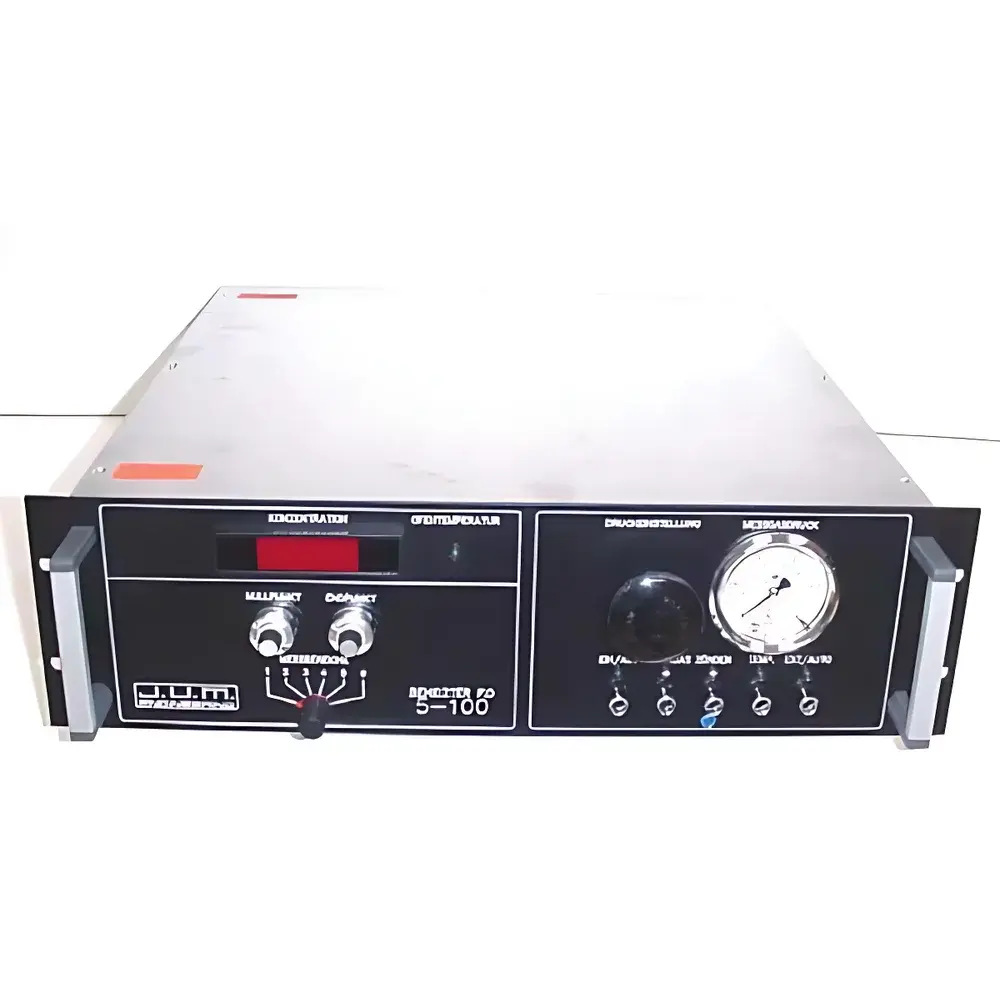
J.U.M. 5-100 Rack-Mounted Pressurized Gas Total Hydrocarbons Analyzer with FID
| Brand | J.U.M. |
|---|---|
| Origin | Germany |
| Model | 5-100 |
| Detection Principle | Flame Ionization Detection (FID) |
| Instrument Type | Online Analyzer |
| Configuration | TVOC Analyzer |
| Measurement Range | 0–1000 ppm |
| Resolution | 0.1 ppm |
| Accuracy | ±5% of reading |
| Response Time | <60 s |
| Detector Sensitivity | 1 ppm full-scale for CH₄ |
| Oven Temperature | 190 °C |
| Carrier/Combustion Air | Integrated air supply |
Overview
The J.U.M. 5-100 Rack-Mounted Pressurized Gas Total Hydrocarbons Analyzer is an engineered solution for continuous, quantitative measurement of total hydrocarbon content—including methane and higher aliphatic/aromatic VOCs—in pressurized industrial gas streams. Designed specifically for ultra-high-purity applications, it employs a flame ionization detector (FID) operating under precisely controlled thermal conditions. Unlike ambient-temperature or unheated sampling systems, the 5-100 integrates J.U.M.’s proprietary heated sample path architecture, maintaining the entire gas pathway—including transfer lines, valves, and detector chamber—at a constant 190 °C. This eliminates condensation of high-boiling-point hydrocarbons (e.g., C₆+ alkanes, xylenes, styrene), ensuring representative sampling and metrological integrity across the full dynamic range. The analyzer conforms to fundamental principles of quantitative gas-phase hydrocarbon analysis as defined in ASTM D1946 (Standard Test Method for Analysis of Natural Gas by Gas Chromatography) and ISO 8573-5 (Compressed air — Part 5: Test methods for oil content), though operated as a non-separative total hydrocarbon monitor rather than a speciated GC system.
Key Features
- Rack-mount 19-inch chassis (4U height) compliant with EN 60297-3-100 for integration into centralized control cabinets or analytical shelters
- FID detector with optimized hydrogen–air stoichiometry and low-noise electrometer circuitry, delivering stable baseline and linear response from 0.1 ppm to 1000 ppm (as CH₄-equivalent)
- Full-path heating at 190 °C, including sample inlet, flow regulators, and detector housing—preventing adsorption, condensation, or memory effects common in trace-level hydrocarbon analysis
- Integrated zero-air generator and pressure-regulated combustion air supply, eliminating dependency on external compressed air sources and reducing calibration drift
- Modular flow control architecture supporting inlet pressures up to 10 bar(g), compatible with process gas headers without external pressure reduction
- Self-diagnostic firmware with real-time monitoring of flame status, oven temperature deviation, FID bias voltage, and signal-to-noise ratio
Sample Compatibility & Compliance
The 5-100 is validated for direct analysis of pressurized, dry, non-corrosive carrier gases including nitrogen (N₂), oxygen (O₂), argon (Ar), helium (He), carbon dioxide (CO₂), and synthetic air. It is not intended for use with hydrogen-rich, halogenated, sulfur-containing, or highly reactive matrices (e.g., Cl₂, NH₃, H₂S) without prior consultation and optional hardware modifications. The instrument meets electromagnetic compatibility requirements per EN 61326-1 (industrial environment) and safety standards per EN 61010-1. Its design supports compliance with Good Manufacturing Practice (GMP) environments when deployed with audit-trail-enabled software (see Software & Data Management). While not certified as SIL-rated, its architecture enables integration into safety-instrumented systems (SIS) via 4–20 mA analog output and discrete alarm relays.
Software & Data Management
The analyzer operates with J.U.M.’s PC-based Analytical Control Suite (ACS v3.2+), providing configuration, calibration management, trend logging, and report generation. All user actions—including zero/span adjustments, parameter changes, and system resets—are timestamped and logged with operator ID (when integrated with domain authentication). Data export complies with ASTM E1382 (Standard Guide for Computerized Data Acquisition in Analytical Chemistry) and supports CSV, XML, and OPC UA protocols. Optional 21 CFR Part 11 compliance packages include electronic signatures, role-based access control, and immutable audit trails—suitable for regulated pharmaceutical, semiconductor, and specialty gas manufacturing facilities requiring GLP/GMP documentation.
Applications
- Monitoring residual hydrocarbons in bulk ultra-high-purity (UHP) gases supplied to semiconductor fab tooling (e.g., etch, CVD, ALD chambers)
- Validation of hydrocarbon removal efficiency in activated carbon beds and catalytic purifiers used in gas purification skids
- In-line verification of hydrocarbon contamination during regeneration cycles of cryogenic air separation units
- Trace-level hydrocarbon surveillance in inert blanketing gas networks for lithium-ion battery electrode drying ovens
- Periodic verification of hydrocarbon carryover in high-pressure CO₂ streams used in supercritical fluid extraction (SFE) systems
- Real-time feedback control for thermal desorption units in environmental air monitoring stations
FAQ
Does the 5-100 require external hydrogen supply?
No. The analyzer uses ambient air as the combustion oxidant; hydrogen is not required. Only compressed instrument air (or built-in air generator) and electrical power are needed.
Can it measure individual VOC species?
No. The 5-100 is a total hydrocarbon analyzer (THC) based on FID response. It reports sum concentration as methane-equivalent (ppm C₁); speciation requires GC-FID or GC-MS coupling.
What maintenance intervals are recommended?
FID nozzle cleaning every 6 months; annual verification of oven temperature uniformity and detector linearity using certified CH₄ standards.
Is remote diagnostics supported?
Yes—via Ethernet interface with Modbus TCP and SNMPv3 support; secure remote access requires firewall-configured VLAN segmentation.
How is calibration traceability established?
Using NIST-traceable methane-in-nitrogen standards (e.g., Scott-Marrin, Air Liquide); certificate of analysis must accompany each calibration gas cylinder.
Related Products







