
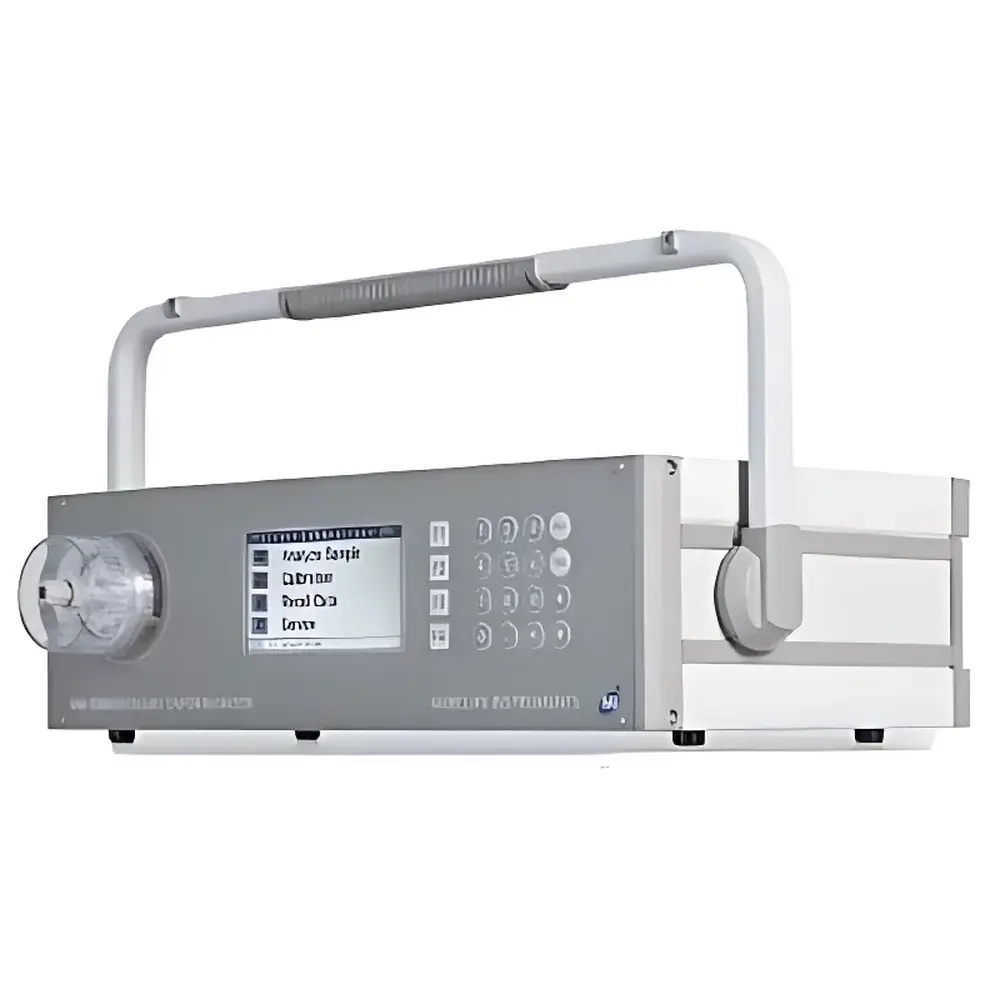
Mercury Instruments VM-3000 Portable Mercury Vapor Analyzer
| Brand | Mercury Instruments |
|---|---|
| Origin | Germany |
| Model | VM-3000 |
| Instrument Type | Portable |
| Measurement Principle | Cold Vapor Atomic Absorption (CVAAS) |
| Detection Limit | ≤ 0.1 µg/m³ |
| Repeatability | ≤ 1.0% (CVAAS) |
| Linearity Error | ±1% (CVAAS) |
| Wavelength | 253.7 nm |
| UV Source | Electrodeless Low-Pressure Mercury Lamp (EDL) |
| Measurement Cell | Heated Fused Silica |
| Response Time (99%) | < 1 s |
| Measuring Ranges | Range I: 0.1–100 µg/m³ (0.01–10 ppb) |
| Range II | 0–1000 µg/m³ |
| Range III | 0–2000 µg/m³ (0–200 ppb) |
| Sensitivity | 0.1 µg/m³ (0.01 ppb) |
| Alarm | 3-Level Programmable + Status Alarms (Cell Soiling, UV Lamp Exhaustion, Battery Level) |
| Display | Graphical LCD with Backlight |
| Outputs | 4–20 mA, RS-232, Optional Data Logger |
| Power | External 12 V DC or Integrated 12 V Rechargeable Battery (≈5 h runtime) |
Overview
The Mercury Instruments VM-3000 is a field-deployable, real-time mercury vapor analyzer engineered for high-fidelity quantification of elemental mercury (Hg⁰) in ambient air and process gas streams. It operates on the principle of Cold Vapor Atomic Absorption Spectroscopy (CVAAS), utilizing a narrow-band, high-stability ultraviolet light source at the resonant absorption wavelength of atomic mercury (253.7 nm). Unlike broad-spectrum UV sources, the electrodeless low-pressure mercury lamp (EDL) delivers spectral purity essential for minimizing interferences from ozone, hydrocarbons, or particulate scattering—ensuring robust specificity in complex industrial or environmental matrices. The heated fused silica measurement cell prevents condensation of moisture or volatile organics, maintaining optical path integrity across variable humidity and temperature conditions. With a sub-second response time (<1 s to 99% signal), continuous real-time output, and detection capability down to 0.1 µg/m³ (0.01 ppb), the VM-3000 meets the performance requirements for occupational exposure monitoring (OEL compliance), stack emission verification, and rapid site screening per ISO 6879, ASTM D6784-22, and EU Directive 2010/75/EU (IED).
Key Features
- Stabilized EDL UV source with dual-beam reference feedback control, eliminating drift and enabling long-term baseline stability without daily recalibration.
- Heated optical path (fused silica cell) actively maintained above dew point to prevent condensation-induced signal attenuation or contamination buildup.
- Three user-selectable measurement ranges (0.1–100, 0–1000, and 0–2000 µg/m³), each optimized for dynamic range and noise floor—supporting both trace-level workplace monitoring and high-concentration leak detection.
- Integrated status diagnostics: automatic alerts for optical window soiling, UV lamp end-of-life, battery depletion, and flow path obstruction—enabling predictive maintenance and audit-ready operational logging.
- Rugged aluminum housing with ergonomic handle and optional 19″ rack-mount kit, rated IP54 for field use in industrial environments including refineries, chlor-alkali plants, and waste treatment facilities.
- Factory-calibrated optical and electronic subsystems; calibration traceability documented to NIST-traceable Hg permeation standards; optional annual factory recalibration service available with full certificate of conformance.
Sample Compatibility & Compliance
The VM-3000 is designed for direct analysis of undiluted, unfiltered ambient air and inert carrier gases (e.g., N₂, H₂, Ar). It accommodates sample flow rates of 0.5–2.0 L/min via integrated diaphragm pump with >10,000-hour service life. An inline particulate filter (replaceable 0.2 µm PTFE membrane) protects the optical cell while introducing negligible pressure drop. The instrument complies with key regulatory frameworks governing mercury monitoring: it satisfies the analytical performance criteria outlined in EN 14181 (QAL1/QAL2), supports GLP-compliant data acquisition under FDA 21 CFR Part 11 when paired with validated data logger firmware, and aligns with US EPA Method 101A and ISO 6879 for fixed and mobile source testing. Its linear response (±1% error over full scale) and repeatability (≤1.0% RSD) meet QA/QC thresholds required for reporting to national emission inventories (e.g., UNECE LRTAP, US TRI).
Software & Data Management
Data acquisition and configuration are managed via the embedded graphical LCD interface with intuitive menu navigation and real-time trend plotting. All measurements are timestamped and stored internally (non-volatile memory, 10,000+ records). Analog 4–20 mA output enables seamless integration into DCS/SCADA systems for continuous emissions monitoring (CEMS). RS-232 serial communication supports bidirectional command protocol for remote configuration, zero/span verification, and bulk data export to CSV or Excel-compatible formats. Optional data logger firmware adds configurable sampling intervals (1 s to 60 min), alarm-triggered event capture, and encrypted SD card storage compliant with ISO/IEC 27001 data integrity guidelines. Audit trails—including operator ID, calibration events, and system diagnostics—are retained for ≥12 months and exportable for regulatory review.
Applications
- Occupational hygiene monitoring in chlor-alkali electrolysis cells, dental laboratories, and fluorescent lamp recycling facilities.
- Continuous stack emission monitoring for coal-fired power plants, municipal solid waste incinerators, and cement kilns subject to MATS or IED permit limits.
- Rapid reconnaissance of contaminated brownfield sites, former mining areas, and mercury-amalgam processing zones using walkover survey mode.
- In-process quality control of high-purity hydrogen, nitrogen, and argon used in semiconductor manufacturing and pharmaceutical synthesis.
- Validation of mercury removal efficiency in activated carbon or sulfur-impregnated adsorbent beds during pilot-scale testing.
- Field-based research in atmospheric chemistry, including boundary layer Hg⁰ flux studies and validation of passive sampler networks.
FAQ
What is the recommended calibration frequency for routine compliance monitoring?
For GLP/GMP or regulatory reporting applications, a 7-day zero-and-span verification is advised; full multi-point calibration using NIST-traceable permeation tubes is recommended every 3 months or after maintenance events.
Can the VM-3000 measure mercury in flue gas with high moisture or SO₂ content?
Yes—the heated optical path (typically maintained at 50–60°C) prevents water condensation, and the 253.7 nm spectral selectivity ensures minimal interference from SO₂ absorption bands (which peak >280 nm). For high-SO₂ streams (>500 ppm), optional catalytic scrubbers are available to remove oxidizing species upstream.
Is the instrument suitable for unattended long-term deployment?
With the integrated 12 V battery option (5 h runtime) or external DC supply, and optional solar-charged power kits, the VM-3000 supports autonomous operation for up to 30 days when configured with 1-min averaging and SD-card logging.
Does the VM-3000 support remote diagnostics and firmware updates?
Yes—via RS-232 or optional Ethernet/WiFi module, users can initiate self-tests, retrieve diagnostic logs, and apply certified firmware patches remotely without physical access.
How is measurement traceability documented for audit purposes?
Each unit ships with a Certificate of Calibration referencing NIST SRM 2670a (Mercury Permeation Standard), including uncertainty budget (k=2), linearity verification data, and zero stability test results over 24 h.





