
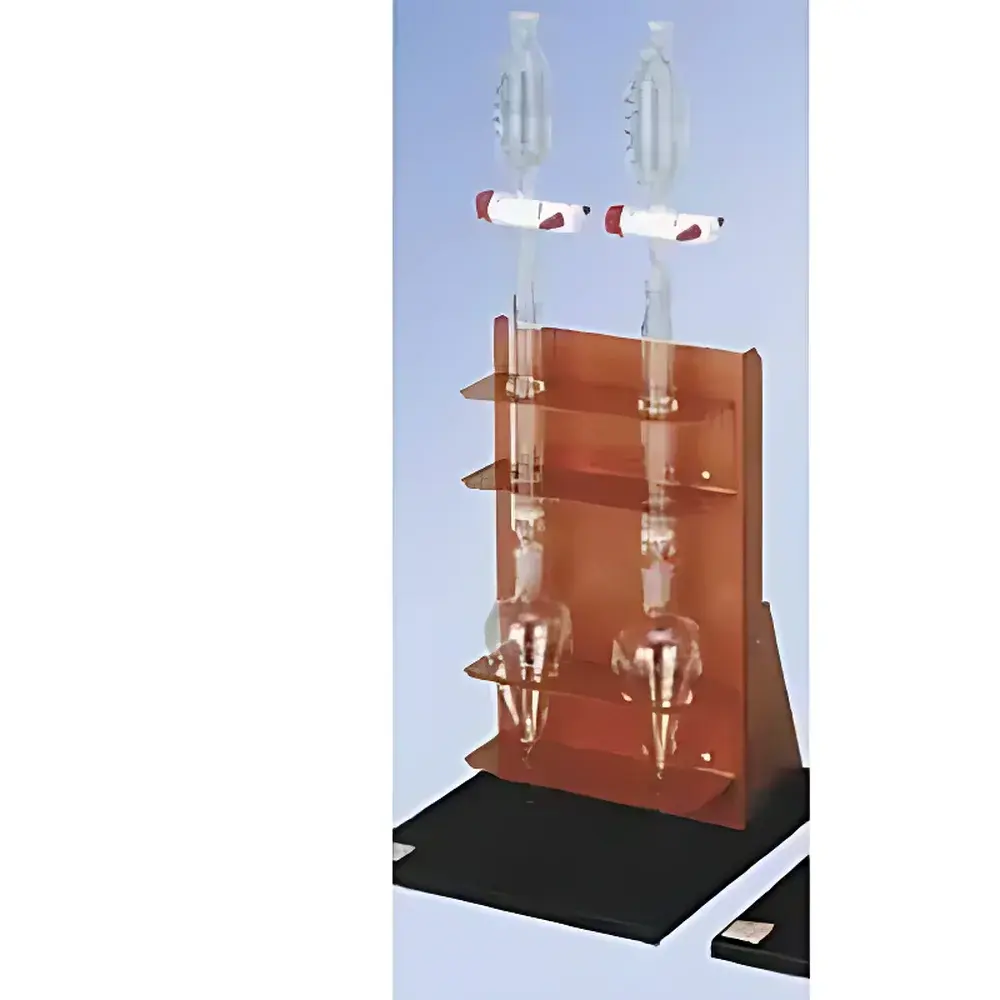
Behr CUS 2 Fat Extraction and Cleanup System
| Origin | Germany |
|---|---|
| Manufacturer Type | Authorized Distributor |
| Origin Category | Imported |
| Model | Behr CUS 2 |
| Pricing | Available Upon Request |
| Material | Borosilicate Glass (Compliant with ISO 9377-2) |
| Configuration | Dual-Column Parallel Setup |
| Weight | ~3 kg |
| Dimensions (W×D×H) | ~23 × 27 × 50 cm |
| Included Components | Support Stand, Two 100 mL Graduated Collection Flasks, Two Purification Columns (Part No. 2804800203), Two Dropping Funnels, Two Kuderna-Danish Concentration Vessels |
Overview
The Behr CUS 2 Fat Extraction and Cleanup System is a precision-engineered, dual-channel laboratory apparatus designed for the quantitative isolation, purification, and concentration of lipids and fat-soluble analytes from complex solid or semi-solid matrices—primarily in food, feed, environmental, and agricultural testing laboratories. Based on the principle of continuous liquid–liquid extraction combined with gravity-driven column chromatography, the CUS 2 implements a standardized cleanup workflow aligned with ISO 9377-2:2020 (“Water quality — Determination of hydrocarbons — Part 2: Method using gas chromatography after liquid–liquid extraction and clean-up”), as well as complementary protocols referenced in AOAC Official Methods 991.36 and EN 15569-1. Its all-borosilicate-glass construction ensures chemical inertness, thermal stability, and full traceability—critical for regulatory compliance in GLP- and GMP-aligned environments.
Key Features
- Dual independent purification channels enable simultaneous processing of two samples without cross-contamination or operational overlap—reducing total analysis cycle time by up to 50% compared to single-column systems.
- Full compliance with ISO 9377-2 mechanical and material specifications: all wetted parts are manufactured from Class A borosilicate glass (DIN ISO 3585), including calibrated 100 mL graduated collection flasks, standardized Kuderna-Danish concentrators, and precision-bore purification columns (internal diameter tolerance ±0.15 mm).
- Modular, tool-free assembly: columns integrate via PTFE-tipped ground-glass joints; dropping funnels feature stopcock-controlled flow regulation for reproducible eluent delivery (0.5–3 mL/min typical range).
- Compact footprint (~23 × 27 × 50 cm) and low mass (~3 kg) allow seamless integration into fume hoods or dedicated extraction workstations without structural reinforcement.
- No electrical components or moving parts—ensuring intrinsic safety during solvent-intensive operations involving hexane, petroleum ether, or dichloromethane.
Sample Compatibility & Compliance
The CUS 2 supports a broad range of sample types—including meat, dairy products, fish tissue, soil extracts, sludge digests, and edible oils—provided they undergo prior homogenization and solvent-assisted fat solubilization (e.g., Soxhlet or Randall pre-extraction). Each purification column accommodates standard sorbents such as silica gel, Florisil®, or activated alumina (10–20 g bed mass), enabling selective removal of phospholipids, sterols, pigments, and co-extracted polar interferences. The system meets documentation requirements for ISO/IEC 17025:2017 accredited laboratories when used within validated SOPs, and its passive design inherently satisfies explosion-proof and spark-free operation mandates under ATEX Directive 2014/34/EU for Zone 1/2 solvent handling areas.
Software & Data Management
As a fully manual, non-instrumented purification platform, the CUS 2 does not incorporate embedded electronics, firmware, or proprietary software. All procedural parameters—including solvent volume, elution rate, fraction timing, and column conditioning steps—are recorded manually in laboratory notebooks or LIMS-integrated electronic batch records. This architecture eliminates validation overhead associated with 21 CFR Part 11-compliant audit trails while preserving full analyst control and method transparency—particularly advantageous during regulatory inspections where raw procedural fidelity is prioritized over automated data capture.
Applications
- Preparative cleanup prior to GC-FID or GC-MS analysis of polycyclic aromatic hydrocarbons (PAHs), polychlorinated biphenyls (PCBs), and organochlorine pesticides in food and environmental samples.
- Isolation of total lipid fractions for subsequent fatty acid methyl ester (FAME) profiling per ISO 12966-2.
- Removal of triglyceride interference in vitamin A, D, and E quantification workflows (EN 12822, AOAC 2005.05).
- Standardized fat recovery verification in nutritional labeling compliance (EU Regulation No. 1169/2011, FDA 21 CFR §101.9).
- Method development and reference material certification where operator-defined elution gradients and visual endpoint detection are required.
FAQ
Does the CUS 2 require electrical power or compressed gas?
No—it operates entirely passively using gravity-driven flow and ambient atmospheric pressure.
Can I substitute alternative column packing materials?
Yes, provided the particle size distribution (typically 60–200 mesh), bed height (≤15 cm), and solvent compatibility align with ISO 9377-2 column performance criteria.
Is calibration documentation included with shipment?
Each glass component carries individual DIN-certified volumetric calibration markings; full traceable calibration certificates (DIN EN ISO/IEC 17025) are available upon request at order stage.
What maintenance is required?
Routine cleaning with appropriate solvents (e.g., acetone followed by methanol) and visual inspection for glass integrity or joint wear—no scheduled servicing intervals apply.
Is the CUS 2 compatible with automated fraction collectors?
Not natively; however, the 100 mL graduated flasks may be interfaced with third-party timed fraction collectors via custom mounting brackets (not supplied).
Related Products



