
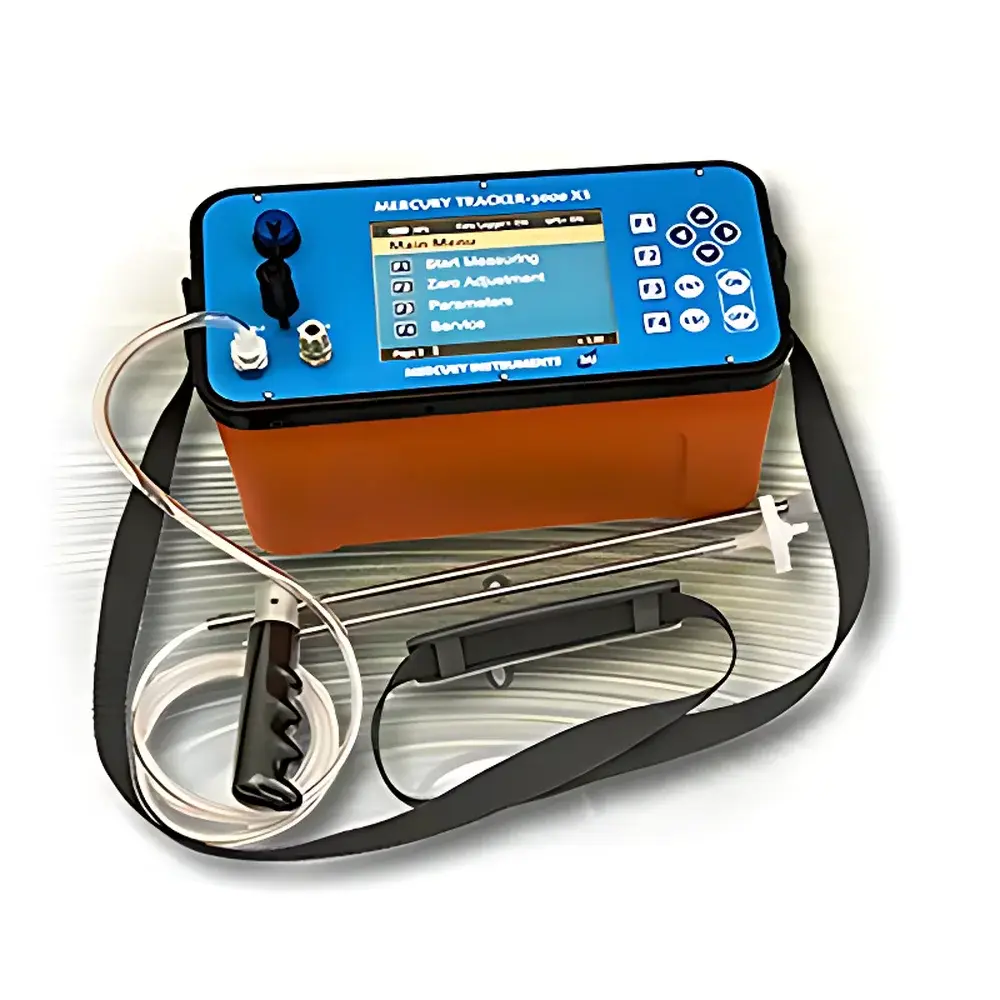
Mercury Instruments Tracker 3000XS Portable Mercury Analyzer
| Brand | Mercury Instruments |
|---|---|
| Origin | Germany |
| Model | 3000XS |
| Instrument Type | Portable |
| Measurement Principle | Cold Vapor Atomic Absorption Spectrometry (CVAAS) |
| Detection Limit | ≤0.1 µg/m³ |
| Repeatability | ≤1.0% |
| Linearity Error | ±1% |
| Wavelength | 253.7 nm |
| Light Source | Electrodeless Discharge Lamp (EDL) |
| Response Time (99% signal) | 1 s |
| Sensitivity | 0.1 µg/m³ (0.01 ppb) |
| Measurement Ranges | 0–100, 0–1000, 0–2000 µg/m³ |
| Data Logger Capacity | 10,000 readings |
| Power Supply | Rechargeable NiMH battery (6 h operation), 12 V DC input, 100–240 V AC (50/60 Hz) |
| Weight | ~5 kg (with battery) |
| Display | Backlit graphical LCD |
| Output Interfaces | USB, RS232, 4–20 mA analog output |
| Housing | Corrosion-resistant ABS with IP65-rated connectors |
| Pump | Maintenance-free diaphragm pump |
| Filter | Integrated particulate filter at probe inlet |
Overview
The Mercury Instruments Tracker 3000XS is a field-deployable, high-precision portable mercury analyzer engineered for real-time quantification of elemental mercury vapor (Hg⁰) in ambient, workplace, and industrial air matrices. It operates on the well-established principle of Cold Vapor Atomic Absorption Spectrometry (CVAAS), leveraging the unique absorption line of mercury at 253.7 nm. A stable, low-pressure electrodeless discharge lamp (EDL) serves as the UV source, while a dual-beam optical architecture—featuring active reference beam feedback control—ensures long-term photometric stability and minimizes drift from thermal or mechanical perturbations. Unlike catalytic conversion-based systems, the Tracker 3000XS measures Hg⁰ directly without chemical pre-treatment, eliminating interferences from reactive mercury species (e.g., Hg²⁺, HgP) unless explicitly converted via optional thermal or chemical reduction modules. Its compact, ruggedized design enables rapid deployment in uncontrolled environments—from underground mining shafts to remediation sites—without reliance on laboratory infrastructure.
Key Features
- Optical platform built around fused silica sample cell with precisely aligned 253.7 nm UV path; factory-calibrated for trace-level stability over extended operational cycles
- Integrated maintenance-free diaphragm pump delivering consistent flow rates across variable backpressure conditions (e.g., filter loading, hose length)
- Ergonomic shoulder harness and detachable probe assembly optimized for single-operator mobility during extended survey protocols
- Backlit graphical LCD display with intuitive menu navigation and real-time trend visualization (concentration vs. time)
- Onboard data logger storing up to 10,000 timestamped readings with metadata (battery level, lamp status, alarm flags)
- Triple-range measurement capability (0–100 / 0–1000 / 0–2000 µg/m³) selectable via instrument firmware; auto-ranging not supported
- Three-tier programmable alarm system with configurable thresholds for contamination detection, lamp end-of-life, and low-battery warning
- IP65-rated electrical interfaces and corrosion-resistant ABS housing rated for continuous use in humid, saline, or chemically aggressive atmospheres
Sample Compatibility & Compliance
The Tracker 3000XS is validated for direct analysis of undiluted ambient air, stack effluents (post-particulate filtration), and indoor workplace air. It complies with ISO 6879:2021 (ambient air quality—determination of mercury by atomic absorption spectrometry) and supports method development aligned with US EPA Method 101A and ASTM D6784-22 (Standard Test Method for Elemental, Oxidized, Particle-Bound, and Total Mercury in Flue Gas). While the instrument itself does not perform speciation, its CVAAS architecture ensures selectivity for Hg⁰ under standard operating conditions. Particulate matter is removed upstream via an integrated sintered stainless-steel filter (pore size: 5 µm), preventing optical window fouling and extending calibration interval validity. The system meets IEC 61326-1:2013 requirements for electromagnetic compatibility in industrial environments and carries CE marking per EU Directive 2014/30/EU (EMC) and 2014/35/EU (LVD).
Software & Data Management
Data export is supported via USB mass storage mode or RS232 serial protocol (ASCII format), enabling seamless integration with LIMS or custom QA/QC workflows. Firmware v3.2+ includes GLP-compliant audit trail functionality: each stored reading contains embedded timestamps, operator ID fields (configurable), and event logs for lamp ignition cycles, zero/span checks, and battery voltage history. Raw absorbance values (not just concentration) are accessible for secondary validation. No proprietary software installation is required for basic data retrieval; however, Mercury Instruments provides optional PC-based MercuryView Suite (v2.4) for spectral diagnostics, multi-instrument fleet management, and automated report generation compliant with 21 CFR Part 11 Annex 11 requirements (electronic signatures, role-based access control, immutable log archives).
Applications
- Occupational hygiene monitoring in chlor-alkali plants, dental clinics, fluorescent lamp recycling facilities, and gold amalgamation sites
- Rapid leak detection and source identification during mercury spill response and contaminated site characterization (e.g., former industrial brownfields, coal-fired power plant perimeters)
- Compliance verification for OSHA PEL (0.1 mg/m³) and ACGIH TLV-TWA (0.025 mg/m³) exposure limits
- Long-term ambient air quality surveys near artisanal and small-scale gold mining (ASGM) zones
- Validation of mercury control technologies (e.g., activated carbon injection, catalytic oxidation units) via upstream/downstream paired measurements
- Field calibration transfer for fixed-site continuous emission monitoring systems (CEMS)
FAQ
Does the Tracker 3000XS require daily calibration?
No. Factory calibration remains stable for ≥3 months under typical field use. A two-point verification (zero air + certified span gas) is recommended before each survey day per ISO 6879:2021 Section 8.2.
Can it measure oxidized mercury (Hg²⁺) or particulate-bound mercury?
Not directly. The CVAAS configuration detects only elemental Hg⁰. For total gaseous mercury (TGM), a thermal converter (optional accessory) must be installed upstream to reduce Hg²⁺ prior to analysis.
What maintenance intervals apply to the optical cell and EDL lamp?
The fused silica cell requires no routine cleaning if operated with the integrated filter; lamp lifetime exceeds 5,000 hours. Both components are user-replaceable using standard Torx tools—no optical realignment needed.
Is the data logger compliant with FDA 21 CFR Part 11?
The onboard logger meets ALCOA+ principles (Attributable, Legible, Contemporaneous, Original, Accurate); full Part 11 compliance requires MercuryView Suite with enabled electronic signature and audit trail modules.
How does temperature/humidity affect measurement accuracy?
The instrument incorporates internal temperature compensation algorithms per NIST SP 800-142. Relative humidity >90% may cause condensation in the sample line—use of a Nafion dryer (optional) is advised for prolonged high-moisture operation.
Related Products




