
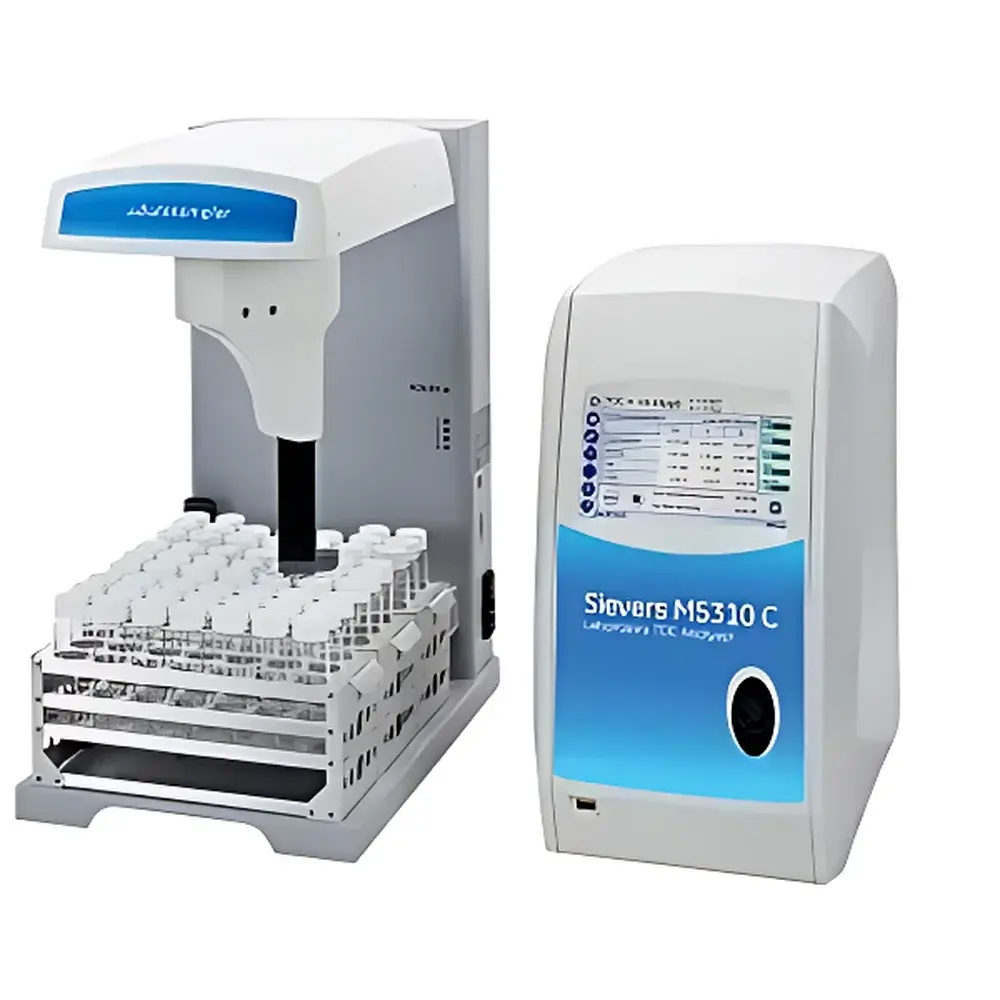
Sievers M5310C Laboratory Total Organic Carbon (TOC) Analyzer
| Brand | Sievers (Veolia) |
|---|---|
| Origin | USA |
| Model | M5310C |
| Instrument Type | Laboratory TOC Analyzer |
| Detection Principle | Membrane Conductivity Detection |
| Oxidation Method | UV/Persulfate Oxidation |
| Measurement Range | 4 ppb – 50 ppm |
| Accuracy | ±2% or ±0.5 ppb (whichever is greater) |
| Resolution | 0.01 ppb |
| Detection Limit | 4 ppb |
| Repeatability | ≤1% RSD |
| Analysis Time | 2 minutes |
| Calibration Interval | 12 months |
| Regulatory Compliance | US EPA Method 415.3 & Standard Methods 5310 C |
Overview
The Sievers M5310C Laboratory Total Organic Carbon (TOC) Analyzer is a high-precision, regulatory-compliant instrument engineered for routine and validation-critical TOC analysis in drinking water, purified water, and pharmaceutical process water applications. It employs a robust two-stage oxidation strategy—combined ultraviolet (UV) light and sodium persulfate—to quantitatively convert non-purgeable organic carbon (NPOC) into carbon dioxide. The resulting CO₂ is selectively stripped from the aqueous matrix and measured via proprietary membrane conductivity detection—a method offering inherent selectivity, minimal reagent consumption, and immunity to ionic interferences common in conductometric direct measurement. Designed specifically for compliance-driven environments, the M5310C delivers trace-level sensitivity down to 4 ppb with sub-part-per-trillion resolution (0.01 ppb), enabling reliable monitoring of low-TOC source waters and ultra-pure process streams where organic contamination poses microbiological or chemical stability risks.
Key Features
- Regulatory-validated detection architecture compliant with US EPA Method 415.3 and Standard Methods for the Examination of Water and Wastewater 5310 C—fully supporting audit-ready reporting for drinking water utilities and pharmaceutical manufacturers.
- Integrated UV/persulfate oxidation system with real-time reaction monitoring ensures complete organic carbon mineralization across diverse matrices, including chlorinated, humic-rich, and low-conductivity waters.
- Membrane-based conductivity detector eliminates drift associated with electrode fouling and provides stable baseline performance over extended calibration intervals (up to 12 months under GLP conditions).
- Intuitive 7-inch capacitive touchscreen interface with context-aware dashboard navigation, graphical status indicators, and embedded troubleshooting wizards for rapid fault isolation.
- Automated reagent dosing algorithm dynamically adjusts persulfate concentration and flow rate based on sample TOC concentration—minimizing reagent waste and optimizing oxidation efficiency without user intervention.
- Flexible operational modes: discrete batch analysis (2-minute cycle time), unattended sequential sampling via optional autosampler, or integration into existing plant SCADA systems for semi-continuous monitoring.
Sample Compatibility & Compliance
The M5310C accommodates a broad range of aqueous samples relevant to municipal and industrial water quality management, including raw surface water, finished drinking water, groundwater, filtered distribution system samples, and purified water (PW) per USP and EP 2.2.44 specifications. Its NPOC methodology inherently corrects for inorganic carbon interference through acidification and sparging, ensuring specificity for organic carbon species. The analyzer meets data integrity requirements under FDA 21 CFR Part 11 when configured with electronic signatures, audit trail logging, and role-based access control—making it suitable for GMP-regulated environments requiring full traceability from sample injection to final report generation.
Software & Data Management
Instrument control, method configuration, and data review are managed through Sievers’ embedded firmware and optional PC-based Analytical Software Suite (version 5.x). The onboard database implements relational schema design optimized for rapid querying by date, operator ID, sample ID, or method parameter set. All analytical events—including calibration verifications, system suitability tests, maintenance logs, and error flags—are timestamped and stored with immutable audit trails. Export formats include CSV, PDF, and XML for LIMS integration, and raw conductivity traces are retained for retrospective reprocessing. Calibration curves support multi-point linear and quadratic regression with automatic outlier rejection per ICH Q2(R2) guidelines.
Applications
- Drinking water treatment plants: Real-time assessment of treatment efficacy (e.g., coagulation, ozonation, GAC filtration) and early detection of watershed organic loading shifts.
- Pharmaceutical manufacturing: Routine TOC verification of purified water (PW) and water for injection (WFI) systems per USP/EP monographs and Annex 1 requirements.
- Environmental laboratories: Accredited testing for regulatory reporting under the Safe Drinking Water Act (SDWA) and Clean Water Act (CWA) programs.
- Research institutions: Kinetic studies of natural organic matter (NOM) degradation, disinfection by-product (DBP) precursor tracking, and membrane fouling correlation analysis.
- Power generation facilities: Monitoring condensate polishers and boiler feedwater TOC to prevent corrosion and deposition in high-pressure steam cycles.
FAQ
What oxidation methods does the M5310C support?
The M5310C uses dual oxidation: 185/254 nm UV lamps combined with catalyzed sodium persulfate—enabling >95% oxidation efficiency for recalcitrant compounds such as pyridine and sucrose per Standard Methods validation protocols.
Is the instrument compliant with FDA 21 CFR Part 11?
Yes—when deployed with enabled electronic signature functionality, secure user authentication, and full audit trail recording, the M5310C satisfies Part 11 requirements for electronic records and signatures in regulated industries.
Can the M5310C operate in continuous online mode?
It supports semi-continuous operation via analog/digital I/O or Modbus TCP integration; however, true 24/7 unattended online use requires external sample conditioning (e.g., pressure regulation, particulate filtration) and is typically implemented with the Sievers M9 inline variant.
How often must the instrument be calibrated?
Calibration verification is recommended daily or per batch; full multi-point calibration is required every 12 months—or sooner if performance verification fails—as documented in the instrument’s IQ/OQ/PQ validation package.
Does the system require daily maintenance?
No routine daily maintenance is required; the only consumables are high-purity reagents and CO₂ scrubber cartridges, with typical replacement intervals of 3–6 months depending on sample load and matrix complexity.







