
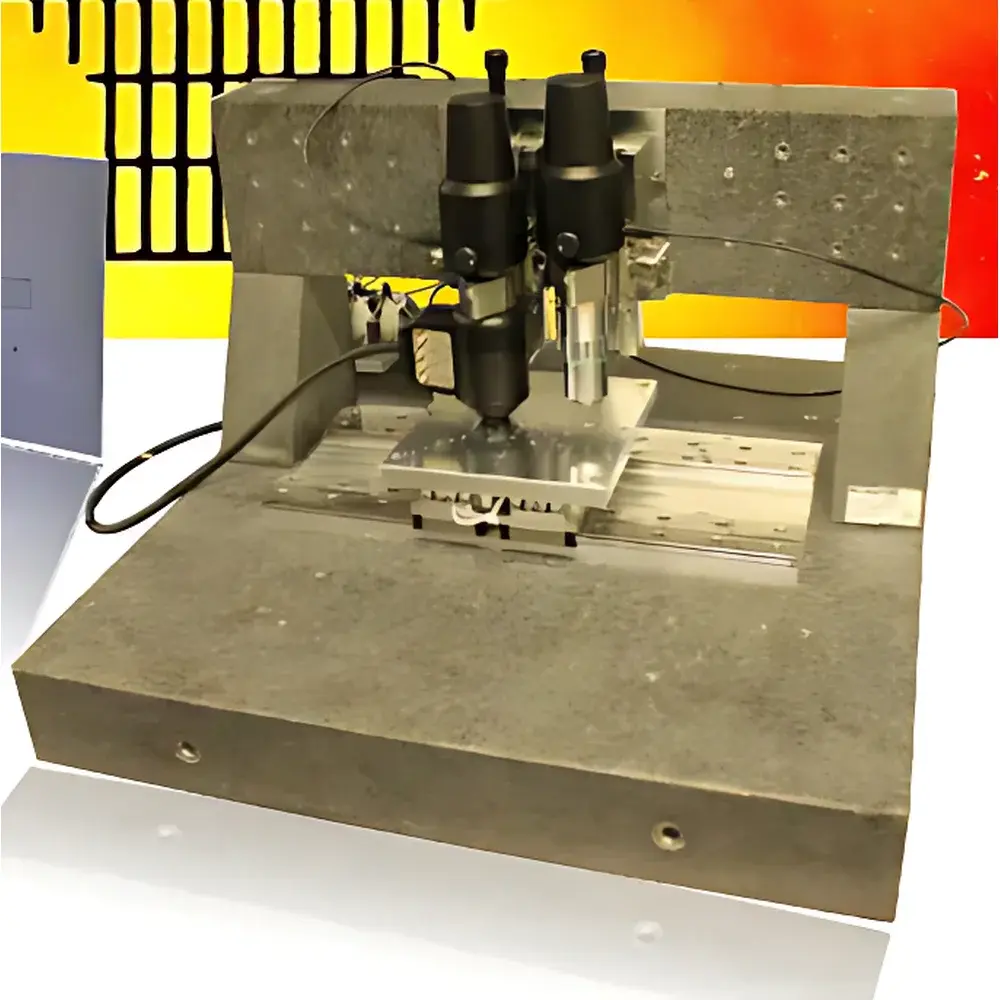
DME DS95Navi Atomic Force Microscope
| Brand | DME |
|---|---|
| Origin | Denmark |
| Model | DS95Navi |
| Positioning Detection Noise | X-Y < 0.15 nm RMS, Z = 35 pm |
| Sample Dimensions | Diameter < 15 mm, Thickness < 5 mm |
| Sample Stage Travel Range | 180 nm × 180 nm |
Overview
The DME DS95Navi Atomic Force Microscope is a high-precision scanning probe microscope engineered for nanoscale metrology, long-term repeatability, and multi-modal surface characterization in research and industrial R&D environments. Built upon DME’s proprietary Navigator 220™ referencing technology, the DS95Navi overcomes a fundamental limitation of conventional AFMs: spatial reproducibility across sessions. Unlike systems requiring manual repositioning or fiducial markers, the DS95Navi uses embedded reference structures and coordinate-mapped stage navigation to relocate target regions with ≤250 nm positional fidelity—even after sample removal and reinstallation. This capability is rooted in its integrated optical alignment path, ultra-stable granite-based mechanical architecture, and closed-loop piezoelectric positioning system. The instrument operates on core AFM principles—measuring cantilever deflection via laser beam reflection and photodiode detection—to deliver quantitative topographic, mechanical, and functional property mapping at sub-nanometer resolution. Designed for integration into cleanroom-compatible workflows, it supports both ambient and controlled-environment operation, making it suitable for semiconductor process control, thin-film metrology, and nanomaterials development.
Key Features
- Navigator 220™ automated repositioning system enabling repeatable, session-to-session localization of regions of interest (ROI) with ≤250 nm accuracy
- DS95 SPM scanner with compact monolithic design delivering exceptional mechanical stability and scan rates up to 30 Hz
- Plug-and-play cantilever exchange mechanism—engineered for rapid, contamination-minimized, and operator-safe tip replacement
- Integrated optical axis aligned coaxially with the SPM scanning head, providing real-time visual context during coarse positioning and ROI targeting
- Z-direction hardware linearity and noise performance: < 0.05 nm RMS; atomic step resolution of 0.06 nm RMS on HOPG
- Self-regulating laser/cantilever alignment system ensuring consistent optical lever sensitivity across extended operation
- Modular base platform (DS95 Multi-Base) supporting co-integration of AFM, nanoindenter, and optical microscopy modules
- Low-noise integrated electronics within the scanning head—optimized for electrical SPM modes including KPFM, EFM, and SCM
Sample Compatibility & Compliance
The DS95Navi accommodates samples up to 15 mm in diameter and 5 mm in thickness, compatible with standard wafer fragments, TEM grids, and custom substrates used in nanofabrication. Its sample stage offers 180 nm × 180 nm fine-range travel, while optional motorized macro-stage configurations extend XY range to 200 × 150 mm with reference coordinate tracking. The system supports ambient, inert gas, and liquid-cell operation via configurable environmental enclosures. All electronic subsystems comply with IEC 61000-6-3 (EMC emission) and IEC 61000-6-2 (immunity) standards. Data acquisition and instrument control meet GLP/GMP traceability requirements when paired with DiProWa software configured for audit trail logging per FDA 21 CFR Part 11 guidelines.
Software & Data Management
Control and analysis are performed using DME’s DiProWa (Digital Programmable Waveform Analyzer) platform—a modular, scriptable environment supporting real-time waveform generation, synchronized multi-channel acquisition, and customizable feedback loop tuning. Optional C26ScanTool provides advanced scan automation, batch processing, and ROI navigation scripting. All acquired data are stored in vendor-neutral HDF5 format with embedded metadata (timestamp, calibration parameters, mode settings, user annotations). DiProWa includes built-in tools for cross-sectional profiling, roughness quantification (Sa, Sq, Sz per ISO 25178), and phase/amplitude demodulation for dynamic mode analysis. Export options include TIFF, CSV, and MATLAB-compatible binaries for third-party statistical or machine learning pipelines.
Applications
- Nanoscale lithography process monitoring—including CD uniformity, sidewall angle assessment, and resist swelling behavior
- Mechanical property mapping via force-distance spectroscopy and nanoindentation integration
- Surface charge distribution analysis using Kelvin Probe Force Microscopy (KPFM) on gate dielectrics and 2D materials
- Magnetic domain imaging (MFM) of spintronic devices and patterned media
- Electrostatic potential profiling (EFM) in organic photovoltaics and perovskite thin films
- Conductive AFM (SCM) for local carrier transport evaluation in heterostructures and quantum dot arrays
- In-situ growth monitoring of ALD/CVD-deposited layers with sequential air-gap reinsertion and re-localization
FAQ
How does the Navigator 220™ system achieve sub-250 nm repositioning accuracy without fiducials?
It combines high-resolution stage encoders, embedded reference microstructures on the sample holder, and coordinate transformation algorithms that compensate for thermal drift and mechanical hysteresis across multiple sessions.
Is the DS95Navi compatible with vacuum or liquid environments?
Yes—optional environmental chambers support operation under nitrogen purge, low-pressure inert gas, or aqueous immersion; liquid cells require compatible cantilevers and acoustic isolation mounts.
What SPM modes are natively supported by the DS95Navi hardware?
All standard and advanced modes: contact, tapping (AC), lift-mode, LFM, MFM, KPFM, EFM, SCM, and STM—with mode-specific electronics and feedback controllers integrated into the scanning head.
Can the DS95Navi be integrated with existing optical microscopes or prober stations?
Yes—the DS95 Multi-Base platform is mechanically and electronically designed for co-mounting with IglooCompact, GraniteProberStation 150, and other DME-compatible instrumentation.
Does the system support automated batch analysis of multiple ROIs across different samples?
Yes—DiProWa’s scripting engine enables fully automated navigation, image acquisition, and parameter extraction across predefined site maps, with results exported to relational databases or LIMS interfaces.




