
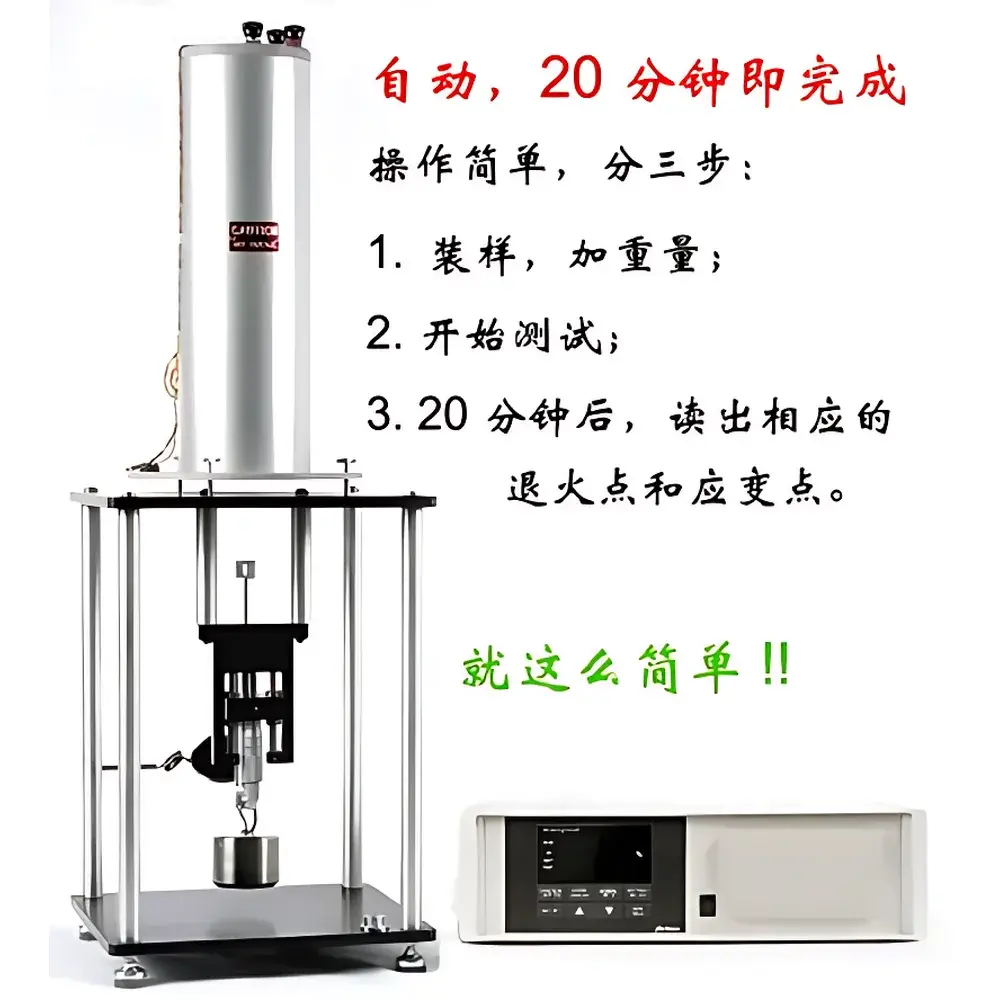
Orton ANS800 Series Annealing Point and Strain Point Tester
| Brand | Orton |
|---|---|
| Origin | USA |
| Model | ANS800 Series |
| Max Operating Temperature | 800 °C or 1000 °C |
| Compliance | ASTM C336 |
| Temperature Control | PID-controlled, automated |
| Measurement Principle | LVDT-based fiber elongation monitoring under controlled cooling |
| Data Processing | Automated calculation of annealing point (AP) and strain point (SP) per ASTM C336 |
| Accuracy | ±1 °C (for glass fiber samples) |
| Software | Orton proprietary control & analysis suite with real-time plotting, statistical reporting, and audit-ready data logging |
Overview
The Orton ANS800 Series Annealing Point and Strain Point Tester is a precision thermal-mechanical instrument engineered for the standardized determination of two critical viscoelastic transition temperatures in silicate and specialty glasses: the annealing point (AP) and strain point (SP). These parameters reflect the temperature-dependent relaxation behavior of glass networks and serve as essential process control indicators in glass manufacturing, quality assurance, and materials development. The system operates in strict accordance with ASTM C336, “Standard Test Method for Annealing Point and Strain Point of Glass,” which defines AP as the temperature at which a standardized 0.65 mm diameter glass fiber elongates at a rate of 0.14 mm/min under a specified static load while cooling at 4 °C/min; SP is derived by extrapolating the AP elongation curve to the temperature where the elongation rate equals 0.0316 × AP rate. The ANS800 implements this methodology using a high-stability vertical furnace, calibrated LVDT displacement transducers, and closed-loop PID temperature regulation—ensuring metrological traceability and inter-laboratory reproducibility.
Key Features
- Two configurable maximum operating temperatures: 800 °C and 1000 °C models accommodate standard soda-lime, borosilicate, aluminosilicate, and low-expansion glasses.
- Automated test execution: After manual fiber loading and weight application, a single “START” command initiates full sequence control—including furnace ramp/cooling profile, real-time displacement acquisition, derivative-based rate computation, and AP/SP interpolation—all without operator intervention.
- Integrated LVDT displacement sensing with sub-micrometer resolution ensures continuous, drift-compensated monitoring of fiber extension during thermal transients.
- Proprietary Orton software provides dual-mode operation: strict ASTM C336 compliance mode or customizable protocol mode (e.g., variable cooling rates, alternative load configurations) for method development and comparative studies.
- Real-time graphical interface displays temperature vs. time, displacement vs. time, and elongation rate vs. temperature curves—enabling immediate visual validation of test integrity.
- Onboard statistical engine computes mean, standard deviation, and confidence intervals across multi-sample batches, supporting GLP-compliant reporting requirements.
Sample Compatibility & Compliance
The ANS800 is optimized for cylindrical glass fibers conforming to ASTM C336 geometry specifications (diameter 0.65 ± 0.01 mm, length ≥100 mm). It supports both commercially drawn fibers and lab-prepared specimens, provided dimensional consistency and surface homogeneity are maintained. All hardware and firmware comply with ASTM C336-22 requirements for thermal uniformity, load application accuracy, and displacement measurement uncertainty. The system architecture supports 21 CFR Part 11–ready software configuration (with electronic signatures, audit trails, and user access controls), making it suitable for regulated environments including ISO 17025-accredited laboratories and FDA-audited glass packaging facilities. Calibration certificates for LVDT sensors and thermocouples are NIST-traceable and include documented uncertainty budgets.
Software & Data Management
The Orton ANS800 software suite comprises three tightly integrated modules: (1) Control Module, managing furnace sequencing, sensor polling (10 Hz sampling), and safety interlocks; (2) Analysis Module, applying numerical differentiation to raw displacement data to compute instantaneous elongation rate, identifying AP via threshold crossing and SP via logarithmic extrapolation; and (3) Reporting Module, generating PDF/CSV reports containing raw data tables, annotated plots, pass/fail flags against specification limits, and summary statistics. All datasets are stored in a relational SQLite database with immutable timestamps and operator ID tagging. Export functions support LIMS integration via ODBC and direct import into MATLAB, Python (Pandas), or JMP for advanced multivariate analysis.
Applications
- Batch release testing of container glass (e.g., pharmaceutical vials, ampoules) to verify compositional stability and thermal history consistency.
- Development of low-CTE glasses for display substrates and semiconductor encapsulation, where precise AP/SP correlation with network modifier content is critical.
- Root-cause analysis of devitrification or distortion issues in float glass annealing lehrs.
- Validation of glass-ceramic nucleation schedules by tracking AP depression during heat treatment.
- Interlaboratory round-robin studies supporting revision of international standards (e.g., ISO 7884-7, DIN 52320).
FAQ
Does the ANS800 require routine recalibration of its LVDT sensor?
Yes—Orton recommends annual calibration using certified gauge blocks and traceable micrometers. A built-in self-test verifies linearity and zero offset prior to each test run.
Can the system test non-cylindrical specimens such as ribbons or rods?
No—the ASTM C336 method mandates cylindrical geometry for defined stress distribution. Non-standard geometries require method validation per ISO/IEC 17025 Clause 7.2.2.
Is the software compatible with Windows 11 and 64-bit architectures?
Yes—the current release (v4.3.1) supports Windows 10 and 11 (64-bit), with .NET Framework 4.8 and TLS 1.2 encryption enabled for secure network deployment.
How is thermal uniformity verified across the furnace hot zone?
Each unit ships with a furnace mapping certificate showing ≤±1.5 °C gradient over a 25 mm axial zone at 550 °C, measured using five calibrated PtRh10-Pt thermocouples per ASTM C1042.
What documentation is provided for regulatory submissions?
The package includes IQ/OQ protocols, software validation summary (including boundary testing and failure mode analysis), and a full traceability matrix linking hardware IDs, calibration records, and firmware versions.



