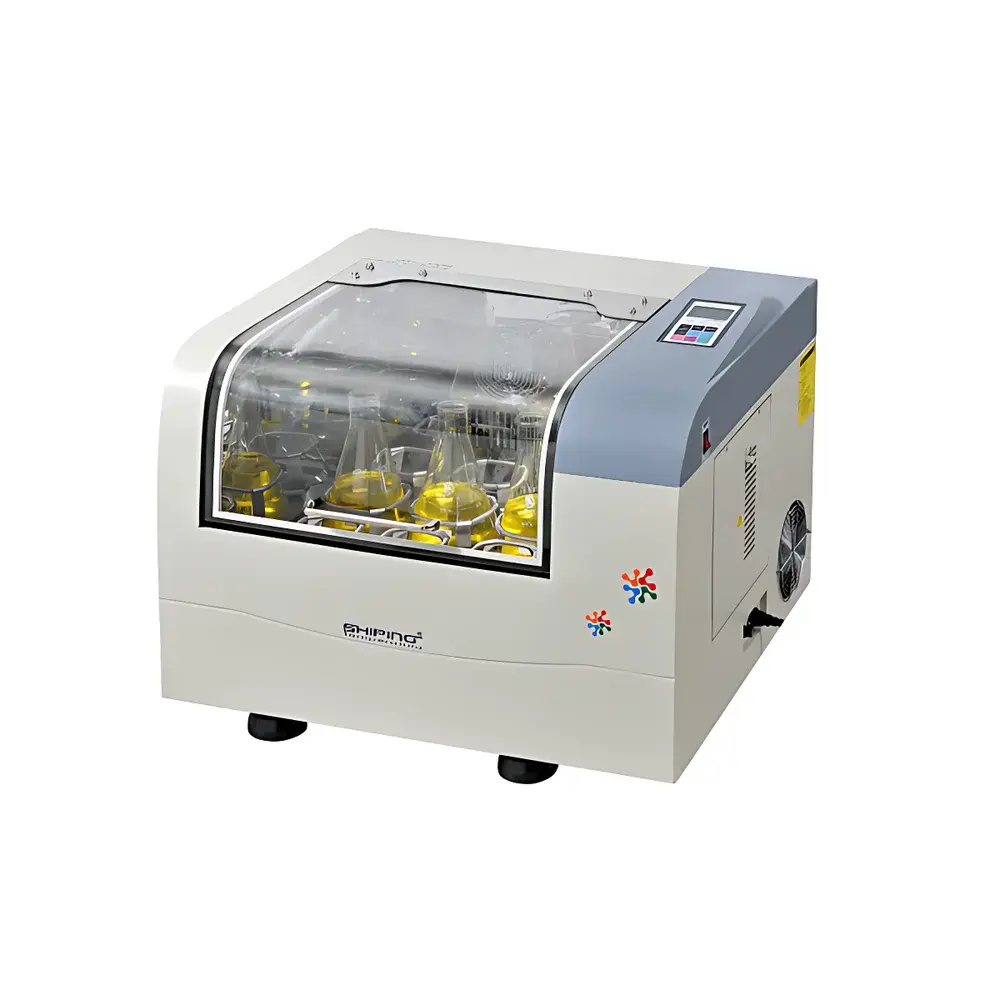
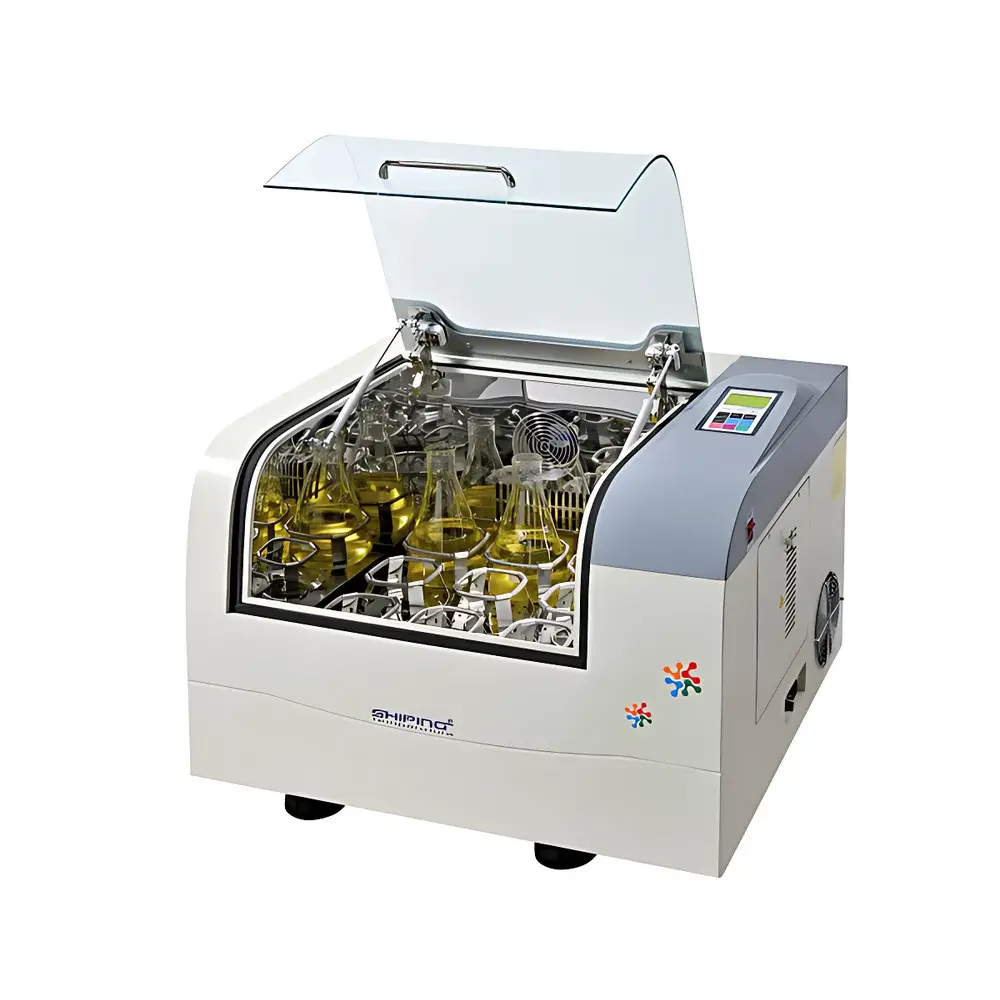
Shanghai Shiping SPH-200B Benchtop Incubated Orbital Shaker
| Brand | Shanghai Shiping |
|---|---|
| Origin | Shanghai, China |
| Manufacturer Type | Direct Manufacturer |
| Product Category | Domestic |
| Model | SPH-200B |
| Price Range | USD 2,800–7,000 (est.) |
| Instrument Type | Incubated Orbital Shaker |
| Timer Range | 0–999 min 59 sec |
| Oscillation Speed | 30–400 rpm |
| Orbit Diameter | 25 mm |
| Temperature Range | 4–60 °C |
| Shelf Quantity | 1 |
| Temperature Uniformity | ±1 °C |
| Temperature Accuracy | ±0.1 °C |
| Ambient Operating Temperature | 5–35 °C |
| Speed Accuracy | ±1 rpm |
| Chamber Volume | 83 L |
| Interior Dimensions (W×D×H) | 490 × 470 × 360 mm |
| Shelf Dimensions (W×D) | 420 × 400 mm |
| Max Load Capacity | 5 × 2000 mL or 9 × 1000 mL or 9 × 500 mL or 16 × 250 mL or 25 × 100 mL or 25 × 50 mL |
| Heating Power | 400 W |
| Cooling Power | 130 W |
| Motor Power | 80 W |
| Total Power Consumption | 706 W |
| Net Weight | 83 kg |
| Height with Lid Open | 990 mm |
| Power Supply | AC 200–240 V, 50–60 Hz |
| Drive Mechanism | Single-axis Parallellogram Dynamic Balance Drive |
| Noise Level | <45 dB(A) |
| Refrigerant | R134a (CFC-free) |
| Bearing | Imported Double-row Precision Bearings |
| Chamber Material | 304 Stainless Steel Mirror Finish |
| Shelf Material | 304 Stainless Steel Brushed Finish |
| Flask Clamp Material | 304 Stainless Steel Mirror Finish (Elasticity: 360°, Hardness: 420 HBW) |
| External Casing | ABS Engineering Plastic |
| Safety Features | Dual-limit temperature/speed alarm, independent overtemperature cut-off, leakage/overcurrent protection, sensor fault detection, refrigeration overload protection |
| Control System | PID Microprocessor with LCD Display, 8-segment programmable curve, memory retention, auto-restart after power failure, parameter encryption, factory reset |
Overview
The Shanghai Shiping SPH-200B Benchtop Incubated Orbital Shaker is an engineered platform for precise, reproducible cultivation of microbial, cellular, and biochemical samples under controlled temperature and agitation conditions. It operates on the principle of orbital shaking—generating uniform circular motion with a fixed 25 mm diameter orbit—to ensure homogeneous suspension, efficient gas exchange, and consistent mass transfer across culture vessels. Integrated Peltier-assisted cooling and resistive heating enable stable thermal regulation from 4 °C to 60 °C, making it suitable for low-temperature enzyme assays, mesophilic bacterial growth, and thermosensitive mammalian cell expansion. Its robust single-axis parallellogram drive mechanism eliminates mechanical backlash and minimizes vibrational coupling, delivering high positional repeatability and long-term operational stability—critical for extended incubation protocols exceeding 72 hours.
Key Features
- High-fidelity temperature control: ±0.1 °C setpoint accuracy and ±1 °C uniformity across the entire chamber volume, validated per ISO 17025-compliant calibration procedures.
- Low-noise orbital drive: Single-axis dynamic balance architecture with imported double-row precision bearings ensures 100,000 hours MTBF—optimized for shared laboratory environments and overnight operation.
- GMP-compliant chamber design: 304 stainless steel mirror-finish interior (electropolished option available), seamless corners, and autoclavable flask clamps support cleaning validation and residue-free decontamination cycles.
- Programmable microprocessor control: 8-segment ramp-and-soak temperature/speed profiles, real-time parameter logging, password-protected settings, and automatic power-failure recovery meet GLP/GMP documentation requirements.
- Triple-layer safety architecture: Independent hardware-based overtemperature cutoff, dual-limit speed monitoring, refrigeration compressor overload protection, and ground-fault circuit interruption safeguard personnel, samples, and instrumentation.
- Modular accessory compatibility: Standardized mounting interface supports interchangeable platforms—including universal spring-loaded shelves, Erlenmeyer flask clamps (50–2000 mL), microtiter plate holders, and custom silicone-adhesive mats for low-volume tubes.
Sample Compatibility & Compliance
The SPH-200B accommodates standard ANSI/SLAS-compliant labware including borosilicate glass flasks (up to 2 L), polypropylene conical tubes, PCR strip racks, and 96-well plates. Its 83 L chamber and 420 × 400 mm shelf allow simultaneous processing of heterogeneous vessel configurations without cross-contamination risk. All wetted surfaces comply with USP Class VI biocompatibility standards; non-porous stainless steel construction meets FDA 21 CFR Part 11 data integrity prerequisites when paired with optional audit-trail-enabled software. The unit is CE-marked and conforms to IEC 61010-1:2010 for electrical safety in laboratory equipment.
Software & Data Management
While the base configuration features standalone PID control via front-panel LCD, optional RS-485/USB interfaces enable integration with LIMS or ELN systems using Modbus RTU or ASCII protocol stacks. Logged parameters—including actual vs. setpoint temperature, real-time RPM, cumulative runtime, and alarm events—are timestamped and exportable as CSV files. Firmware supports configurable audit trails with user ID tagging, electronic signature fields, and immutable record retention—fully aligned with ALCOA+ principles for regulated pharmaceutical and clinical research applications.
Applications
- Microbial fermentation kinetics (E. coli, yeast, Bacillus spp.) under aerobic or microaerobic conditions
- Recombinant protein expression in shaker flasks with dissolved oxygen optimization
- Cell-based assays requiring temperature-synchronized stimulation (e.g., heat shock, cold arrest)
- Enzyme activity profiling across thermal gradients (4–60 °C) with kinetic sampling
- Environmental microbiology: BOD incubation, water quality indicator culturing, and soil extract enrichment
- Biopharmaceutical process development: Media optimization, seed train scaling, and stability testing per ICH Q5C guidelines
FAQ
What is the minimum operating temperature, and can it maintain sub-ambient conditions?
The SPH-200B achieves stable operation at 4 °C using R134a refrigerant and forced-air heat exchange—validated for continuous use at ambient temperatures ≤30 °C.
Is the temperature uniformity verified across the full shelf area?
Yes—uniformity is certified at ±1 °C (9-point mapping per ASTM E2251-19) with all load configurations specified in the technical datasheet.
Can the unit be integrated into a centralized lab automation network?
Standard RS-485 communication allows daisy-chaining up to 32 units; optional Ethernet gateway modules provide MQTT/OPC UA compatibility for Industry 4.0 deployment.
Does the shaker support compliance with 21 CFR Part 11 for electronic records?
When configured with the optional data logger and user authentication module, full Part 11 compliance—including electronic signatures, audit trails, and role-based access—is achievable.
What maintenance intervals are recommended for long-term reliability?
Compressor oil inspection every 24 months; bearing lubrication not required (sealed-for-life design); quarterly verification of door seal integrity and temperature sensor drift using NIST-traceable reference standards.
Related Products