
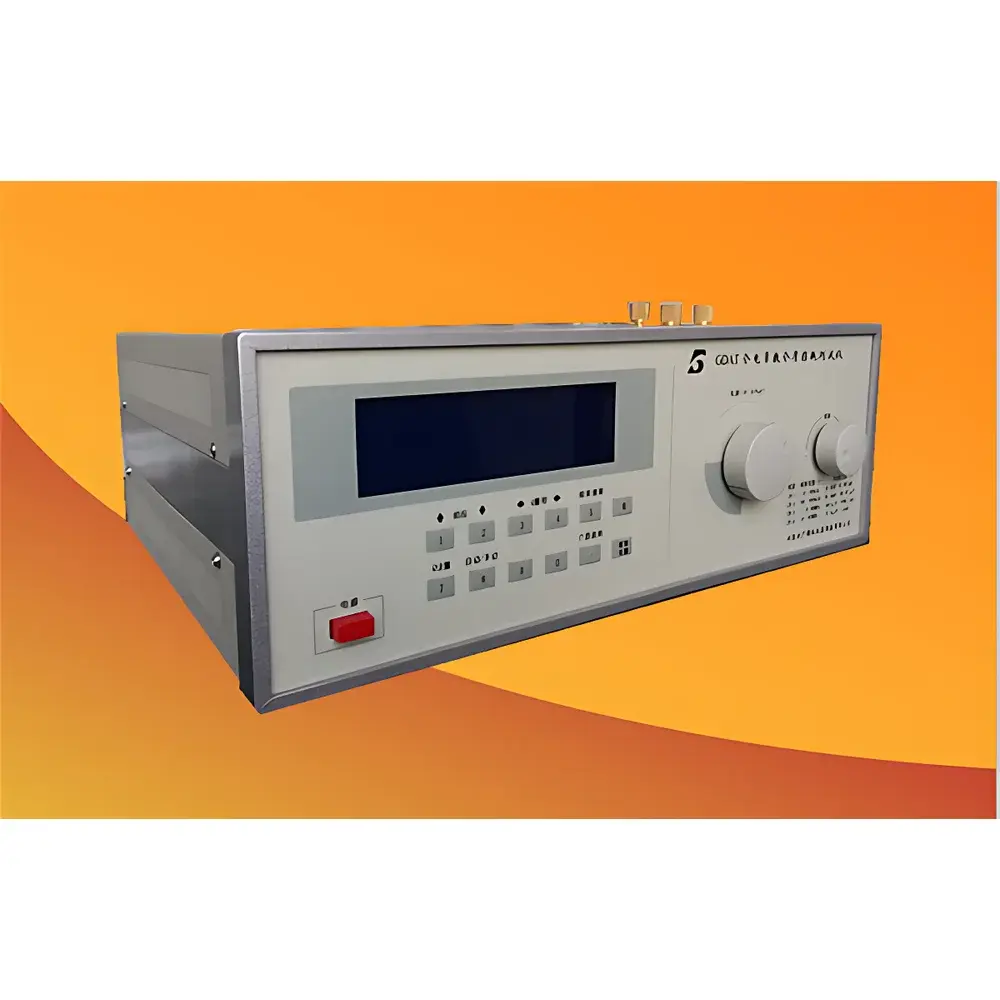
Beiguang Jingyi GDAT Series High-Frequency Q-Meter for Dielectric Constant and Loss Tangent Measurement of Plastics and Elastomers
| Brand | Beiguang Jingyi / All Precision Instrument |
|---|---|
| Origin | Beijing, China |
| Manufacturer Type | Direct Manufacturer |
| Product Origin | Domestic (China) |
| Model | GDAT Series |
| Price | USD 1,400 (FOB Beijing) |
Overview
The Beiguang Jingyi GDAT Series High-Frequency Q-Meter is an engineered precision instrument designed for the quantitative determination of dielectric constant (εr) and dissipation factor (tan δ) of insulating polymeric and elastomeric materials—particularly plastics, rubber compounds, ceramic composites, and advanced non-metallic dielectrics. It operates on the principle of high-frequency series resonance, leveraging a digitally stabilized RF signal source and automated capacitance-frequency tracking to deliver traceable, repeatable measurements across a broad frequency spectrum (10 kHz to 160 MHz). Unlike broadband impedance analyzers or low-frequency LCR meters, the GDAT series employs resonant cavity methodology optimized for high-Q material characterization—enabling accurate extraction of intrinsic dielectric loss mechanisms in bulk samples under controlled field conditions. Its architecture conforms to the measurement philosophy outlined in GB/T 1409–2006, which aligns with international practices for evaluating electrical insulation performance at power, audio, and radio frequencies—including meter- and decimeter-wave bands.
Key Features
- Wide-frequency coverage: 10 kHz – 160 MHz, segmented into four calibrated bands with automatic band switching and digital frequency synthesis (DDS)
- Q-value measurement range: 2 to 1023, with five manual/auto-selectable ranges (30, 100, 300, 1000) and real-time auto-ranging capability
- Integrated dual-electrode test fixture system: Independent cylindrical and parallel-plate electrode configurations—ensuring compliance with ASTM D150 and IEC 60250 sample geometry requirements
- Microprocessor-controlled tuning: ATMega128-based core with stepper-motor-driven main capacitor (CT), enabling precise, backlash-free capacitance positioning and automatic resonance search (frequency sweep or capacitance sweep mode)
- High-stability signal generation: Automatic amplitude control (AAC) loop maintains ±0.1 dB output level stability over temperature and load variations
- Four-line backlit LCD interface: Displays real-time parameters including excitation frequency, CT value, inductance (Lx), Q-value, Q-range status, auto-search indicators, and pass/fail comparison status
- Residual parameter compensation: Factory-calibrated correction for residual inductance (L0 ≈ 7–26 nH) and stray capacitance ensures measurement integrity below 1 µH and sub-pF levels
Sample Compatibility & Compliance
The GDAT Series supports standardized dielectric testing of solid, rigid, and flexible polymer specimens—including thermoplastics (e.g., PVC, PE, PP), thermosets (e.g., epoxy, phenolic), elastomers (e.g., silicone, EPDM), and ceramic-polymer composites. Sample mounting follows GB/T 1409–2006 and ISO 2577 protocols: flat-surface specimens are measured using parallel-plate electrodes (diameter 25 mm or 50 mm, adjustable gap), while tubular or irregular geometries utilize coaxial cylindrical electrodes. The instrument meets electromagnetic compatibility (EMC) requirements per GB/T 18268.1–2010 (IEC 61326-1) and safety standards per GB 4793.1–2007 (IEC 61010-1). While not certified to FDA 21 CFR Part 11, its data logging and pass/fail threshold functions support GLP-compliant documentation when integrated with external audit-trail software.
Software & Data Management
The GDAT Series operates as a standalone benchtop instrument with no embedded PC or proprietary software stack. All measurement logic, calibration routines, and user interface functions are implemented in firmware. Data output is limited to on-screen display and audible pass/fail feedback (via built-in buzzer). For laboratory integration, users may record results manually or via external RS-232 (optional) or analog voltage output (0–5 V proportional to Q or tan δ). No cloud connectivity, remote control API, or database export is provided—consistent with industrial QA/QC environments requiring deterministic, validation-ready operation. Calibration records, Q-value tolerance settings, and frequency-specific correction coefficients are retained in non-volatile memory and survive power cycles.
Applications
- Quality assurance of polymer insulators used in cable jacketing, transformer bushings, and printed circuit board substrates
- R&D evaluation of dielectric filler dispersion (e.g., BaTiO3, SiO2) in rubber matrices for tunable permittivity
- Process monitoring of crosslink density in vulcanized elastomers via tan δ temperature sweeps (when paired with environmental chamber)
- Characterization of microwave-absorbing composites for aerospace shielding applications
- Validation of high-frequency stability in antenna encapsulants and radome materials
- Academic research on relaxation dynamics in amorphous polymers using frequency-domain dielectric spectroscopy (FDS) principles
FAQ
What standards does the GDAT Series comply with?
It implements the test methodology specified in GB/T 1409–2006, which is technically equivalent to ASTM D150 and IEC 60250 for dielectric constant and loss tangent measurement. Frequency accuracy and Q-value uncertainty are validated against national metrology institute traceable reference inductors (e.g., BQG-2 standard coil set).
Can it measure liquid or powder samples?
No—the GDAT Series is configured exclusively for solid-state dielectric testing using fixed-geometry electrodes. Liquids require guarded electrode cells; powders demand pelletization and sintering prior to measurement.
Is calibration required before each use?
A 30-minute warm-up is mandatory for thermal stabilization. Daily verification using a reference inductor (e.g., LKI-1 set) is recommended for production environments. Full recalibration is advised every 12 months or after mechanical shock.
Does it support temperature-controlled measurements?
The base unit has no integrated temperature stage. However, the electrode fixtures are compatible with third-party environmental chambers (−40 °C to +150 °C) when cabling and grounding are implemented per IEC 60601-1 leakage current limits.
How is measurement uncertainty quantified?
Per GB/T 1409–2006 Annex B, total Q-value uncertainty comprises: ±5% inherent error (10 kHz–10 MHz), ±7% working error (10 kHz–10 MHz), ±6% inherent error (10 MHz–160 MHz), and ±8% working error (10 MHz–160 MHz), plus ±2% of full-scale reading. Residual parameter corrections further reduce systematic bias by up to 15% in low-inductance regimes.



