
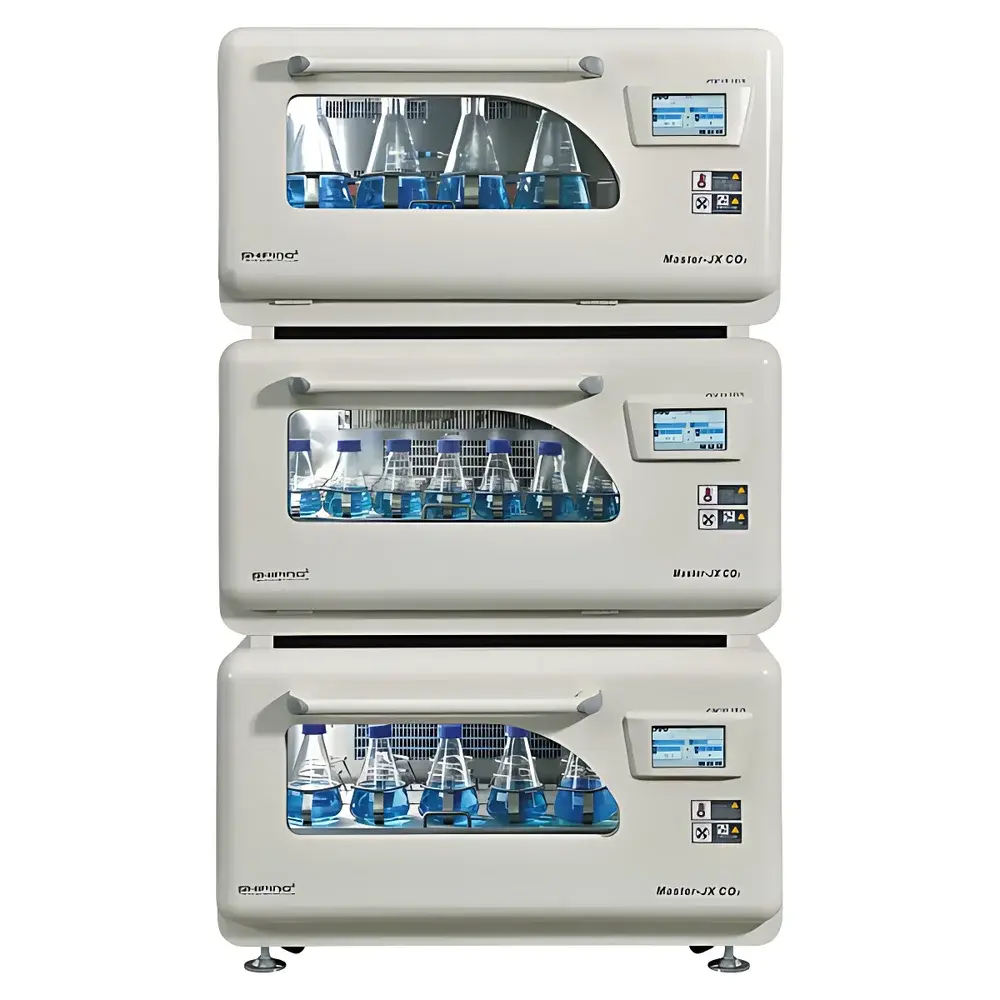
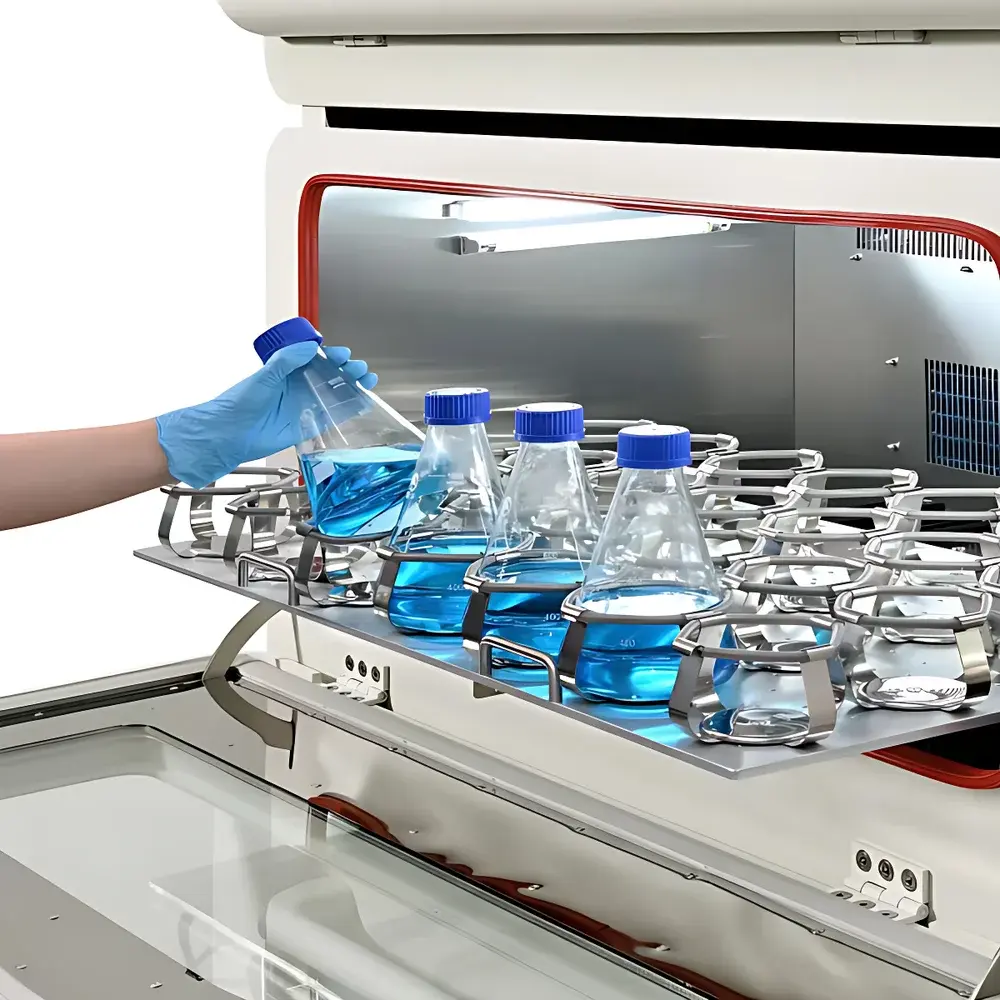
Shanghai Shiping Master-JX 2021R Plus CO₂-Regulated Incubator Shaker
| Brand | Shanghai Shiping |
|---|---|
| Origin | Shanghai, China |
| Manufacturer Type | OEM Manufacturer |
| Instrument Type | CO₂-Regulated Temperature-Controlled Orbital Shaker |
| Timer Range | 0–999.59 h (continuous mode available) |
| Oscillation Speed | 30–300 rpm |
| Orbit Diameter | 25 mm (50 mm optional) |
| Temperature Range | 4°C to 60°C |
| Number of Shaking Platforms | 1 |
| Internal Volume | 208 L |
| Platform Dimensions | 780 × 500 mm |
| Max Capacity | 40 × 250 mL flasks / 28 × 500 mL / 15 × 1000 mL / 12 × 2000 mL |
| CO₂ Control Range | 0–20% (v/v) |
| CO₂ Accuracy | ±0.3% |
| CO₂ Stability | ±0.1% |
| CO₂ Sensor | Imported NDIR infrared sensor |
| Temp Uniformity | ≤ ±0.5°C @ 37°C |
| Temp Accuracy | ±0.1°C |
| Temp Recovery Time | ≤10 min after 30-sec door opening |
| Humidification | Passive (natural evaporation) |
| Sterilization | Integrated 8 W UV-C lamp (254 nm) |
| Air Filtration | 0.2 µm HEPA-grade inline filter for inlet gas |
| Power | Heating 1000 W / Cooling 195 W / Motor 250 W |
| Net Weight | 324 kg |
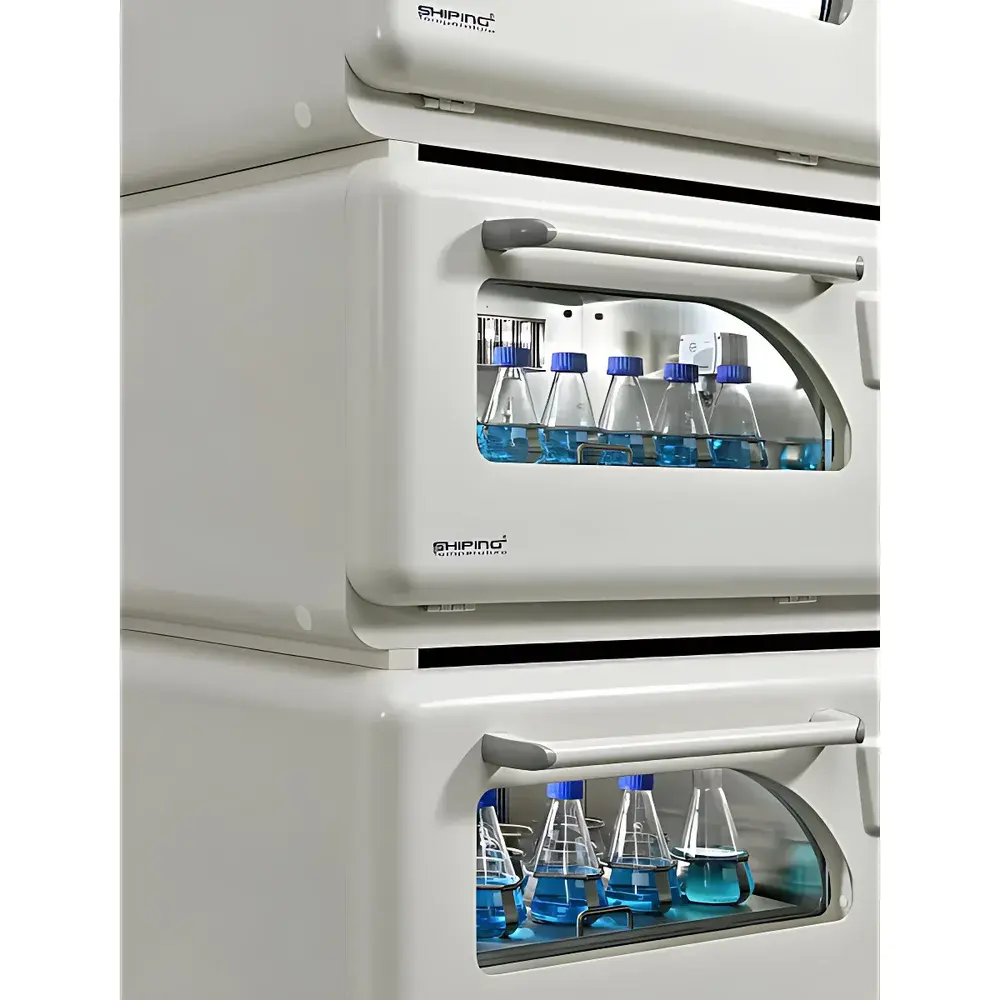
| Stackable | Up to 3 units |
| Compliance | Designed per ISO 13485-aligned cleanroom-compatible mechanical architecture |
Overview
The Shanghai Shiping Master-JX 2021R Plus CO₂-Regulated Incubator Shaker integrates precise temperature control, programmable orbital agitation, and real-time CO₂ concentration regulation within a single GMP-aligned platform. Engineered for mammalian cell culture, hybridoma expansion, insect and plant cell suspension systems, and recombinant protein expression workflows, it operates on the principle of controlled convective thermal equilibrium combined with constant-speed eccentric drive mechanics. Unlike standard incubator shakers, this unit incorporates an NDIR (non-dispersive infrared) CO₂ sensor calibrated to traceable standards, enabling stable gas-phase environmental control essential for pH-sensitive cultures reliant on bicarbonate buffering. The chamber employs forced-air circulation with optimized baffle geometry to eliminate thermal stratification—validated at ≤±0.5°C uniformity across the full working volume at 37°C. Its refrigeration system utilizes an imported inverter-driven compressor, delivering high-efficiency cooling down to 4°C without evaporator frost accumulation, even during extended operation.
Key Features
- Single-axis balanced drive mechanism (patented design) eliminates mechanical friction, ensuring silent, low-vibration operation at all speeds (30–300 rpm), with ±1 rpm speed accuracy.
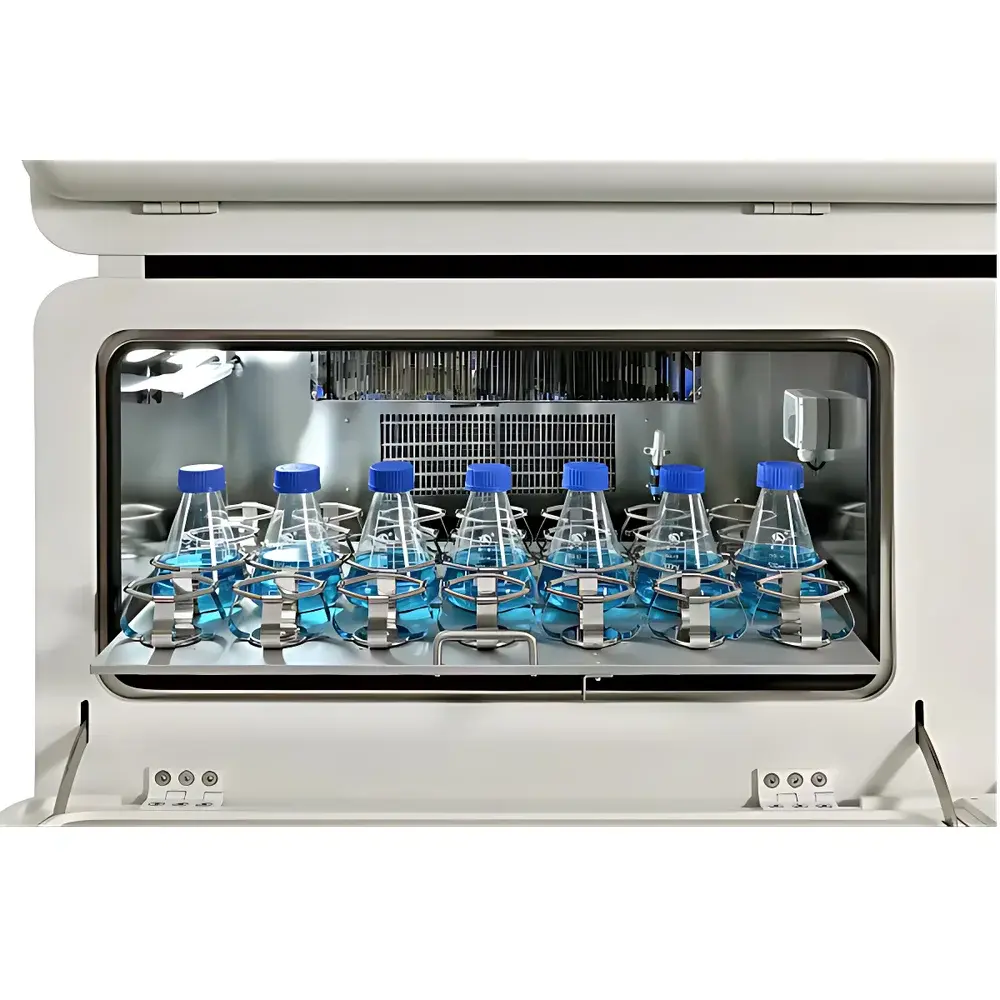
- Full SUS304 stainless steel interior with radius-cornered construction meets ISO 14644-1 Class 7 cleanroom surface requirements and facilitates validated cleaning protocols.
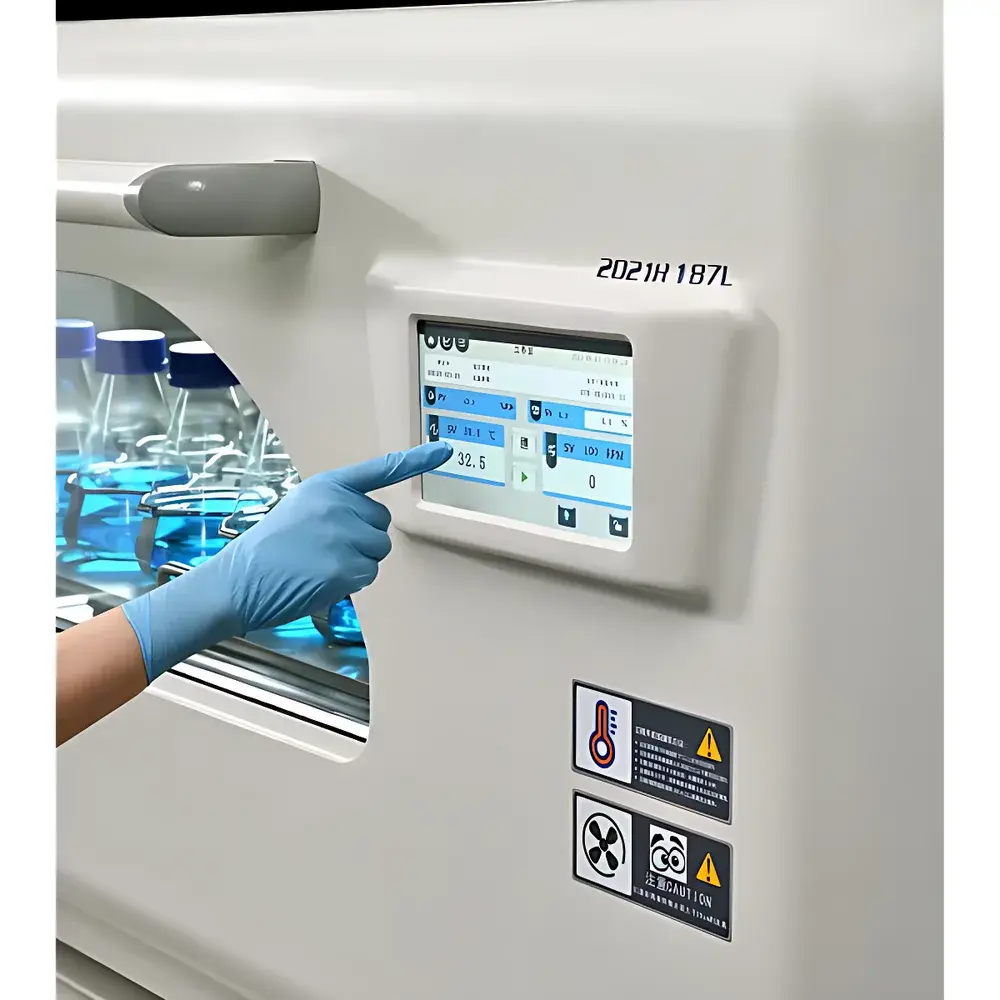
- 7-inch high-resolution capacitive touchscreen interface with glove-compatible operation, bilingual (English/Chinese) UI, and configurable user access levels (Level 1–3) compliant with ALCOA+ data integrity principles.
- Dual-layer tempered safety glass door with integrated LED illumination and UV-C sterilization lamp (254 nm, 8 W) enables non-invasive visual monitoring while maintaining thermal and CO₂ integrity.
- Modular expandability: optional active humidification, photoperiod-controlled lighting, high-speed microplate shaking (up to 1000 rpm, 3 mm orbit), gas blending inlet (N₂/air/O₂/CO₂), and remote monitoring via Ethernet/WiFi-enabled controller.
- Comprehensive safety architecture: triple-redundant overtemperature cutoff, motor overspeed shutdown, leakage current protection (IEC 61000-4-5 compliant), and automatic CO₂ purge upon door opening.
Sample Compatibility & Compliance
The Master-JX 2021R Plus accommodates standard vented and non-vented culture vessels—from 25 mL to 2000 mL Erlenmeyer flasks—as well as deep-well plates and roller bottles when used with optional adhesive platforms. Its 208 L internal volume and freely extendable 780 × 500 mm platform support heterogeneous loading configurations without compromising oscillation stability. All wetted surfaces comply with USP material classification for pharmaceutical contact; the chamber’s airflow path includes a 0.2 µm sterile-grade inline filter for external gas supply lines. The system is engineered to support regulatory submissions under FDA 21 CFR Part 11 (with optional audit trail logging and electronic signature modules), EU Annex 11, and ISO/IEC 17025–accredited laboratory environments. Optional IQ/OQ/PQ documentation packages are available for installation and operational qualification.
Software & Data Management
Embedded firmware supports continuous data acquisition at 1-second intervals, storing up to 15 million timestamped records (≥5 years at default logging frequency). All parameters—including temperature, CO₂ %, RPM, door status, UV lamp cycle, and alarm events—are time-stamped with millisecond precision and exportable via USB 2.0 to CSV or XML formats. The system maintains immutable operation logs with user ID attribution, supporting forensic review for GLP audits. Real-time trend visualization includes dual-Y axis plots (e.g., CO₂ vs. temperature), deviation alerts, and customizable threshold-based notifications. Data encryption (AES-128) and password-protected configuration locks prevent unauthorized parameter modification. Firmware updates are performed offline via signed binary files to ensure integrity.
Applications
This instrument serves core applications in biopharmaceutical upstream processing, academic cell biology, and industrial enzyme production. It is routinely deployed for transient transfection cultures requiring synchronized aeration and pH stability, fed-batch CHO cell expansions where dissolved oxygen transfer correlates directly with orbital amplitude and speed, and microbial consortia studies demanding strict CO₂ modulation (e.g., anaerobic acetogen cultivation). In plant biotechnology, its optional lighting module enables photomorphogenic assays under controlled spectral and temporal regimes. For QC labs, the unit supports compendial methods including USP (cell culture performance testing) and EP 2.6.27 (microbial growth promotion testing), particularly when paired with humidity and gas modulation add-ons.
FAQ
Does the system support 21 CFR Part 11 compliance?
Yes—when configured with audit trail logging, electronic signatures, and role-based access control (RBAC), the system meets core technical requirements for electronic records and signatures.
What is the CO₂ sensor calibration interval and traceability?
The NDIR sensor is factory-calibrated against NIST-traceable gas standards; recommended recalibration every 12 months or after 2000 hours of operation.
Can the shaker operate at 4°C with CO₂ enabled?
Yes—the refrigeration system and CO₂ delivery are decoupled; CO₂ injection remains functional across the full 4–60°C range.
Is the stainless steel chamber suitable for hydrogen peroxide vapor (HPV) decontamination?
Yes—SUS304 construction and sealed drive housing withstand validated HPV cycles per ISO 14644-3 Annex B protocols.
How is temperature uniformity verified during qualification?
Per ISO 14644-3, 9-point mapping (3×3 grid at mid-height) is performed using calibrated PT100 probes; results must demonstrate ≤±0.5°C deviation at setpoint.






