
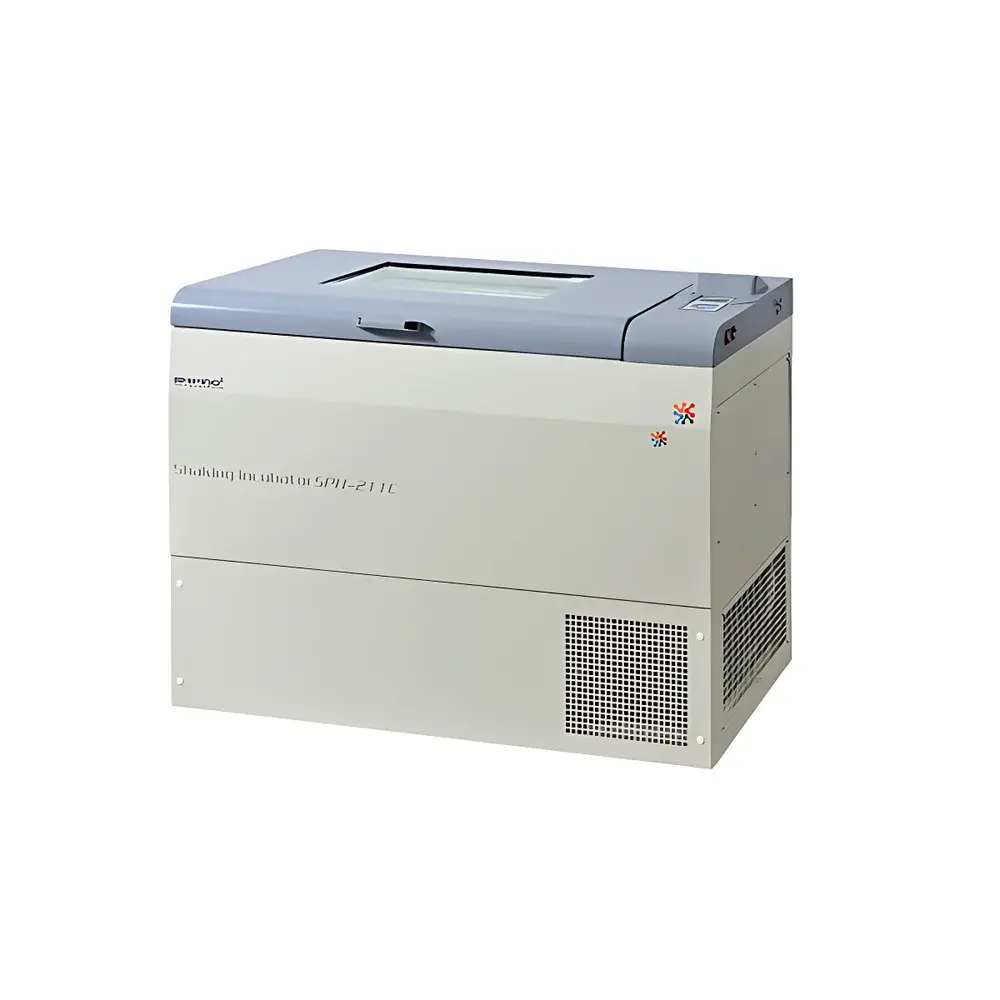
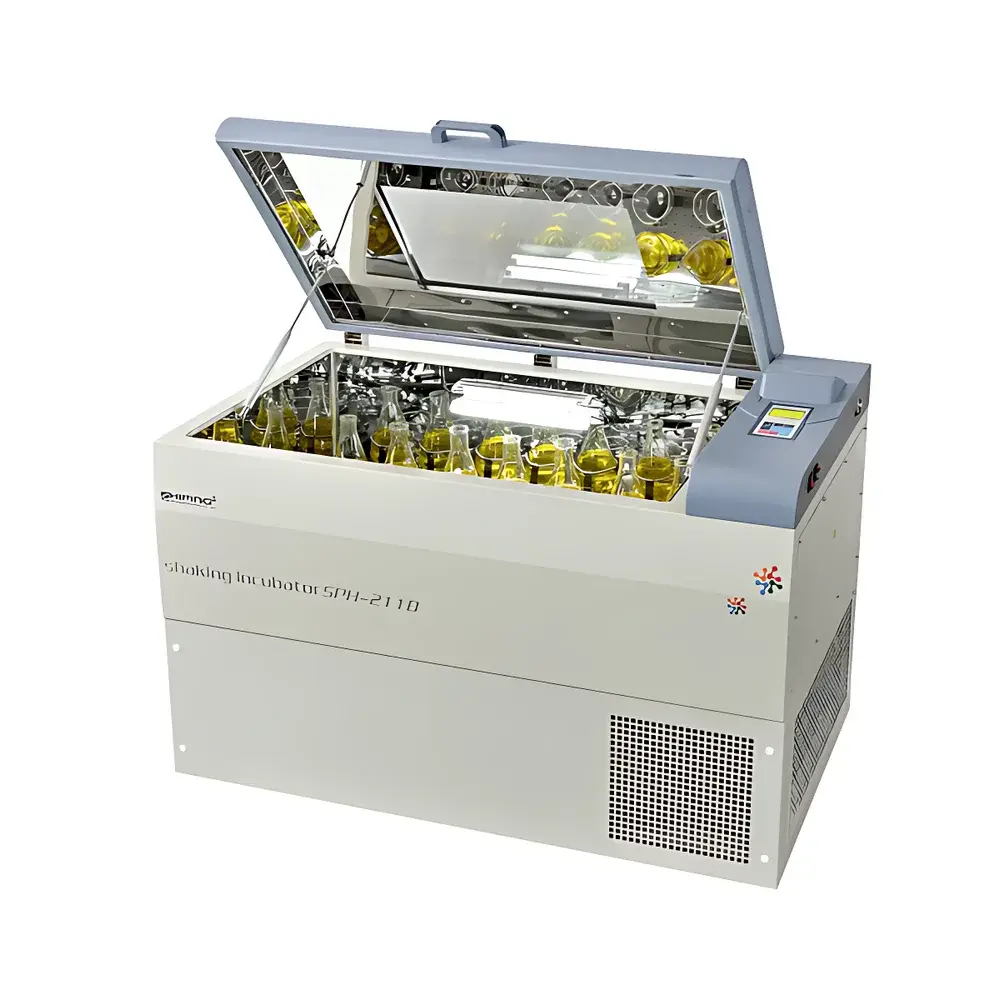
Shanghai Shiping SPH-211C High-Profile Large-Capacity Incubated Orbital Shaker
| Brand | Shanghai Shiping |
|---|---|
| Origin | Shanghai, China |
| Manufacturer Type | Direct Manufacturer |
| Product Category | Domestic |
| Model | SPH-211C |
| Instrument Type | Full-Temperature Incubated Shaker |
| Timer Range | 0–500 h |
| Oscillation Frequency | 50–300 rpm |
| Orbit Diameter | Φ25 mm |
| Temperature Range | 4–60 °C |
| Shelf Quantity | 1 |
Overview
The Shanghai Shiping SPH-211C High-Profile Large-Capacity Incubated Orbital Shaker is an engineered platform for precise, long-duration cultivation and mixing of biological samples under controlled thermal and mechanical conditions. Designed around orbital shaking dynamics—where the platform rotates in a circular motion with a fixed 25 mm diameter orbit—the system ensures uniform suspension, oxygen transfer, and nutrient distribution across heterogeneous cultures. Its integrated refrigeration and heating system enables stable temperature maintenance from 4 °C (suitable for cold-sensitive protein expression or low-temperature fermentation) to 60 °C (supporting thermophilic microbial growth or enzyme activity assays). With a total internal volume of 259 L and a large 920 × 500 mm stainless steel shelf, the SPH-211C accommodates high-throughput configurations—including up to 28 × 500 mL flasks or 40 × 250 mL vessels—making it suitable for scalable bioprocess development, QC batch testing, and academic research requiring reproducible environmental control.
Key Features
- Single-axis balanced drive mechanism based on a parallelogram dynamic equilibrium architecture—minimizing mechanical friction, eliminating vibration-induced drift, and achieving operational noise <45 dB(A) during continuous 24/7 operation.
- High-reliability mechanical core: precision-machined ductile iron structural components, 45# carbon steel shaft (220–250 HBW tempered), and imported dual-row angular contact bearings rated for ≥100,000 hours of service life under nominal load.
- Temperature control via PID microprocessor with environmental scanning algorithm; accuracy ±0.1 °C, uniformity ±1 °C across the chamber; uses R134a non-ozone-depleting refrigerant and frost-free evaporator design.
- GMP-compliant interior: 304 stainless steel mirror-finish chamber with seamless arc-corner construction; removable 304 brushed-steel shelf and bottle clamps (360° elasticity, 420 HV hardness) for corrosion resistance and cleanability.
- Safety triad protection system: independent over-temperature cutoff, speed deviation alarm, sensor fault detection, earth-leakage circuit interruption, and compressor overload protection.
- Double-glazed, thermally insulated tempered glass door with integrated LED illumination and optional UV germicidal lamp (8 W) for sterile observation and decontamination cycles.
Sample Compatibility & Compliance
The SPH-211C supports diverse vessel formats including Erlenmeyer flasks (up to 5 L), test tubes, microtiter plates (via optional plate holders), and custom fixtures such as silicone adhesive mats or spring-loaded platforms. Its chamber geometry and airflow pattern conform to ISO 14644-1 Class 8 (ISO Class 100,000) cleanroom-compatible handling practices when used in controlled environments. While not certified to GLP or GMP out-of-the-box, its parameter logging, password-protected settings, auto-recovery after power failure, and audit-ready timer functions align with foundational requirements for regulated workflows per FDA 21 CFR Part 11 Annex 11 expectations—particularly when paired with validated external data acquisition systems.
Software & Data Management
Equipped with an LCD interface and embedded PID controller, the SPH-211C offers eight-segment programmable ramp-and-hold temperature and speed profiles, real-time parameter display, and persistent memory for up to 10 user-defined protocols. All operational parameters—including setpoints, actual values, elapsed time, and alarm events—are locally stored with timestamping. Optional RS-485/Modbus RTU communication allows integration into centralized lab monitoring networks (e.g., LabVantage, Siemens Desigo, or custom SCADA). Calibration offset correction for both temperature and RPM is supported via administrator-level access, facilitating traceable instrument qualification (IQ/OQ) documentation.
Applications
- Microbial and mammalian cell culture propagation under defined thermal-aerobic conditions
- Enzyme kinetics studies requiring consistent agitation at sub-ambient or elevated temperatures
- Fermentation process optimization and scale-down modeling for biopharmaceutical upstream development
- DNA/RNA hybridization, immunoassay incubation, and antigen–antibody binding kinetics
- Environmental microbiology—water quality testing, BOD/COD sample agitation, and soil extract homogenization
- Food safety validation—pathogen enrichment (e.g., Salmonella, Listeria) in buffered peptone water or selective broths
FAQ
What is the maximum flask capacity supported by the SPH-211C?
The unit accommodates up to six 5 L flasks, eight 3 L flasks, fourteen 2 L flasks, eighteen 1 L flasks, twenty-eight 500 mL flasks, or forty 250 mL flasks—configured on a single 920 × 500 mm shelf.
Does the shaker support programming for multi-step temperature and speed profiles?
Yes—it features eight-segment programmable curves for both temperature and rotation speed, enabling complex experimental protocols such as cold-start induction followed by gradual warming and acceleration.
Is the refrigeration system frost-free and compatible with continuous low-temperature operation?
Yes—the imported R134a compressor and optimized evaporator design ensure frost-free performance at 4 °C for extended durations without manual defrost cycles.
Can the device be integrated into a networked laboratory information management system (LIMS)?
Via optional Modbus RTU (RS-485) interface, the SPH-211C supports read-only parameter polling and event logging, compatible with most industrial-grade LIMS and MES platforms.
What materials are used for critical wetted parts to ensure chemical and sterilization compatibility?
All interior surfaces, shelf, and flask clamps are constructed from ASTM A240 Type 304 stainless steel; gaskets and seals meet USP Class VI biocompatibility standards and withstand repeated autoclaving or VHP decontamination cycles.





