
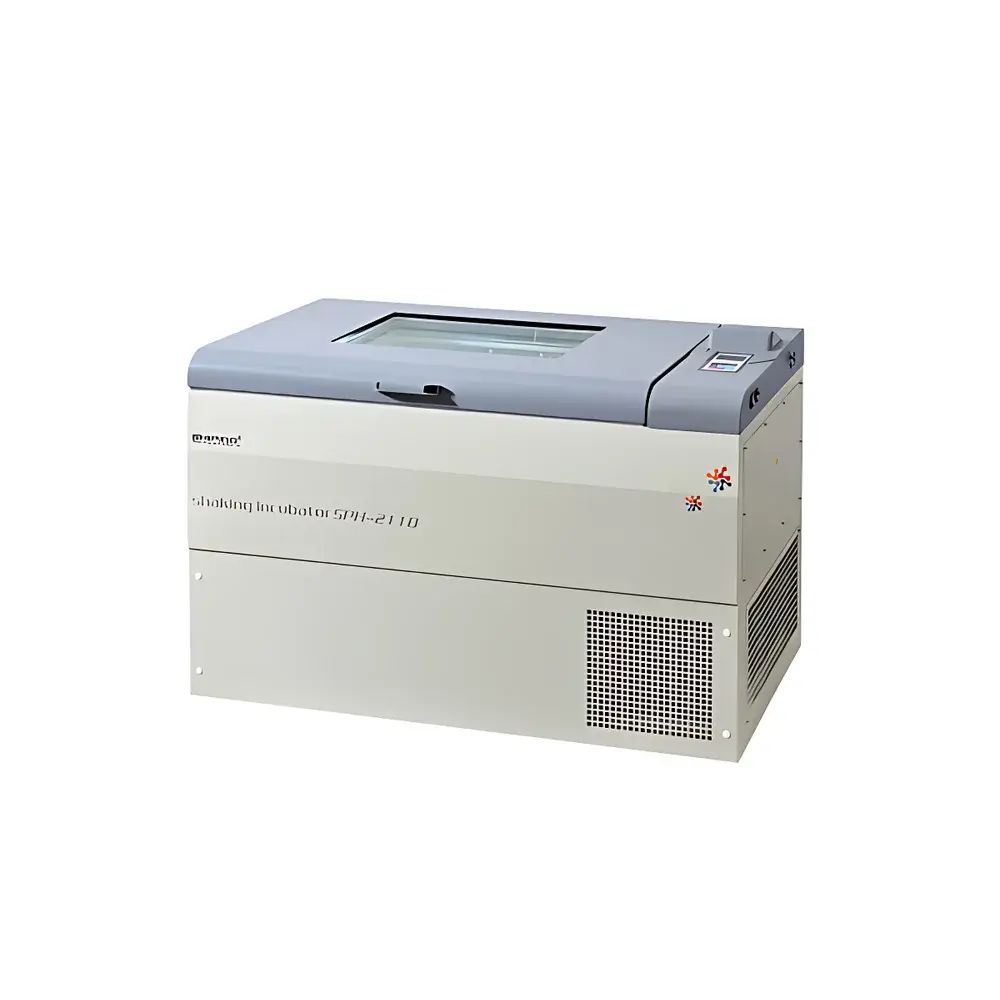
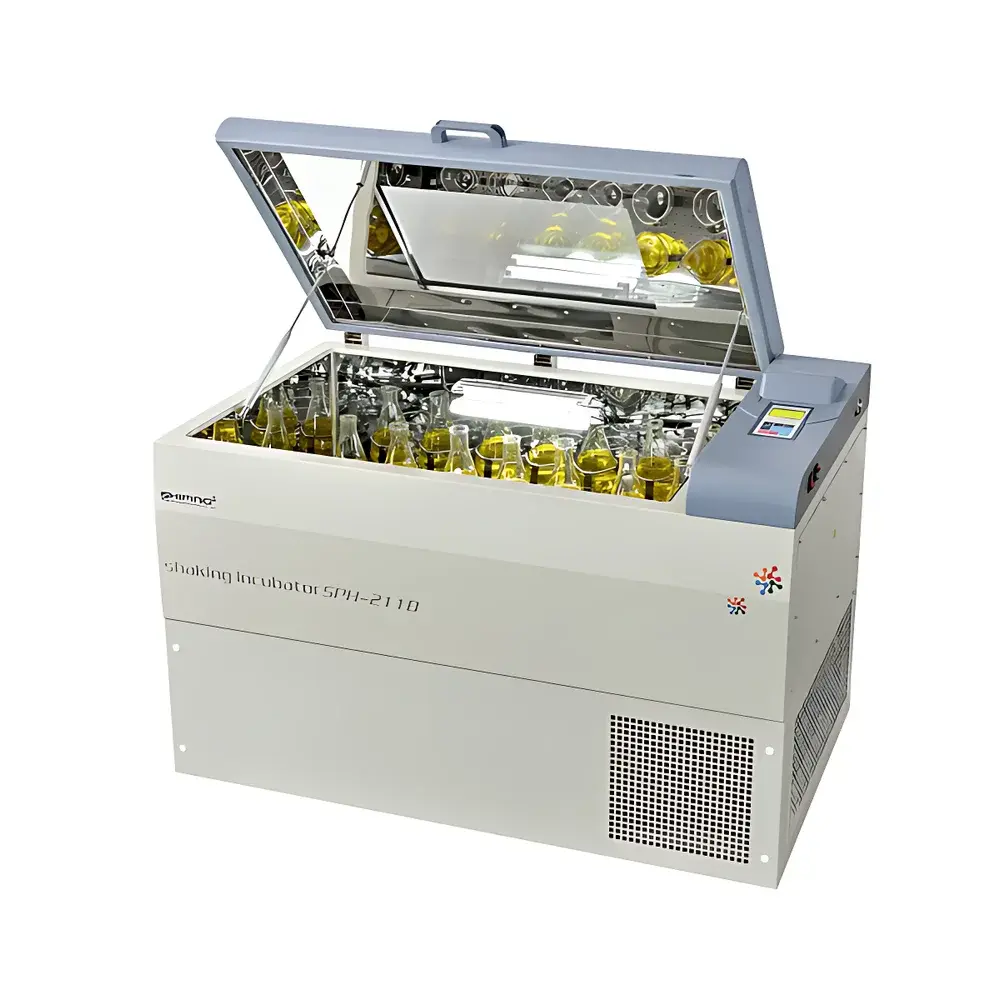
ShiPing SPH-211B Benchtop Refrigerated Orbital Shaker Incubator
| Brand | ShiPing |
|---|---|
| Origin | Shanghai, China |
| Manufacturer Type | OEM Manufacturer |
| Model | SPH-211B |
| Temperature Range | 4–60 °C |
| Temperature Uniformity | ±1 °C |
| Temperature Accuracy | ±0.1 °C |
| Speed Range | 30–300 rpm |
| Speed Accuracy | ±1 rpm |
| Orbit Diameter | 25 mm |
| Chamber Volume | 200 L |
| Shelf Dimensions | 920 × 500 mm |
| Max Load Capacity | 2000 mL × 14 |
| Power Supply | AC 200–240 V, 50–60 Hz |
| Total Power Consumption | 1366 W |
| Noise Level | <45 dB(A) |
| Net Weight | 216 kg |
Overview
The ShiPing SPH-211B is a benchtop refrigerated orbital shaker incubator engineered for precision-controlled microbial growth, cell culture expansion, enzymatic assays, and biochemical reaction optimization under dynamically regulated temperature and agitation conditions. It operates on the principle of orbital shaking—generating uniform circular motion (25 mm diameter orbit) to ensure homogeneous suspension of cultures while minimizing shear stress on sensitive biological samples. Integrated refrigeration (R134a-free compressor) and PID-controlled heating enable stable thermal environments from 4 °C to 60 °C—critical for low-temperature fermentation, mesophilic bacterial propagation, or thermosensitive protein expression studies. Designed for GMP-aligned laboratories, its all-stainless-steel chamber (AISI 304 mirror-finish interior with radius-corner geometry), sealed double-glazed observation door, and corrosion-resistant hardware meet stringent hygienic design requirements for pharmaceutical QC, bioprocess development, and academic research workflows.
Key Features
- Single-axis balanced drive mechanism based on parallelogram dynamic equilibrium architecture—eliminates mechanical friction, ensures zero speed drift, and delivers long-term operational stability (>10,000 hours MTBF).
- High-reliability mechanical core: ductile iron housing, precision-machined 45# carbon steel shaft (220–250 HBW hardness), and imported dual-row angular contact bearings rated for ≥100,000 hours at rated load.
- Refrigeration system with original-brand hermetic compressor and eco-friendly R134a refrigerant—enables frost-free operation, rapid cooldown, and ±0.3 °C thermal stability across the full chamber volume.
- LCD interface with PID microprocessor-based environmental scanning control—supports multi-segment programmable ramping, parameter encryption, auto-recovery after power interruption, and real-time deviation logging.
- Triple-layer safety architecture: independent over-temperature cutoff (mechanical backup), overspeed alarm with audible/visual alert, motor current monitoring, and ground-fault circuit interrupter (GFCI) protection.
- Ergonomic stainless-steel accessories: spring-loaded orbital plate (304 brushed finish), universal bottle clamps (304 mirror-polished, 360° elasticity, 420 HV hardness), and optional enzyme plate holders compatible with ANSI/SLAS standards.
Sample Compatibility & Compliance
The SPH-211B accommodates standard laboratory vessels including Erlenmeyer flasks (up to 2000 mL), test tubes, microtiter plates, and culture bottles—configured via interchangeable mounting platforms. Its chamber geometry (970 × 550 × 375 mm internal dimensions) supports high-density loading without compromising airflow uniformity. The unit complies with IEC 61010-1:2010 for electrical safety in laboratory equipment and meets ISO 13485 design control requirements for medical device manufacturing support applications. All wetted surfaces satisfy USP Class VI material compatibility guidelines; surface finish Ra ≤ 0.8 µm facilitates validated cleaning protocols per FDA CGMP Annex 1 (2022) and EU GMP Part 1. Optional UV germicidal lamp (8 W, 254 nm) enables routine chamber decontamination between batches.
Software & Data Management
While the SPH-211B operates as a standalone instrument with embedded firmware, its control module supports audit-trail-capable data export via RS-232 serial interface (optional USB-to-serial adapter). Logged parameters—including actual vs. setpoint temperature, real-time RPM, elapsed time, and alarm events—are timestamped and stored in non-volatile memory for up to 30 days. Firmware version 2.4+ includes configurable data sampling intervals (1–60 s), CSV-formatted output, and GLP-compliant electronic signature fields for operator authentication. For integration into LIMS or MES systems, Modbus RTU protocol support is available upon request—enabling traceable batch records compliant with 21 CFR Part 11 when paired with validated third-party software.
Applications
- Microbial cultivation: aerobic/anaerobic growth of Escherichia coli, Bacillus subtilis, and yeast strains under controlled dissolved oxygen surrogates.
- Protein expression: induction of recombinant proteins in E. coli BL21(DE3) with precise temperature ramping (e.g., 37 °C → 16 °C) during IPTG addition.
- Cell line maintenance: suspension culture of CHO or HEK293 cells in serum-free media with optimized orbital amplitude to prevent aggregation.
- Environmental microbiology: BOD testing, wastewater biofilm studies, and soil extract enrichment under standardized ASTM D5210-92 agitation conditions.
- Pharmaceutical stability: accelerated degradation studies per ICH Q1A(R2) using synchronized thermal-cycling and agitation profiles.
FAQ
What is the maximum flask size supported on the SPH-211B platform?
The unit accommodates up to fourteen 2000 mL Erlenmeyer flasks simultaneously when using standard universal clamps—subject to center-of-gravity constraints and recommended fill ratios (≤70% volume).
Does the SPH-211B support validation documentation (IQ/OQ/PQ)?
Yes—ShiPing provides factory-verified calibration certificates for temperature (NIST-traceable Pt100 sensor) and speed (laser tachometer), along with customizable OQ protocols aligned with ISO/IEC 17025.
Can the unit operate continuously for 72+ hours without performance degradation?
Designed for unattended operation, the SPH-211B has been validated for 168-hour continuous duty cycles at 37 °C / 150 rpm with ≤0.5 °C thermal excursion and no measurable speed variance.
Is remote monitoring possible via Ethernet or Wi-Fi?
Standard configuration includes RS-232 only; Ethernet/Wi-Fi modules are available as factory-installed options with TLS 1.2 encrypted communication and REST API endpoints.
How is condensation managed during low-temperature operation?
The dual-pane tempered glass door incorporates inert-gas-filled interstitial space and perimeter heating elements—suppressing dew formation below 15 °C ambient while maintaining optical clarity.



