
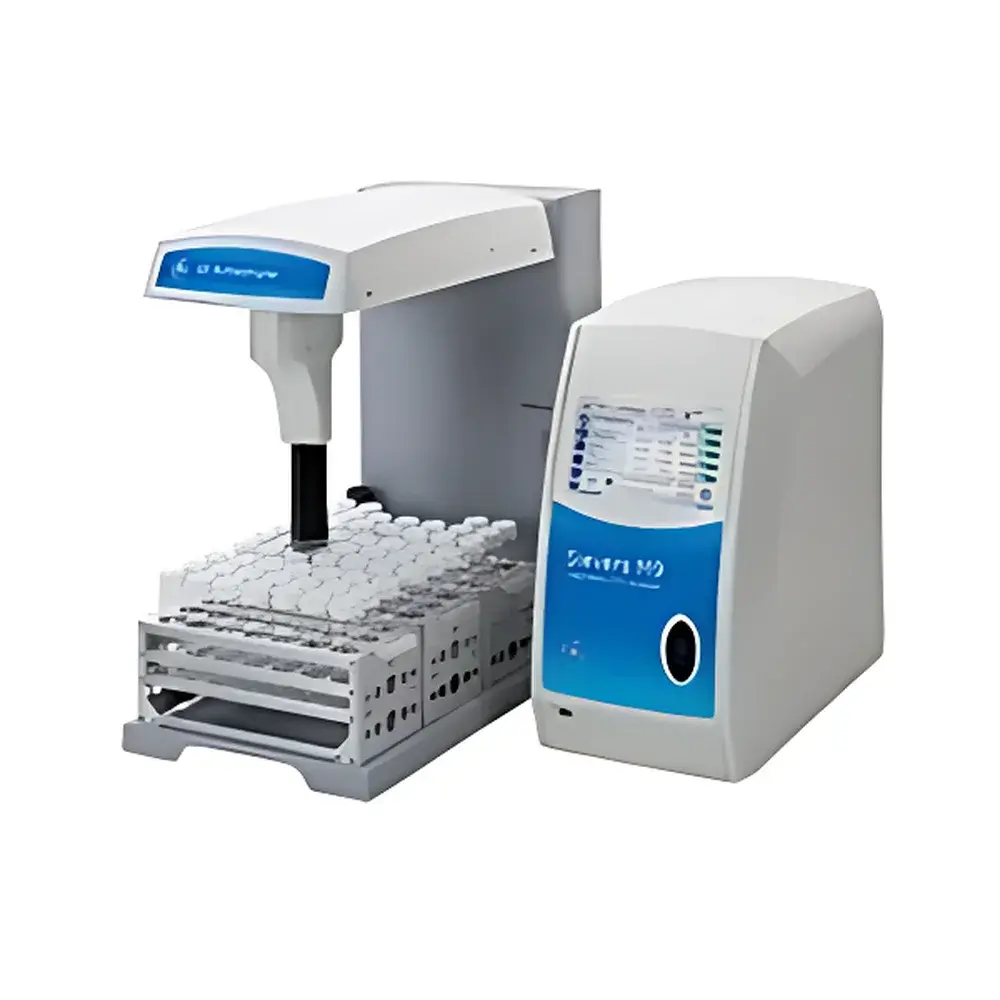
Sievers M9 Laboratory Total Organic Carbon Analyzer
| Brand | Sievers (Veolia) |
|---|---|
| Origin | USA |
| Model | M9 Laboratory |
| Detection Principle | Membrane Conductivity Detection |
| Oxidation Method | UV/Persulfate Oxidation |
| Measurement Range | 0.03 ppb – 50 ppm |
| Accuracy | ±2% or ±0.5 ppb (whichever is greater) |
| Resolution | 0.01 ppb |
| Detection Limit | 0.03 ppb |
| Repeatability | ≤1% RSD |
| Analysis Time | 2 minutes |
| Calibration Interval | 12 months |
| Communication Interfaces | USB, 4–20 mA, Modbus TCP/IP |
| Enclosure Rating | Dust- and Splash-Resistant (for online/portable variants) |
| Design | Modular, Touchscreen Dashboard, Reagent-Free Operation (no external gases or hazardous chemicals required) |
Overview
The Sievers M9 Laboratory Total Organic Carbon (TOC) Analyzer is an advanced, regulatory-compliant instrument engineered for high-precision quantification of organic carbon in ultrapure water, pharmaceutical process streams, clean-in-place (CIP) rinse solutions, and environmental water matrices. It employs a dual-stage oxidation strategy—combining 185/254 nm UV irradiation with sodium persulfate catalysis—to fully mineralize non-purgeable organic carbon (NPOC) into CO₂. The resulting carbon dioxide is selectively stripped from the aqueous matrix using membrane conductivity detection—a robust, reagent-free measurement technique that eliminates interferences from inorganic ions and minimizes maintenance burden. Unlike traditional NDIR or GC-based TOC systems, the M9’s membrane-conductivity architecture delivers stable baseline performance across wide dynamic ranges without optical alignment or gas supply dependencies. Its design adheres to critical industry standards including USP , EP 2.2.44, JP 2.59, ASTM D5907, and ISO 8245—making it suitable for GMP-regulated environments where data integrity and audit readiness are mandatory.
Key Features
- Sub-part-per-trillion sensitivity: Achieves a method detection limit of 0.03 ppb TOC with 0.01 ppb resolution—enabling trace-level monitoring in semiconductor-grade UPW and biopharmaceutical water-for-injection (WFI) systems.
- Two-minute analysis cycle: Optimized fluidic pathways and real-time conductivity compensation reduce total analysis time without compromising recovery or precision.
- Touchscreen dashboard interface: Intuitive 10.1-inch capacitive display with context-aware soft keys, guided workflows, and embedded help overlays—reducing operator training time and minimizing manual entry errors.
- Modular hardware architecture: Field-replaceable oxidation, sparging, and detection modules support rapid service intervention and minimize instrument downtime.
- Zero external gas or chemical dependency: No compressed air, zero-air generators, or acid reagents required—eliminating consumable logistics and safety hazards associated with traditional persulfate-acid oxidation methods.
- Automated compliance routines: Preloaded pharmacopeial test sequences (e.g., system suitability per USP , blank verification, carryover assessment) execute with full electronic signatures and audit trail logging.
Sample Compatibility & Compliance
The M9 accepts liquid samples ranging from deionized water to moderately saline matrices (up to 1000 µS/cm conductivity), with automatic conductivity compensation ensuring accuracy across varying ionic strength. It supports direct injection of filtered (0.45 µm) or unfiltered samples via optional autosampler integration. All data acquisition, processing, and storage comply with FDA 21 CFR Part 11 requirements—including role-based access control, electronic signatures, immutable audit trails, and secure user authentication. The system is validated per IQ/OQ/PQ protocols and includes built-in calibration verification checks traceable to NIST-certified potassium hydrogen phthalate (KHP) standards. Routine operation meets GLP and GMP documentation expectations for regulated laboratories conducting water quality release testing.
Software & Data Management
Instrument control and data handling are managed through Sievers Insight™ Software—a Windows-based platform supporting local and networked deployment. The relational database structure enables complex querying by sample ID, batch number, analyst, date range, or method version. Raw sensor outputs, intermediate calculations (e.g., TC, IC, NPOC), and QC metrics are stored with timestamped metadata. Export formats include CSV, PDF reports (with configurable templates), and XML for LIMS integration. Secure remote access is available via TLS-encrypted Modbus TCP/IP or HTTPS-enabled web portal—allowing centralized fleet monitoring while maintaining data sovereignty. All software updates undergo rigorous regression testing and are distributed with version-controlled release notes compliant with ICH Q5A and ISO/IEC 17025 change management guidelines.
Applications
- Pharmaceutical manufacturing: WFI, Purified Water (PW), and Clean Steam condensate monitoring per USP/EP/JP monographs.
- Semiconductor fabrication: Ultrapure water loop surveillance at point-of-use locations to ensure sub-ppb organic contamination control.
- Power generation: Boiler feedwater and condensate purity verification to prevent turbine deposit formation.
- Environmental compliance labs: EPA Method 415.3 and ISO 8245 implementation for wastewater effluent and surface water reporting.
- Academic and contract research: Method development for emerging contaminants (e.g., PFAS precursors, low-MW organics) requiring high-sensitivity carbon profiling.
FAQ
Does the M9 require daily calibration?
No. The M9 is designed for extended calibration stability with a recommended 12-month calibration interval under routine use, verified daily via system suitability testing.
Can the M9 measure both TC and IC simultaneously?
Yes. The instrument performs sequential TC and IC determinations using automated acid sparging and purge cycles within a single run, calculating NPOC as the difference.
Is the membrane conductivity detector susceptible to chloride interference?
No. The hydrophobic gas-permeable membrane selectively transports CO₂ while rejecting dissolved ions—including Cl⁻, SO₄²⁻, and NO₃⁻—ensuring accurate TOC quantification in high-salinity samples.
What validation documentation is provided with the instrument?
Each unit ships with a Factory Acceptance Test (FAT) report, IQ/OQ protocol templates, and a Certificate of Conformance traceable to NIST standards. PQ support materials include blank/standard acceptance criteria and repeatability verification worksheets.
How is data integrity ensured during power interruption or network failure?
All measurements are buffered locally on redundant non-volatile memory; unsynchronized data auto-resyncs upon network recovery with time-stamped conflict resolution logic.
Related Products







