
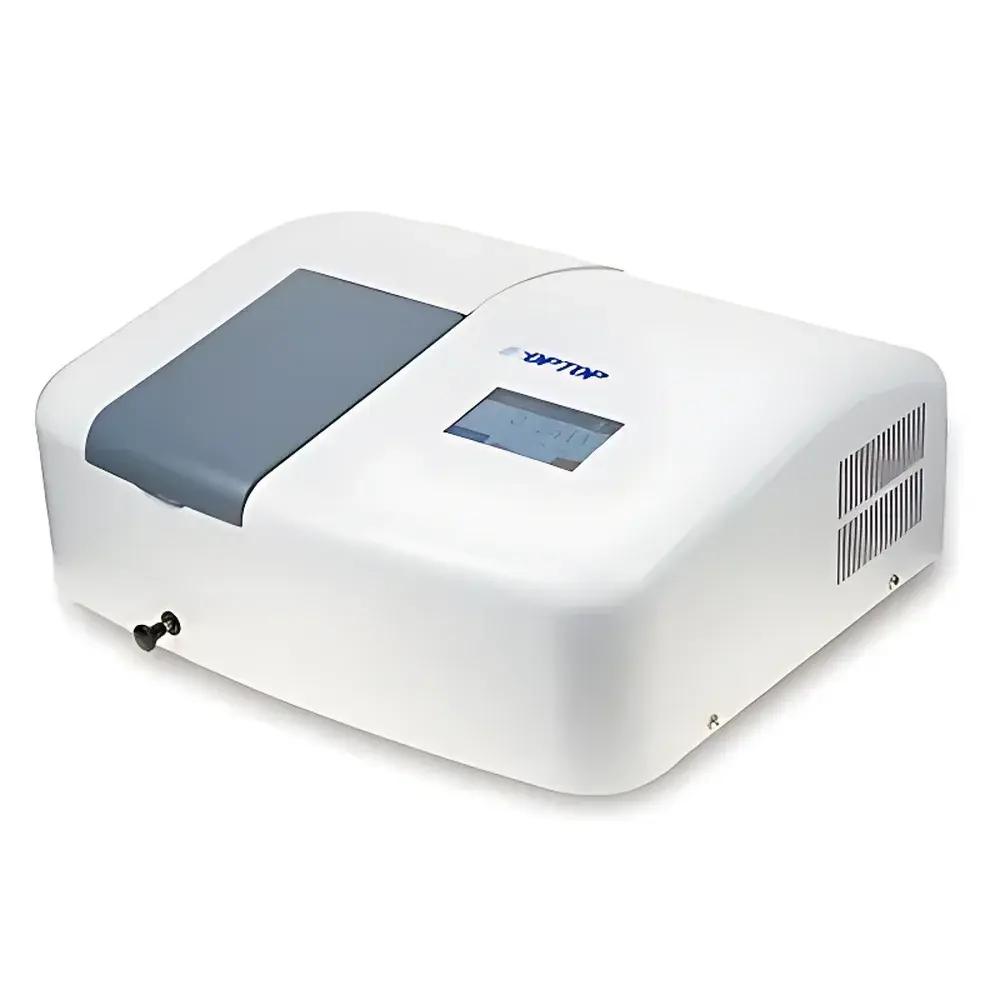
Sunny Hengping 752/754/756PC UV-Vis Spectrophotometer
| Brand | Sunny Hengping Instrument |
|---|---|
| Origin | Shanghai, China |
| Manufacturer Type | Direct Manufacturer |
| Regional Classification | Domestic (China) |
| Model | 752 / 754 / 756PC |
| Optical Design | Single-beam |
| Detector Type | Photocell |
| Wavelength Range | 190–1100 nm |
| Wavelength Accuracy | ±0.5 nm |
| Spectral Bandwidth | 2 nm (756PC), 4 nm (752/754) |
| Wavelength Resolution | 0.1 nm |
| Display | 4.3-inch color TFT touchscreen (480 × 272 pixels) |
| Data Interface | USB 2.0 |
| Power Supply | 220 V ±10%, 50 Hz or 110 V ±10%, 60 Hz |
| Net Weight | 10.5 kg |
| Dimensions (W×D×H) | 470 × 380 × 225 mm |
Overview
The Sunny Hengping 752/754/756PC UV-Vis Spectrophotometer is a benchtop single-beam optical instrument engineered for routine and research-grade quantitative and qualitative analysis in chemistry, biochemistry, pharmaceutical quality control, and environmental testing laboratories. It operates on the principle of Beer–Lambert law-based absorbance measurement, utilizing a Czerny–Turner (C-T) monochromator with a 1200-line/mm holographic grating to deliver precise wavelength selection across the ultraviolet, visible, and near-infrared spectral range (190–1100 nm). The 756PC variant features a narrow 2 nm spectral bandwidth—critical for resolving closely spaced absorption peaks and improving photometric accuracy—while the 752 and 754 models employ a 4 nm bandwidth optimized for general-purpose applications requiring robust signal-to-noise performance. All models integrate a stable photocell detector and stepper-motor-driven automatic wavelength scanning, ensuring reproducible spectral acquisition without manual alignment.
Key Features
- Automatic wavelength scanning with 0.1 nm resolution and ±0.5 nm wavelength accuracy—enabling high-fidelity spectral reconstruction and method transferability.
- 4.3-inch high-resolution color TFT touchscreen interface (480 × 272 pixels) with intuitive icon-driven navigation—designed for glove-compatible operation and reduced training time in regulated environments.
- Direct concentration readout functionality with user-definable concentration factors—supporting rapid assay turnaround for standard QC workflows.
- Linear and non-linear regression calibration (up to cubic and piecewise linear curves) for multi-point quantitative analysis—compatible with single-, dual-, and triple-wavelength measurement modes.
- DNA/protein quantification module with preconfigured A260/A280 ratio calculation, built-in extinction coefficients, and customizable wavelength/factor inputs—validated against USP and ISO 15795:2018 guidelines for nucleic acid purity assessment.
- Time-scan (kinetic) mode with programmable sampling intervals from 0.1 s to 9999 s—suitable for enzyme kinetics, reaction monitoring, and stability studies under GLP-compliant conditions.
Sample Compatibility & Compliance
The instrument accommodates standard 10 mm pathlength cuvettes (glass, quartz, or plastic), including matched pairs for baseline correction. Optional accessories include micro-volume adapters (down to 50 µL), temperature-controlled cell holders (±0.1 °C stability), and fiber-optic probes for remote or in-situ measurements. From a regulatory standpoint, the 756PC model—when equipped with optional audit trail firmware—supports ALCOA+ data integrity principles and meets foundational requirements for FDA 21 CFR Part 11 compliance, including electronic signature capability, user access control, and immutable event logging. All models conform to IEC 61010-1 safety standards and electromagnetic compatibility (EMC) per EN 61326-1. CE marking applies to EU-market units supplied with appropriate documentation packages.
Software & Data Management
The UV-Solution workstation software (standard on 756PC, optional for 754) provides a modular, Windows-based platform supporting full spectral acquisition, post-processing, and report generation. Core functions include wavelength scanning (absorbance, transmittance, energy), kinetic time scans, multi-wavelength quantitation, and 3D contour mapping (absorbance vs. wavelength vs. time). Advanced processing tools—such as Savitzky–Golay smoothing, derivative spectroscopy (1st–3rd order), peak/valley detection, and overlay comparison—are implemented using validated numerical algorithms traceable to NIST reference spectra. Data export options include CSV, Excel (.xlsx), BMP image files, and XML-based structured reports compatible with LIMS integration. Audit trail configuration (optional) records operator actions, parameter changes, and result modifications with timestamps and user IDs—fully compliant with GMP Annex 11 and ISO/IEC 17025 documentation requirements.
Applications
This spectrophotometer serves critical roles across multiple domains: in pharmaceutical QC labs, it validates raw material identity and assay potency per USP and EP 2.2.25; in academic research, it supports ligand-binding studies via titration-based absorbance shifts; in food safety testing, it enables nitrate/nitrite quantification at 540 nm using Griess reagent chemistry; and in water quality labs, it measures COD, phosphate, and heavy metal complexes following APHA Standard Methods. Its DNA/RNA quantification workflow aligns with QIAgen and Thermo Fisher protocol equivalency benchmarks, while its kinetic mode facilitates Michaelis–Menten parameter estimation in enzymology studies. Routine use cases also include dye concentration verification, polymer degradation monitoring, and pigment stability profiling under accelerated aging conditions.
FAQ
What is the difference between the 752, 754, and 756PC models?
The 752 and 754 share identical optical specifications (4 nm bandwidth, 200–1000 nm or 190–1100 nm range) but differ in software capability—the 754 includes basic curve-fitting and multi-wavelength analysis, whereas the 756PC adds full UV-Solution workstation support, 2 nm bandwidth, and audit trail readiness.
Is quartz cuvette compatibility supported across all models?
Yes—all models accept standard 10 mm quartz cuvettes for measurements below 220 nm. UV-grade quartz is recommended for reliable performance in the far-UV region (190–220 nm).
Can the instrument be integrated into a laboratory information management system (LIMS)?
Yes—via USB-hosted CSV/Excel exports and optional XML report templates, enabling automated ingestion into LIMS platforms that support file-based data import protocols.
Does the 756PC meet regulatory requirements for pharmaceutical testing?
When configured with audit trail firmware and operated under documented SOPs, the 756PC satisfies core elements of FDA 21 CFR Part 11 and EU GMP Annex 11 for electronic records and signatures—subject to site-specific validation per IQ/OQ/PQ protocols.
What maintenance is required to ensure long-term photometric accuracy?
Annual verification using NIST-traceable holmium oxide and didymium filters is recommended. Daily baseline correction using air or solvent blank, plus periodic lamp intensity checks (deuterium and tungsten sources), ensures consistent performance over extended service life.




