
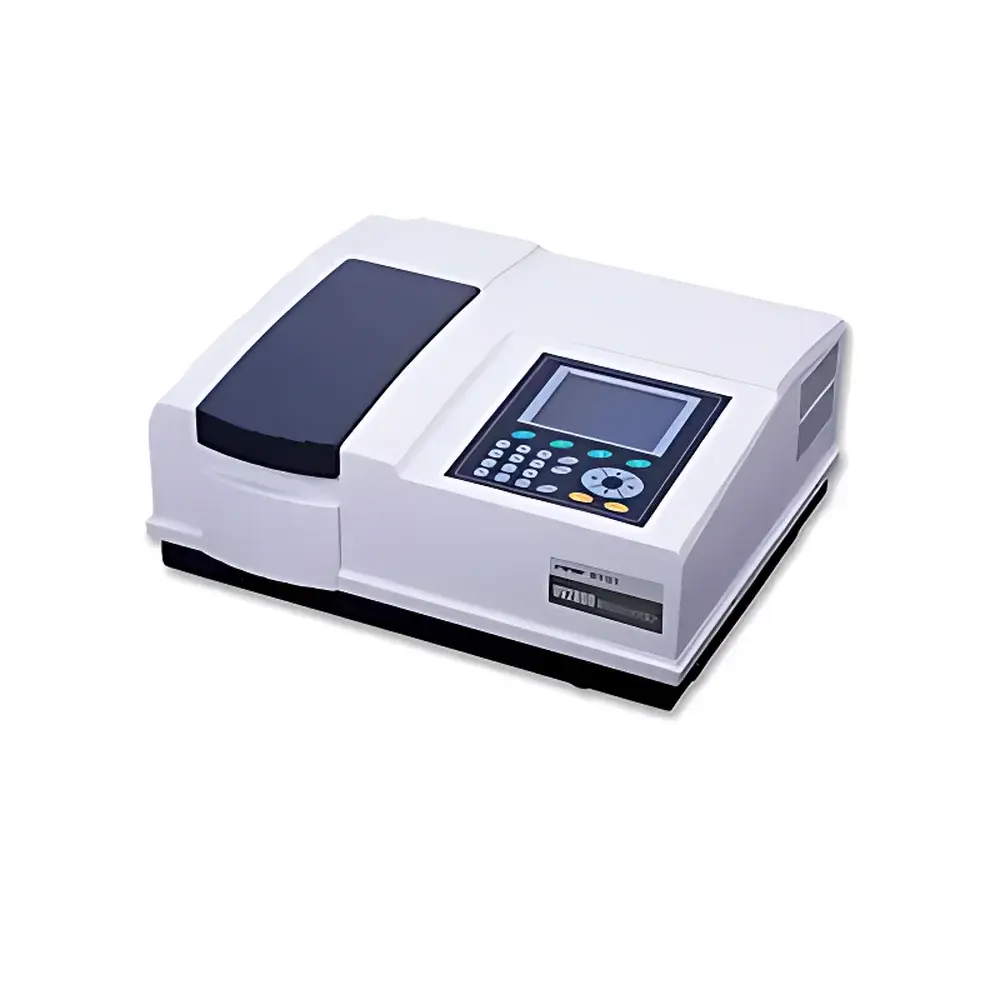
Sunny Hengping UV2800 / UV2800S Dual-Beam Ultraviolet-Visible Spectrophotometer
| Brand | Sunny Hengping Instrument |
|---|---|
| Origin | Shanghai, China |
| Manufacturer Type | Original Equipment Manufacturer (OEM) |
| Regional Classification | Domestic (PRC) |
| Model | UV2800 / UV2800S |
| Optical System | Dual-beam |
| Detector Type | Silicon Photocell |
| Wavelength Range | 190–1100 nm |
| Spectral Bandwidth | 1.8 nm (UV2800) |
| Wavelength Accuracy | ±0.3 nm |
| Wavelength Repeatability | ±0.1 nm |
| Photometric Accuracy | ±0.002 A (0–0.5 A), ±0.004 A (0.5–1 A), ±0.3 %T (0–100 %T) |
| Photometric Repeatability | ±0.001 A (0–0.5 A), ±0.002 A (0.5–1 A), ±0.15 %T (0–100 %T) |
| Stray Light | ≤0.03 %T at 220 nm & 360 nm |
| Baseline Flatness | ±0.001 A (200–1000 nm) |
| Scan Speed | 10–3000 nm/min (adjustable) |
| Display | 320 × 240 pixel LCD (6-inch) |
| Interface | USB 2.0 |
| Power Supply | 220 V ±10 %, 50 Hz or 110 V ±10 %, 60 Hz |
| Dimensions (W × D × H) | 545 × 450 × 235 mm |
| Net Weight | 17.0 kg |
| Gross Weight | 26.0 kg |
Overview
The Sunny Hengping UV2800 and UV2800S are dual-beam ultraviolet-visible (UV-Vis) spectrophotometers engineered for precision absorbance and transmittance measurements across a broad spectral range (190–1100 nm). Based on the fundamental principle of Beer-Lambert law quantification, these instruments employ a stable dual-beam optical architecture to continuously compensate for source intensity drift and detector response variation—ensuring high photometric reproducibility and long-term baseline stability. The UV2800 features a fixed 1.8 nm spectral bandwidth optimized for routine quantitative analysis in QC laboratories, while the UV2800S extends analytical flexibility with four selectable bandwidths (0.5, 1, 1.8, and 4 nm), enabling users to balance resolution, signal-to-noise ratio, and throughput according to sample matrix complexity and regulatory requirements. Both models integrate a deuterium lamp (UV) and tungsten-halogen lamp (visible/NIR) with automatic switching, ensuring seamless coverage without manual intervention.
Key Features
- Dual-beam optical design with real-time reference beam correction, minimizing drift-induced errors during extended scans or kinetic assays.
- Low stray light performance (≤0.03 %T at 220 nm and 360 nm) achieved through precision-aligned optics, high-efficiency diffraction gratings, and optimized detector shielding—critical for accurate high-concentration measurements and UV edge applications.
- Intuitive 6-inch 320 × 240 pixel monochrome LCD interface supporting full-spectrum visualization, interactive zoom, peak/valley detection, and on-board data storage with power-loss protection.
- Tool-free deuterium lamp replacement via flanged socket mount—eliminating post-replacement optical alignment and reducing instrument downtime.
- USB 2.0 interface compatible with UV-Solution workstation software for advanced data acquisition, processing, and compliance-ready reporting.
- Modular accessory support including automatic 6-cell holders, thermostatted cuvette racks (±0.1 °C stability), and micro-volume adapters (down to 50 µL pathlength).
Sample Compatibility & Compliance
The UV2800/UV2800S accommodates standard 10 mm square quartz, glass, or plastic cuvettes (pathlengths 1–100 mm), as well as flow cells, fiber-optic probes, and integrating spheres (with optional accessories). Its photometric accuracy and repeatability meet ASTM E275 and ISO 6059 specifications for UV-Vis spectrophotometer verification. When configured with UV-Solution software and audit trail module (optional), the system supports GLP and GMP environments by providing user-authenticated session logs, immutable measurement records, electronic signatures, and full traceability per FDA 21 CFR Part 11 requirements. Baseline flatness (±0.001 A over 200–1000 nm) and wavelength accuracy (±0.3 nm) are verified using NIST-traceable holmium oxide and didymium filters.
Software & Data Management
The optional UV-Solution software transforms the UV2800/UV2800S into a fully integrated analytical platform. It supports wavelength scanning (with adjustable step intervals from 0.1 to 5 nm), time-based kinetics (sampling intervals from 0.1 s to 60 min), multi-wavelength quantitation, and derivative spectroscopy up to third order. Quantitative modules include linear, quadratic, cubic, and piecewise calibration curves—with support for single-, dual-, and triple-wavelength methods. Specialized workflows include DNA/RNA (260/280 nm ratio, extinction coefficient input) and protein (280/260 nm, BCA/Lowry-compatible calculations). All spectra, kinetic traces, and calibration tables export natively to Excel (.xlsx) or bitmap (.bmp) formats. Raw data files retain metadata (instrument ID, operator, timestamp, method parameters) and are digitally signed to prevent tampering—enabling compliant archiving and cross-laboratory data exchange.
Applications
- Pharmaceutical quality control: Assay of active pharmaceutical ingredients (APIs), excipient purity, dissolution testing, and cleaning validation (e.g., residual solvent quantitation at 205 nm).
- Environmental analysis: Nitrate/nitrite (220 nm), phosphate (880 nm), COD (600 nm), and heavy metal chelates (e.g., Fe-phenanthroline at 510 nm).
- Life sciences: Nucleic acid quantification (A260), protein concentration (A280, A205), enzyme kinetics (NADH oxidation at 340 nm), and cell culture density monitoring (OD600).
- Materials science: Thin-film thickness estimation via interference fringe analysis, semiconductor bandgap determination, and dye degradation kinetics under UV irradiation.
- Food & beverage: Color index (AOAC methods), antioxidant capacity (DPPH assay at 517 nm), and vitamin C (ascorbic acid) stability profiling.
FAQ
What is the difference between UV2800 and UV2800S?
The UV2800 uses a fixed 1.8 nm spectral bandwidth, whereas the UV2800S offers four selectable bandwidths (0.5, 1, 1.8, and 4 nm) to optimize resolution vs. sensitivity for diverse sample types.
Does the instrument comply with pharmacopeial standards?
Yes—the optical performance meets USP , EP 2.2.25, and JP 2.05 requirements for UV-Vis spectrophotometers when operated within specified environmental conditions and validated using certified reference materials.
Can the UV-Solution software generate 21 CFR Part 11-compliant reports?
With the optional Audit Trail module enabled, UV-Solution provides electronic signatures, immutable record history, role-based access control, and full session logging required for regulated environments.
Is temperature-controlled measurement possible?
Yes—via optional Peltier-cooled or water-jacketed cuvette holders (operating range: 5–60 °C, ±0.1 °C stability), suitable for enzyme activity assays and thermal denaturation studies.
What maintenance is required for long-term reliability?
Routine cleaning of the sample compartment and optical window, annual lamp replacement (deuterium: ~1000 h lifetime; tungsten-halogen: ~2000 h), and biannual wavelength/photometric verification using NIST-traceable standards.





