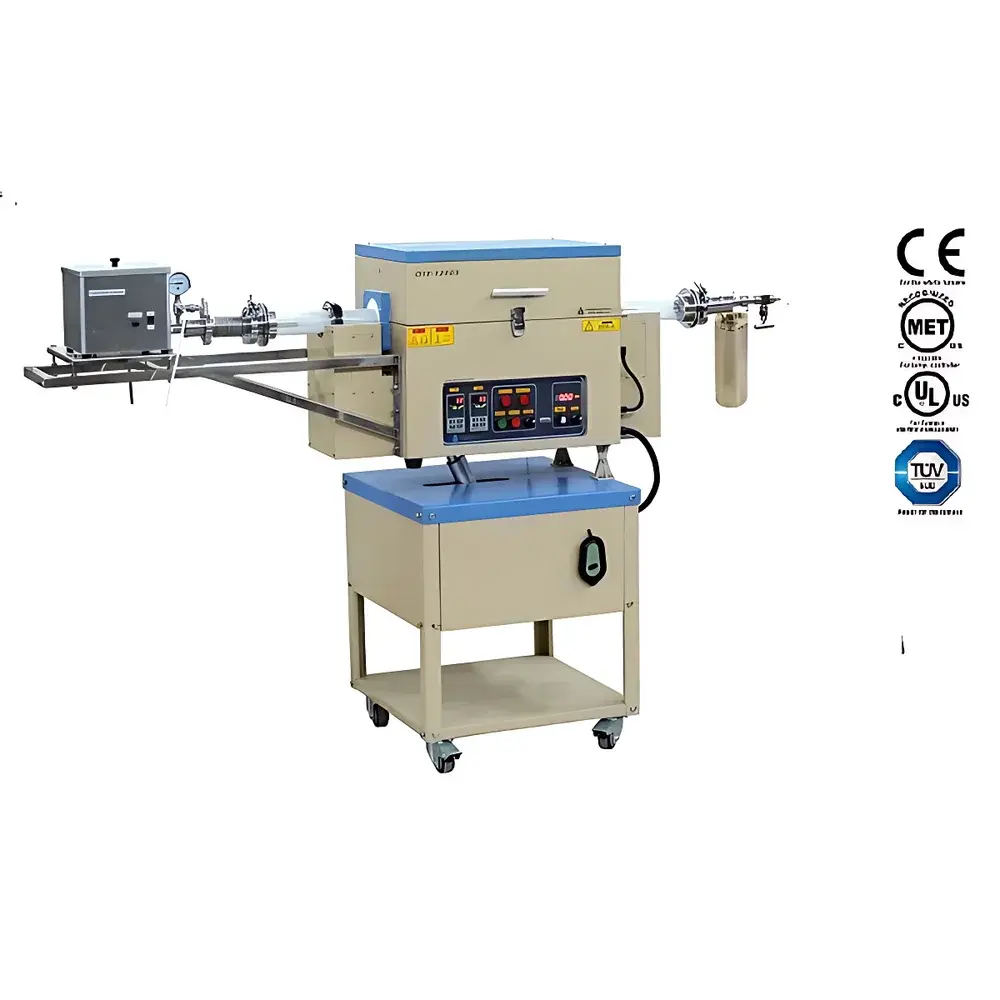
KEJING OTF-1200X-4-R-II-AF Dual-Zone Rotating Tube Furnace for Continuous CVD Coating of Powder Materials
| Brand | KEJING |
|---|---|
| Model | OTF-1200X-4-R-II-AF |
| Maximum Operating Temperature | 1200 °C (≤1 h) |
| Continuous Operating Temperature | 1100 °C |
| Heating Zones | 2 × 200 mm (total 400 mm), each independently controlled |
| Uniform Temperature Zone | 200 mm (±1 °C at setpoint) |
| Tube Dimensions | Quartz, 100 mm OD × 1200 mm L (tapered ends: 60 mm OD) |
| Rotation Speed | 0–10 RPM (DC motor-driven) |
| Tilt Angle | Left 0–30°, Right 0–15° |
| Vacuum Level | 4.5×10⁻² Torr (mechanical pump) |
| Gas Flow Limit | ≤200 SCCM |
| Feed Rate | Up to 97 cm³/min (adjustable via potentiometer) |
| Collection Vessel | 1 L stainless steel canister with inert-atmosphere sealing |
| Power | 4 kW (furnace) + 200 W (feeder), AC 208–240 V, single-phase, 30 A circuit breaker required |
| Net Weight | 125 kg |
| Certifications | CE, UL/MET/CSA compliant (>24 V components), optional TÜV or CSA certification available upon customer request |
Overview
The KEJING OTF-1200X-4-R-II-AF is a dual-zone rotating tube furnace engineered for continuous chemical vapor deposition (CVD) processing of fine powder materials under precisely controlled thermal and atmospheric conditions. Unlike static tube furnaces, its rotation mechanism—combined with internal mixing blades and programmable tilt—ensures uniform exposure of particulate substrates to reactive precursor gases across the entire heated length. The system operates on the principle of fluidized-bed-like transport within a sealed quartz reaction tube, where controlled rotational motion prevents particle agglomeration, promotes homogeneous gas–solid interaction, and enables scalable surface modification. Designed specifically for functional coating of battery electrode powders, it supports high-reproducibility carbon or metal oxide encapsulation (e.g., conductive carbon layers on LiFePO₄ or LiMnNiO₃ cathodes) and synthesis of composite anode materials such as Si/C nanocomposites. Its architecture integrates thermal stability, inert-gas compatibility, and modular gas-handling readiness—making it suitable for R&D laboratories and pilot-scale process development in solid-state energy materials, catalysis, and advanced ceramics.
Key Features
- Dual independent heating zones (2 × 200 mm), each equipped with Omega K-type thermocouples and 30-segment programmable PID controllers for precise thermal profiling and gradient control.
- Rotating quartz tube (100 mm OD × 1200 mm L, tapered ends) mounted on a DC motor drive system with continuously adjustable speed (0–10 RPM) and mechanical tilt capability (left: 0–30°, right: 0–15°) to optimize residence time and mixing efficiency.
- Integrated automatic powder feeder with gas-tight seal, enabling metered introduction of solid precursors into the hot zone under inert atmosphere (N₂, Ar); feed rate adjustable from 0 to 97 cm³/min via front-panel potentiometer.
- Stainless steel 1 L collection canister installed at the outlet end, maintaining atmosphere integrity during product recovery—critical for air-sensitive or pyrophoric coated powders.
- Robust double-layer furnace body with forced-air cooling system and high-purity alumina fiber insulation (coated with Al₂O₃) for thermal efficiency, rapid cooldown, and long-term structural integrity at 1100 °C continuous operation.
- Standard quartz tube mounting includes two stainless steel flanges with integrated needle valves and rotary feedthroughs, supporting leak-tight connections to external gas delivery and vacuum systems.
Sample Compatibility & Compliance
The OTF-1200X-4-R-II-AF accommodates free-flowing, non-sintering powders with particle sizes ranging from submicron to ~100 µm—ideal for cathode active materials (e.g., olivine- and layered-oxide lithium compounds), silicon nanoparticles, metal oxides, and pre-carbonized precursors. It complies with CE safety directives and all electrical components rated above 24 V meet UL, MET, and CSA standards. While not inherently GLP/GMP-certified, the system’s design supports audit-ready operation when paired with validated gas manifolds, calibrated pressure transducers, and documented maintenance logs. For regulated environments (e.g., battery material qualification per ISO 12405 or USP analytical instrument qualification), optional TÜV or CSA certification can be arranged—subject to customer-funded third-party assessment and documentation review.
Software & Data Management
The furnace employs standalone digital temperature controllers with local display and manual setpoint input; no proprietary software is embedded. However, each controller provides analog output (0–5 V or 4–20 mA) compatible with external data acquisition systems (e.g., LabVIEW, MATLAB, or SCADA platforms) for real-time logging of temperature profiles, rotation speed, and process duration. All thermal programs—including ramp rates, hold times, and soak sequences—are stored in non-volatile memory and retain settings after power cycling. For full traceability in quality-critical applications, users may integrate optional Ethernet-enabled controllers (available as upgrade) supporting Modbus TCP communication and 21 CFR Part 11-compliant electronic signatures when deployed with validated software infrastructure.
Applications
- Continuous CVD coating of lithium-ion battery cathode powders (LiCoO₂, NMC, LiFePO₄) with conformal carbon or Al₂O₃ layers to enhance electronic conductivity and interfacial stability.
- Synthesis of silicon–carbon composite anode materials via hydrocarbon decomposition (e.g., C₂H₂ or CH₄) on nano-Si particles, with in situ control over carbon graphitization degree.
- Surface passivation of transition metal phosphides or sulfides for electrocatalytic applications using metalorganic precursors (e.g., TiCl₄ + H₂O for TiO₂ shells).
- Thermal annealing and dopant incorporation in metal oxide nanopowders (e.g., SnO₂, ZnO) under controlled oxygen partial pressure gradients enabled by dual-zone temperature differentials.
- Preparation of core–shell catalyst supports (e.g., Ni@SiO₂, Co@C) where rotational homogeneity minimizes shell thickness variation and improves batch-to-batch reproducibility.
FAQ
What is the maximum safe operating pressure inside the quartz tube?
The internal pressure must not exceed 0.02 MPa (≈0.2 bar gauge). A pressure relief valve is mandatory if upstream gas supply exceeds this limit.
Can the furnace operate under high vacuum during high-temperature runs?
No. At temperatures above 1000 °C, the quartz tube must remain at near-atmospheric pressure to prevent thermal stress-induced fracture. Vacuum operation is only permitted below 1000 °C.
What is the recommended gas flow rate for stable CVD processing?
Total inlet gas flow should be maintained ≤200 SCCM to avoid localized cooling of the quartz tube walls and ensure laminar flow dynamics across the rotating bed.
Is the quartz tube included with the system rated for prolonged use at 1100 °C?
The supplied high-purity fused quartz tube is rated for continuous service up to 1100 °C. Extended exposure above this temperature accelerates devitrification and reduces mechanical strength.
Does the system support integration with mass flow controllers and residual gas analyzers?
Yes. Standard 1/4″ VCR or Swagelok-compatible ports on both flanges allow direct connection to MFCs, RGA inlets, and exhaust scrubbers—enabling closed-loop process monitoring and endpoint detection.