
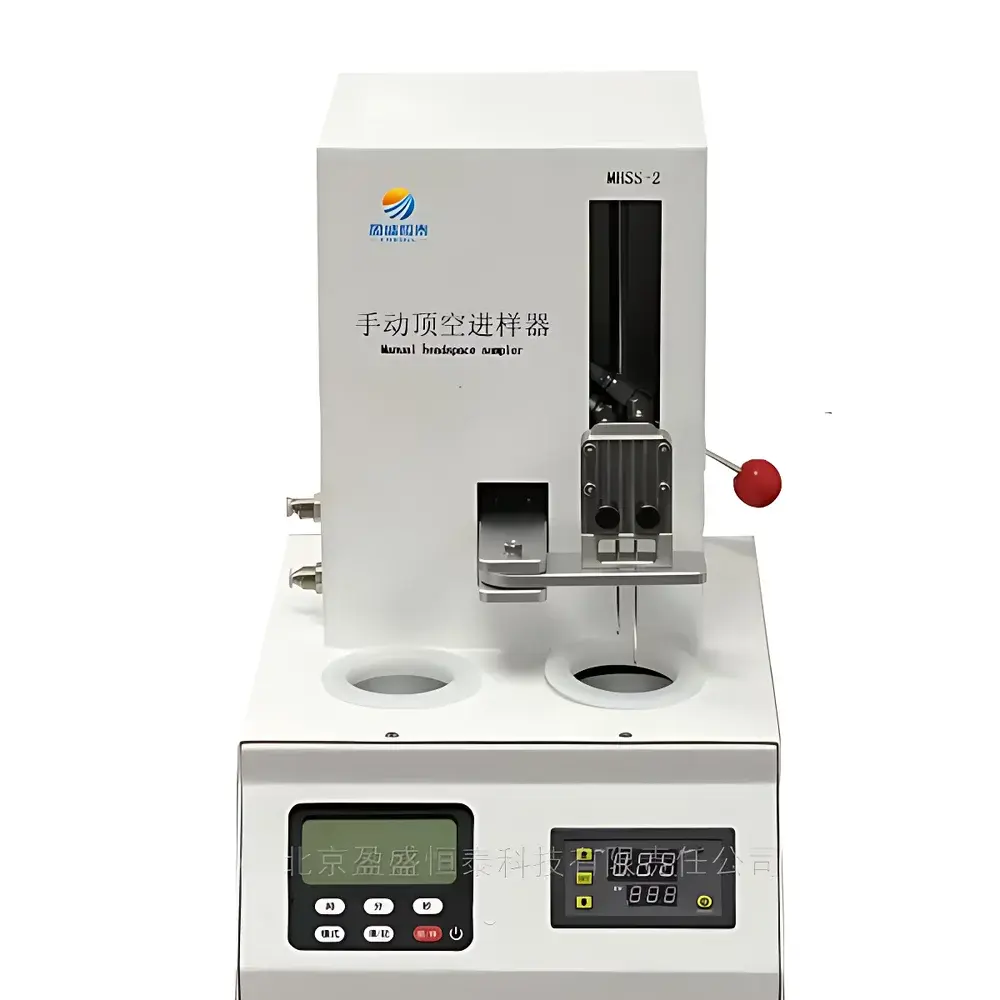
ENSOUL MHSS-2 Manual Headspace Sampler for PEN Series Electronic Nose
| Brand | ENSOUL |
|---|---|
| Model | MHSS-2 |
| Sample Positions | 2 |
| Heating Temperature Range | Ambient to 100 °C |
| Temperature Accuracy | ±3 °C |
| Timer Range | 0–999 min |
| Power Supply | AC 220 V |
| Power Consumption | 420 W |
| Compatibility | PEN-series electronic nose systems |
| Application | Headspace volatile profiling for sensory intelligent analysis |
Overview
The ENSOUL MHSS-2 Manual Headspace Sampler is a purpose-engineered auxiliary module designed exclusively for integration with the PEN-series electronic nose platforms. It operates on the principle of static headspace sampling—thermally equilibrating solid or liquid samples in sealed vials, then manually extracting the volatile organic compound (VOC)-enriched headspace gas via a precision-guided stainless-steel needle for direct introduction into the PEN sensor array. Unlike automated systems, the MHSS-2 employs manual vertical actuation of the sampling needle, granting the operator full tactile control over penetration depth, dwell time, and syringe displacement—critical parameters influencing vapor-phase mass transfer reproducibility. Its compact benchtop architecture, combined with programmable heating and timing functions, ensures consistent thermal conditioning across dual sample positions, thereby minimizing inter-sample variance in VOC headspace concentration—a prerequisite for high-fidelity pattern recognition in olfactory fingerprinting.
Key Features
- Two-position sample carousel enabling sequential analysis without thermal cooldown interruption
- Independent temperature control from ambient to 100 °C with ±3 °C stability—sufficient for low-to-moderate volatility compounds including aldehydes, esters, terpenes, and short-chain fatty acids
- Adjustable timer (0–999 minutes) with audible alarm for precise incubation duration control—essential for kinetic headspace equilibration studies
- Manual needle actuation mechanism with calibrated vertical travel and positive stop limits—ensures repeatable puncture depth and minimizes septum damage or vial overpressure
- Low thermal mass aluminum heating block for rapid temperature ramping and uniform heat distribution across both vial wells
- Integrated safety cutoff and thermal insulation to maintain operator safety during extended heating cycles
Sample Compatibility & Compliance
The MHSS-2 accommodates standard 10–20 mL crimp-top or screw-cap headspace vials (e.g., ASTM D7622-compliant containers). It supports diverse matrices including food homogenates, fermented beverages, pharmaceutical excipients, polymer off-gassing samples, and environmental soil/water extracts. While the unit itself does not carry CE, UL, or FDA certification as a standalone device, its operational parameters align with established headspace methodology guidelines in ISO 17258 (electronic nose performance validation) and ASTM E2799 (sensory analytical terminology). When used within a validated PEN-series workflow under GLP conditions, raw headspace injection data—including timestamped temperature logs and user-initiated actuation events—can be archived as part of audit-ready analytical records.
Software & Data Management
The MHSS-2 operates independently of software control; however, its thermal and timing parameters are synchronized with PEN-series acquisition software (e.g., PEN Workbench v4.x) via hardware-triggered TTL pulses or manual annotation fields. All experimental metadata—including setpoint temperature, equilibration duration, vial ID, and operator initials—are manually logged or imported into the PEN platform’s structured database schema. This enables traceable linkage between physical sampling conditions and resulting sensor response matrices. For regulated environments requiring electronic record integrity, users may implement 21 CFR Part 11-compliant add-ons (e.g., third-party ELN integrations) to enforce user authentication, change tracking, and digital signature workflows around MHSS-2-derived datasets.
Applications
- Quality control of packaged foods: detection of lipid oxidation markers (hexanal, pentanal), microbial spoilage volatiles (dimethyl sulfide, ethanol), and shelf-life prediction
- Pharmaceutical formulation screening: monitoring excipient compatibility, residual solvent profiling (acetone, dichloromethane), and degradation product evolution
- Environmental odor assessment: semi-quantitative characterization of landfill leachate, wastewater treatment emissions, and compost off-gases
- Agri-tech authenticity verification: differentiation of geographical origin in olive oil, honey, and wine based on terroir-specific VOC signatures
- Academic research in chemosensory science: controlled stimulus delivery for cross-modal perception studies and biosensor calibration protocols
FAQ
Is the MHSS-2 compatible with non-PEN electronic nose platforms?
No—the MHSS-2 is mechanically and pneumatically optimized for PEN-series inlet manifolds, including standardized needle port geometry, pressure tolerances, and flow path alignment. Integration with other e-nose systems requires custom adapter design and flow calibration.
Can the MHSS-2 perform dynamic headspace sampling?
No—it is strictly a static headspace sampler. Dynamic (purge-and-trap) functionality requires external gas supply, flow controllers, and cold trap modules not supported by this model.
What maintenance is required for long-term reliability?
Routine cleaning of the heating block recesses and needle guide sleeve with isopropanol; annual verification of temperature sensor calibration using NIST-traceable dry-block calibrators; replacement of silicone septa after ~50 punctures per vial.
Does the MHSS-2 include data logging capability?
No internal memory or USB interface is provided. Temperature and timer status are displayed locally on the LED panel only; all data capture must occur externally via PEN software or manual logbooks.
Is the MHSS-2 suitable for regulated QC laboratories?
Yes—as a peripheral sampling tool within a fully validated PEN-based method. Full compliance depends on documented SOPs covering vial handling, temperature verification, needle sterilization, and operator training—not on the MHSS-2’s intrinsic certification status.




