
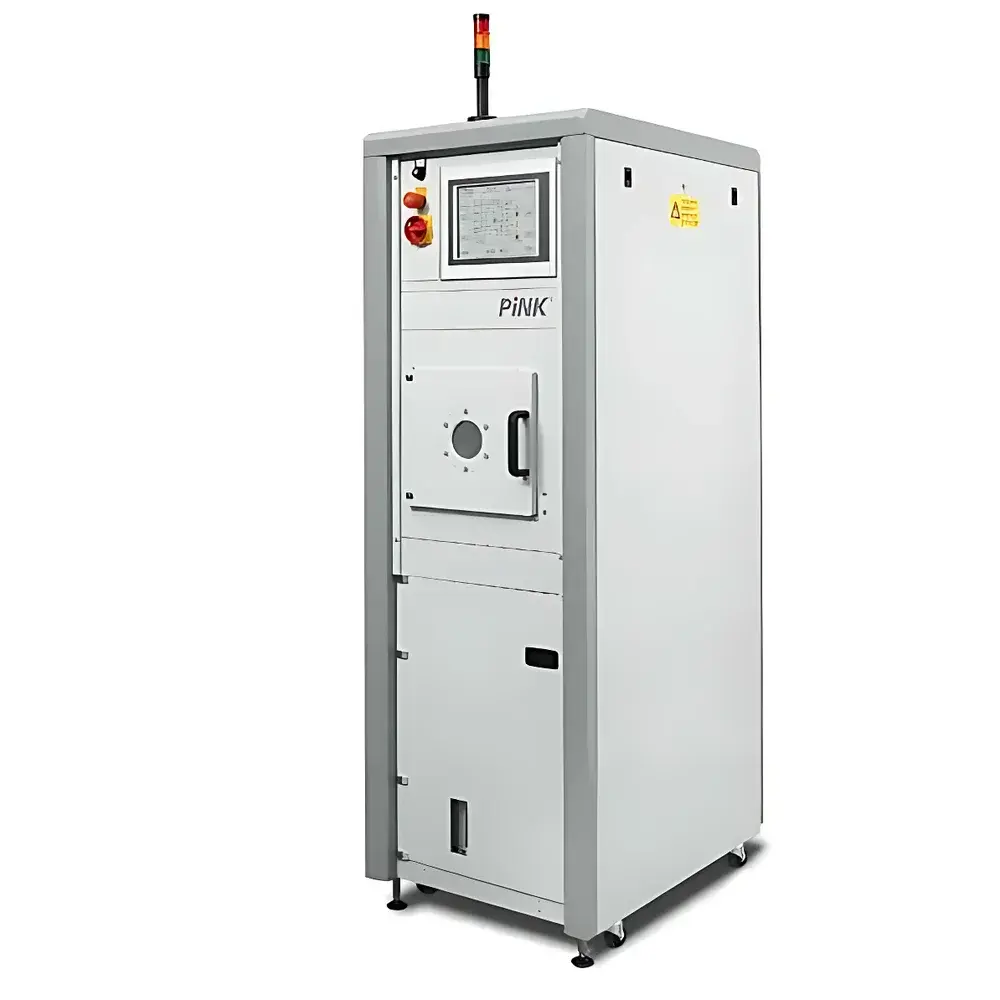
Pink V15-G Microwave Plasma Cleaner
| Brand | Pink |
|---|---|
| Origin | Germany |
| Manufacturer Type | Authorized Distributor |
| Origin Category | Imported |
| Model | V15-G |
| Microwave Frequency | 2.45 GHz |
| Microwave Power Range | 100–600 W |
| Chamber Dimensions (W×D×H) | 250 × 250 × 250 mm |
| Overall Dimensions (W×D×H) | 630 × 900 × 1850 mm |
| Gas Control | Standard Single-Channel MFC, Optional Expansion |
| Electrodeless Plasma Source | Yes |
| Online Integration Capability | Yes |
Overview
The Pink V15-G Microwave Plasma Cleaner is an industrial-grade, electrodeless plasma surface treatment system engineered for high-reproducibility cleaning, activation, and functionalization of substrates under low-pressure conditions. Utilizing 2.45 GHz microwave energy to generate a high-density, uniform plasma without internal electrodes, the V15-G eliminates contamination risks associated with sputtering or arcing—critical for sensitive microelectronic, optical, and biomedical components. Designed and manufactured by PINK GmbH Thermosysteme—a division of the German vacuum technology specialist PINK GmbH—the system integrates seamlessly into cleanroom-compatible environments and automated sample preparation workflows. Its core architecture adheres to ISO 14644-1 Class 5 cleanroom compatibility requirements and supports traceable process execution in accordance with GLP and GMP-aligned laboratory practices.
Key Features
- Electrodeless microwave plasma generation ensures zero particulate shedding and long-term plasma stability across repeated cycles.
- High-radical-density plasma environment (O•, OH•, F•, N•) enables efficient removal of organic contaminants, native oxides, and photoresist residues at sub-monolayer levels.
- Customizable plasma reactor geometry accommodates diverse part geometries—including stacked wafers, MEMS packages, and irregularly shaped optical lenses—without compromising uniformity.
- Precise, closed-loop control of microwave power (100–600 W), gas composition (O₂, Ar, N₂, CF₄, or mixtures), and chamber pressure (1–100 Pa) enables fine-tuned process optimization for material-specific surface modification.
- Integrated mass flow controller (MFC) provides ±1% full-scale accuracy for single-gas operation; optional multi-channel MFC expansion supports sequential or blended gas chemistries.
- Modular design supports integration with robotic load-lock systems and inline conveyor interfaces per SEMI E10 and E12 standards.
Sample Compatibility & Compliance
The V15-G accepts substrates up to 250 mm × 250 mm × 250 mm in volume, including silicon wafers, fused silica optics, ceramic substrates, stainless steel watch components, polymer-based smart cards, and gold-plated RF connectors. Surface treatment outcomes comply with ASTM F2459 (standard guide for plasma cleaning of medical devices) and ISO 15730 (plasma surface activation of plastics). Process logs—including power ramp profiles, gas flow timestamps, and pressure transients—are timestamped and exportable in CSV/Excel format for audit readiness under FDA 21 CFR Part 11 and EU Annex 11 requirements.
Software & Data Management
The system operates via a Windows-based HMI with deterministic real-time control firmware (IEC 61131-3 compliant). All process parameters are stored in a local SQLite database with SHA-256 hashed integrity verification. User access levels (Operator, Technician, Administrator) enforce role-based parameter locking. Audit trails record user login/logout events, parameter changes, and alarm acknowledgments with immutable timestamps. Raw sensor data (microwave forward/reflected power, chamber pressure, MFC setpoints) can be streamed via TCP/IP to external LIMS or MES platforms using OPC UA protocol.
Applications
- Pre-bonding surface activation of glass-to-silicon MEMS wafers to enhance anodic bonding yield.
- Residue-free deburring and oxide reduction on precision-machined watch movement components prior to PVD coating.
- Removal of spin-coated photoresist and developer residues from lithography masks without substrate etching.
- Hydrophilic functionalization of PET and PC substrates used in microfluidic chip fabrication.
- Contamination control for high-NA optical lens assemblies prior to anti-reflective thin-film deposition.
- Surface conditioning of implant-grade titanium alloys to improve osseointegration in pre-clinical device testing.
FAQ
What vacuum level is required for stable plasma ignition?
Stable microwave plasma ignition is achieved between 5–50 Pa, with optimal cleaning uniformity observed at 15–25 Pa using O₂ or Ar/O₂ mixtures.
Can the V15-G be validated for ISO 13485-certified production environments?
Yes—the system supports IQ/OQ documentation packages, including factory acceptance test (FAT) reports, calibration certificates for all critical sensors, and traceable metrology records aligned with ISO/IEC 17025-accredited providers.
Is remote diagnostics supported?
Yes—via encrypted TLS 1.2 VPN tunneling; remote support sessions require dual-factor authentication and leave no persistent remote access channels post-session.
What maintenance intervals are recommended for the microwave waveguide and quartz chamber window?
Quartz window inspection is scheduled every 500 operational hours; waveguide desiccant replacement is required every 12 months or after 2,000 hours of cumulative runtime.



