
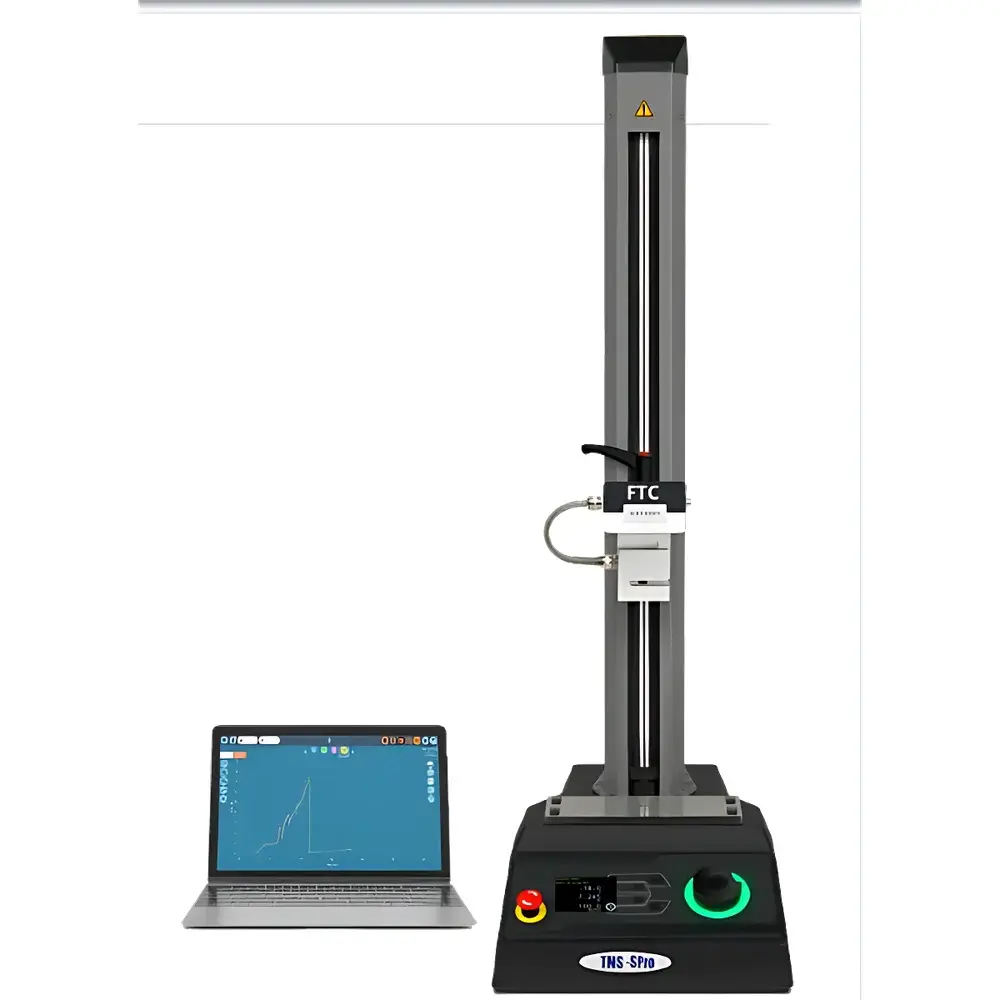
FTC TMS-SPro High-Precision Texture Analyzer
| Brand | FTC |
|---|---|
| Origin | USA |
| Model | TMS-SPro |
| Software Platform | VPro MT |
| Compliance | FDA 21 CFR Part 11, GLP/GMP-ready |
| Application Domain | Food, Pharmaceutical, Agricultural, Cosmetic & Material Science Testing |
| Measurement Principle | Controlled-Force Compression/Tension/Penetration with Load Cell-Based Force Transduction and Precision Displacement Sensing |
Overview
The FTC TMS-SPro High-Precision Texture Analyzer is a research-grade, microprocessor-controlled mechanical testing system engineered for objective, quantitative characterization of physical textural properties in soft solids, semi-solids, and viscoelastic materials. Based on the fundamental principles of uniaxial compression, tension, bending, extrusion, and penetration—measured via high-resolution load cell transduction (typically ±0.01% full scale) and calibrated linear displacement sensing—the TMS-SPro delivers reproducible force-deformation profiles essential for texture profiling, quality control validation, and formulation development. Its modular mechanical architecture supports interchangeable probes (e.g., cylindrical, conical, blade, wire-cut, Kramer shear), fixtures (e.g., three-point bend, tensile grips, dough extensibility rigs), and environmental accessories (e.g., temperature-controlled chambers), enabling standardized execution of ASTM, ISO, and USP methods—including ASTM F307 (penetration resistance), ISO 11357-3 (thermal-mechanical behavior), and USP (mechanical testing of dosage forms).
Key Features
- High-precision dual-range load cell (e.g., 50 N and 500 N options) with real-time digital filtering and thermal drift compensation
- Motor-driven crosshead with programmable speed range (0.01–20 mm/s), acceleration/deceleration ramp control, and position resolution ≤0.1 µm
- VPro MT software platform featuring icon-based, drag-and-drop test method builder—enabling rapid creation of multi-step protocols (e.g., pre-test dwell → compression → hold → decompression → second compression)
- Integrated audit trail with time-stamped, user-identified records of all parameter changes, data exports, and software actions—fully compliant with FDA 21 CFR Part 11 requirements for electronic records and signatures
- Role-based multi-level user permissions (Administrator, Supervisor, Technician, Viewer) with encrypted password policies and session timeout enforcement
- Native support for networked deployment: simultaneous control and data aggregation across multiple TMS-SPro units via centralized server architecture
- Automated data capture including raw force vs. time/displacement curves, peak force, deformation at yield, slope (stiffness), area under curve (toughness), and derived indices (e.g., hardness, cohesiveness, springiness, chewiness per the Bloom–Szczesniak framework)
Sample Compatibility & Compliance
The TMS-SPro accommodates a broad spectrum of sample geometries and mechanical behaviors—from low-force measurements on delicate items (e.g., fresh fruit flesh, gels, yogurt) to high-load evaluation of rigid or fibrous matrices (e.g., cheese blocks, meat jerky, baked goods, pharmaceutical tablets). Standardized fixtures ensure repeatability across laboratories; examples include TA-XT Plus–compatible probe mounts, AACC-approved bread compression platens, and USP-compliant tablet fracture fixtures. All hardware and firmware conform to IEC 61000-6-3 (EMC emissions) and IEC 61010-1 (safety for laboratory equipment). The system is validated for use in GxP environments and supports IQ/OQ documentation packages aligned with ISO/IEC 17025 and ASTM E2500.
Software & Data Management
VPro MT serves as the analytical core of the TMS-SPro ecosystem. Beyond intuitive method development, it provides batch processing, statistical process control (SPC) charting, ANOVA-enabled comparative analysis across ≥100 test runs, and export to CSV, Excel, PDF, and XML formats—including structured metadata (sample ID, operator, timestamp, instrument serial number, calibration status). Raw data files are stored in proprietary .vpr format with embedded checksums to prevent tampering. The software supports LIMS integration via ODBC and HL7 interfaces, and includes built-in report templates compliant with internal SOPs and external regulatory submissions (e.g., FDA IND/NDA modules, EFSA dossiers).
Applications
- Food Science: Quantification of tenderness in cooked meats (Warner–Bratzler shear), crispness of snacks (three-point bend), spreadability of margarines (extrusion), and gel strength of pectin-based desserts (compression)
- Pharmaceutical Development: Tablet hardness and friability assessment, capsule shell elasticity, chewable tablet disintegration kinetics, and transdermal patch adhesion profiling
- Agricultural Research: Fruit ripeness staging via puncture resistance, root tensile strength evaluation, and grain kernel hardness mapping
- Cosmetic Formulation: Rheological fingerprinting of creams and lotions (extrusion flow curves), lipstick breakage force, and mascara film flexibility
- Material Science: Mechanical characterization of hydrogels, biodegradable films, foams, and edible packaging substrates under controlled humidity and temperature conditions
FAQ
Does the TMS-SPro comply with FDA 21 CFR Part 11 for electronic records and signatures?
Yes—VPro MT implements full audit trail logging, electronic signature workflows, and role-based access controls required for regulated environments.
Can test methods be exported and shared between laboratories?
Yes—VPro MT supports .vpm method file export/import, ensuring protocol consistency across global R&D sites.
Is third-party calibration traceable to NIST standards?
All factory calibrations are performed using NIST-traceable deadweight standards and documented in the Certificate of Calibration supplied with each unit.
What types of probes and fixtures are available?
Over 80 standardized probes and fixtures are supported—including Warner–Bratzler blades, Kramer shear cells, spherical probes, and custom-engineered solutions for industry-specific applications.
How is data security maintained during networked operation?
Communication between client workstations and the central server uses TLS 1.2 encryption; local database storage employs AES-256 encryption with key management integrated into Windows Active Directory policies.





