
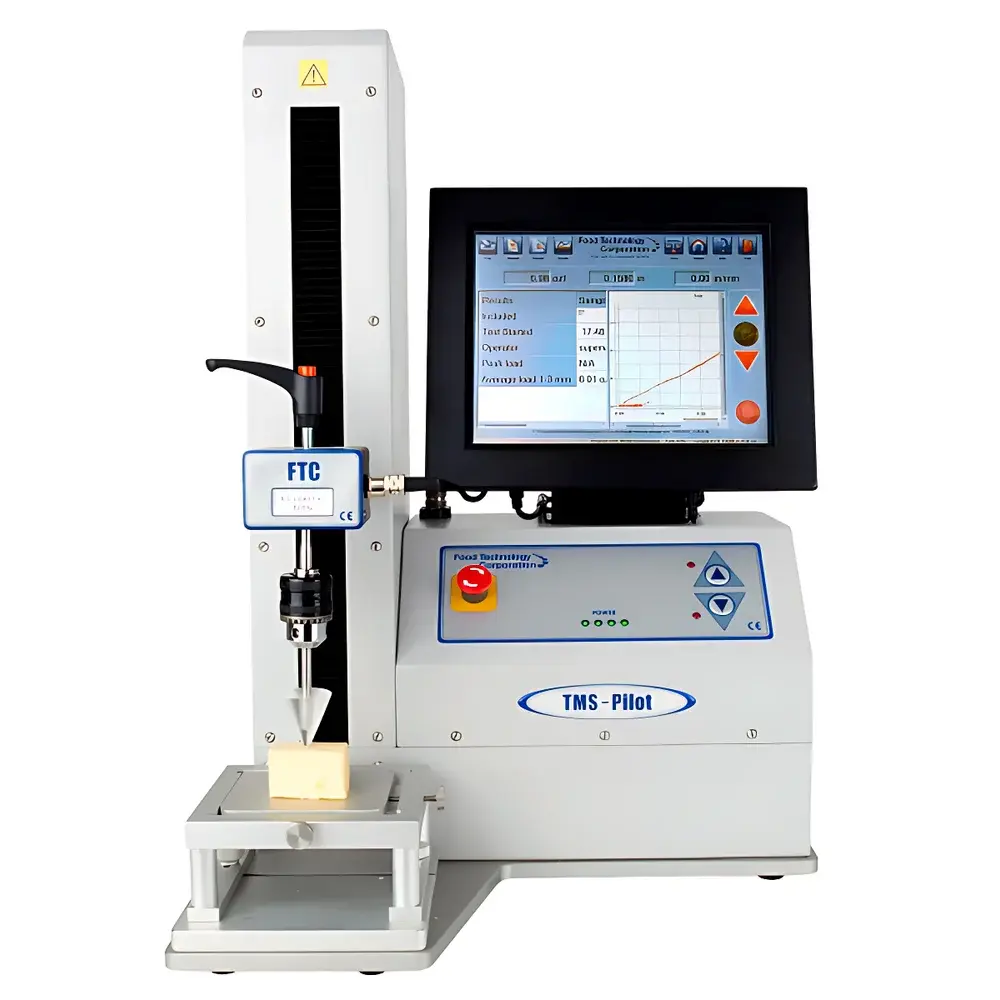
FTC PILOT Texture Analyzer
| Brand | FTC |
|---|---|
| Model | PILOT |
| Type | Universal Texture Analyzer for Food Applications |
| Force Range | Optimized for Low-to-Medium Load Testing (Typical Range: 0–500 N, Configurable per Sensor Module) |
| Display | Integrated High-Resolution LCD Touchscreen Interface |
| Connectivity | USB & RS-232 |
| Compliance | Designed to Support ASTM F2714, ISO 11357-3, USP <721>, and GLP/GMP Data Integrity Requirements |
| Software | FTC Texture Pro™ v4.x with Audit Trail, User Access Levels, and 21 CFR Part 11–Ready Configuration Options |
| Probe Compatibility | Full Interchangeability with FTC Standard Probe Library (e.g., TA-50, TA-100, TA-200 Series) |
| Data Storage | Unlimited Test Method & Result Archiving on Internal SSD |
| Safety | IP20 Enclosure, Emergency Stop, Motor Overload Protection |
| Power Supply | 100–240 VAC, 50/60 Hz |
Overview
The FTC PILOT Texture Analyzer is a purpose-engineered universal testing system designed specifically for routine texture and mechanical property evaluation of food materials under controlled compression, tension, penetration, extrusion, and shear conditions. Built upon the proven Couette-based force transduction architecture and calibrated linear actuation principle, the PILOT delivers high reproducibility in quantifying textural parameters—including hardness, fracturability, cohesiveness, springiness, chewiness, adhesiveness, and resilience—across diverse food matrices. Unlike research-grade rheometers or high-force universal testers, the PILOT is optimized for operational efficiency in QC laboratories, pilot plants, and R&D facilities where daily throughput, method standardization, and regulatory traceability are prioritized over ultra-high resolution or extreme load capacity. Its reduced maximum force range (standard configuration: up to 500 N) reflects an intentional engineering trade-off that enhances sensitivity at lower loads while maintaining structural rigidity and thermal stability during extended test cycles.
Key Features
- Integrated 7-inch capacitive LCD touchscreen interface with intuitive icon-driven navigation—no external PC required for basic operation
- Plug-and-Play modular sensor design: interchangeable load cells (e.g., 5 N, 25 N, 100 N, 500 N) mount without recalibration; auto-recognized by firmware
- User-level access control with password-protected method editing, result export, and system configuration functions
- Onboard storage supports unlimited test method templates and raw force–distance/time datasets; data export via USB to CSV or XML formats
- Mechanically damped crosshead motion ensures smooth, vibration-free probe descent—critical for low-force measurements on delicate samples (e.g., fresh fruit flesh, aerated desserts)
- Compliance-ready firmware architecture: configurable audit trail logging, electronic signatures, and session time-stamping aligned with FDA 21 CFR Part 11 and EU Annex 11 expectations
Sample Compatibility & Compliance
The PILOT accommodates heterogeneous, viscoelastic, and anisotropic food specimens ranging from soft gels (e.g., pectin-based jellies) to semi-solid emulsions (e.g., cheese spreads), fibrous tissues (e.g., cooked meat strips), and particulate systems (e.g., cereal bars). Its standardized mounting platform accepts FTC’s full suite of ISO-traceable probes—including spherical, cylindrical, conical, wire-cut, Kramer shear, and multi-needle arrays—enabling execution of ASTM F2714 (compression of bakery products), ISO 11357-3 (thermomechanical behavior of polymers), and AOAC 985.29 (firmness of fruits). For products exhibiting spatial heterogeneity—such as canned tuna or layered confectionery—the multi-needle probe (e.g., TA-MN5) enables statistically robust sampling across ≥5 discrete locations within a single test cycle, mitigating positional bias and improving inter-test repeatability (RSD < 3.2% for n = 10 replicates on homogenized fish paste).
Software & Data Management
Texture Pro™ v4.x software provides full instrument control, real-time curve visualization, and post-test parameter extraction (e.g., peak force, work of shear, deformation at yield). All analytical routines adhere to ICH Q5E and USP guidelines for instrumental texture assessment. The software supports dual-mode operation: standalone mode (via touchscreen) for rapid pass/fail screening, and networked mode (via Ethernet) for centralized method deployment and LIMS integration. Audit trails record user ID, timestamp, method version, sensor ID, environmental metadata (optional ambient temperature/humidity input), and any manual data edits—retained for ≥36 months per internal retention policy. Exported datasets include embedded calibration certificates and uncertainty budgets traceable to NIST SRM 2241.
Applications
- Objective validation of reformulated products against legacy benchmarks—reducing reliance on subjective sensory panels while preserving correlation with hedonic scores
- Batch release testing of dairy alternatives (e.g., plant-based yogurts) using controlled uniaxial compression to quantify spoonability and mouthfeel consistency
- In-process monitoring of extruded snack expansion ratio and break strength during line trials
- Stability assessment of thermo-reversible gels (e.g., agar, carrageenan) across temperature ramps using programmable environmental chamber coupling (optional)
- Texture mapping of multi-layered products (e.g., sandwich cookies) via sequential probe penetration at defined x-y coordinates
FAQ
Is the PILOT compliant with 21 CFR Part 11 for electronic records and signatures?
Yes—when deployed with Texture Pro™ v4.x in networked mode and configured with role-based authentication, audit trail logging, and electronic signature workflows, the system meets predicate rule requirements for regulated environments.
Can existing FTC probes and fixtures be used interchangeably with the PILOT?
All FTC-standard threaded probes (M6 × 0.75 mm), grips, and fixture mounts are mechanically and electrically compatible without adapter kits or firmware modification.
What is the typical measurement uncertainty for hardness testing on baked goods?
Under ISO 5725-2 validated conditions (n = 6 replicates, 25 °C ± 2 °C), expanded uncertainty (k = 2) for peak force measurement in bread crumb compression is ≤ ±1.8% of reading for loads >10% of sensor full scale.
Does the system support automated pass/fail decision logic based on user-defined limits?
Yes—custom pass/fail thresholds can be assigned per parameter (e.g., “fracture force > 45 N ± 5 N”) with visual alerts and automatic flagging in exported reports.
How is thermal drift compensated during extended testing sessions?
The load cell incorporates temperature-compensated strain gauge bridges and real-time zero-tracking algorithms; warm-up stabilization time is ≤90 seconds after power-on.
Related Products




