
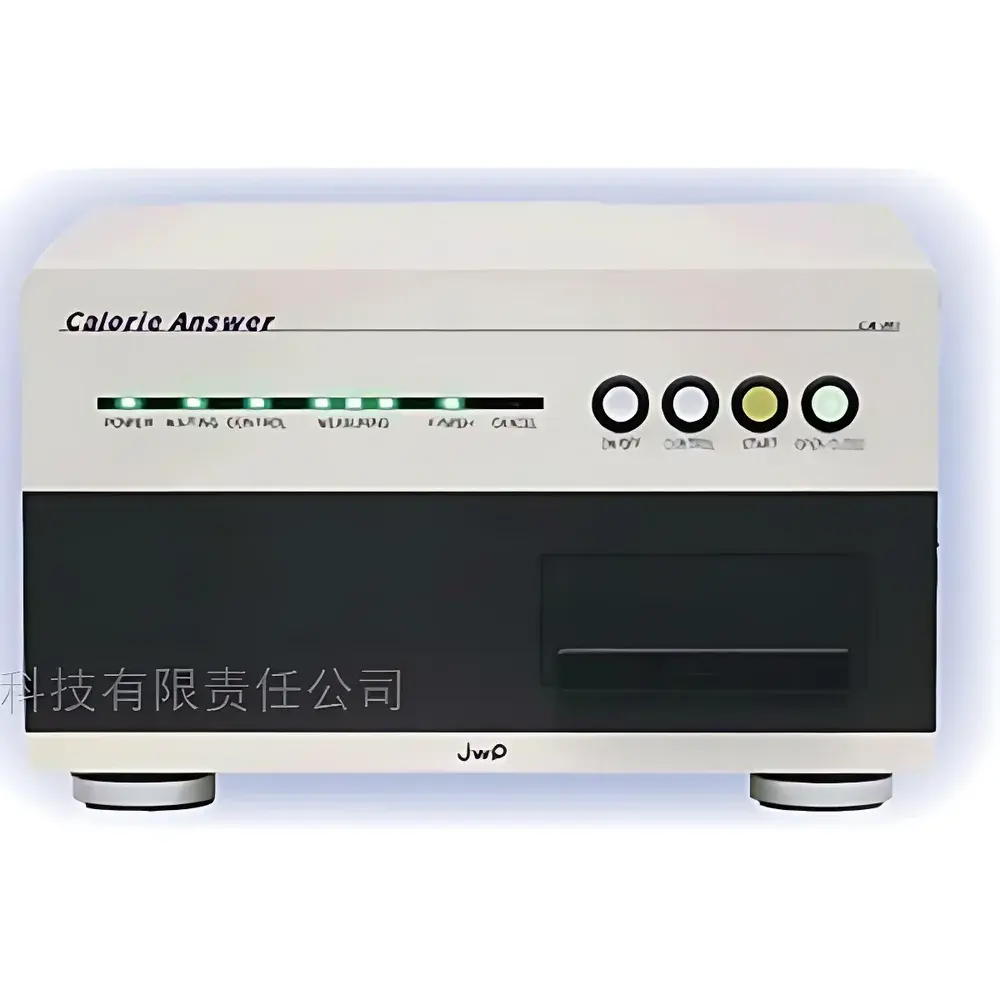
JWP CA-Hi Automated Food Calorimetry & Macronutrient Analyzer
| Brand | JWP |
|---|---|
| Origin | Japan |
| Model | CA-Hi |
| Measurement Principle | Near-Infrared (NIR) Spectroscopy |
| Sample Throughput | ≤80 seconds per measurement |
| Sample Types | Solid, Powder, Liquid (transmission/reflection modes) |
| Data Output | Energy (kcal/100g), Protein (%), Fat (%), Carbohydrates (%), Moisture (%) |
| Connectivity | USB 2.0 |
| Software | CA-Hi Control Suite v3.2 (Windows-compatible) |
| Compliance | ISO 17025-aligned operation, supports GLP audit trails, FDA 21 CFR Part 11–ready data logging |
Overview
The JWP CA-Hi Automated Food Calorimetry & Macronutrient Analyzer is a benchtop near-infrared (NIR) spectrometer engineered for rapid, non-destructive quantification of energy content and major macronutrients in food matrices. Unlike traditional bomb calorimetry or wet-chemistry methods, the CA-Hi employs calibrated NIR reflectance and transmission spectroscopy to generate predictive models for caloric value (kcal/100g), protein, total fat, available carbohydrates, and moisture—without sample digestion, reagents, or operator-dependent preparation. Its optical architecture integrates dual-path optics (fiber-coupled tungsten-halogen source + InGaAs detector array) with temperature-stabilized scanning optics, enabling high spectral reproducibility across heterogeneous samples including baked goods, dairy products, sauces, powders, and beverages. Designed for routine use in food R&D labs, quality control departments, and regulatory testing facilities, the CA-Hi delivers traceable, repeatable results aligned with AOAC Official Method 2016.02 (NIR for food composition) and supports method validation per ISO 12099:2017.
Key Features
- Sub-80-second measurement cycle: Achieves full-spectrum acquisition and multivariate regression analysis in ≤80 s, including auto-alignment, background correction, and result export.
- Dual-mode optical interface: Automatic selection between transmission mode (for liquids, gels, slurries) and diffuse reflectance mode (for solids, granules, powders) via motorized sample stage positioning.
- Mass-normalized reporting: Internal algorithm converts raw spectral response to standardized values per 100 g, accommodating variable sample weights (5–50 g for solids; 2–20 mL for liquids).
- Modular calibration management: Pre-loaded factory calibrations for >120 food categories (e.g., cereals, meats, confectionery); users may develop and validate custom PLS or PCR models using reference datasets.
- Real-time status visualization: Front-panel OLED display shows spectral acquisition progress, signal-to-noise ratio (SNR), and diagnostic flags (e.g., low light intensity, sample misalignment).
- Custom protocol builder: Intuitive GUI allows creation of application-specific workflows—including multi-step sequences (e.g., pre-scan moisture check → main NIR scan → post-calibration verification) with configurable pass/fail thresholds.
Sample Compatibility & Compliance
The CA-Hi accommodates diverse physical forms without homogenization or drying: intact slices (≤25 mm thickness), ground meat, flour blends, yogurt, fruit purees, and oil-in-water emulsions. Its optical path design minimizes scattering artifacts through dynamic baseline correction and wavelength-specific dark-current compensation. All measurements comply with ISO/IEC 17025:2017 requirements for testing laboratories, with built-in instrument qualification (IQ/OQ) routines covering wavelength accuracy (±0.5 nm), photometric linearity (R² ≥ 0.9998), and repeatability (RSD < 1.2% for kcal across 10 replicates). Data integrity meets FDA 21 CFR Part 11 criteria: electronic signatures, immutable audit trails, and role-based access control are enforced within the CA-Hi Control Suite software.
Software & Data Management
CA-Hi Control Suite v3.2 provides a validated Windows desktop environment for instrument control, spectral processing, and regulatory reporting. It includes PCA-based outlier detection, residual analysis for model diagnostics, and automated generation of PDF reports compliant with ISO 22000 Annex SL. Historical datasets (stored locally or on network drives) support cross-batch trend analysis, shelf-life modeling, and statistical process control (SPC) charting. Raw spectra (.jwpnir binary format) and processed results (.csv/.xlsx) are exportable with embedded metadata (operator ID, timestamp, calibration ID, environmental conditions). The software supports LIMS integration via ASTM E1482-compliant XML export and HL7 message mapping for enterprise-level data synchronization.
Applications
- Nutrition labeling compliance: Rapid verification of declared kcal, protein, and fat values per FDA 21 CFR 101.9 and EU Regulation (EU) No 1169/2011.
- Product reformulation: Monitoring macronutrient shifts during sugar/fat reduction trials or alternative protein incorporation (e.g., pea isolate, mycoprotein).
- Supply chain QA: Incoming raw material screening for moisture variation, adulteration detection (e.g., starch dilution in milk powder), and batch release testing.
- Clinical nutrition research: High-throughput dietary assessment in metabolic studies requiring precise energy intake quantification.
- Academic food science: Teaching spectral interpretation, chemometrics, and predictive modeling fundamentals using real-world food spectra libraries.
FAQ
Does the CA-Hi require reference standards for every new food type?
No—factory calibrations cover 120+ food categories. For novel matrices, users may develop custom models using ≥30 representative samples with reference values from AOAC-approved methods.
Can the instrument measure fiber or sodium content?
Not directly; the CA-Hi targets core macronutrients and moisture. Fiber and minerals require complementary techniques (e.g., enzymatic-gravimetric or ICP-MS).
Is method validation support included?
Yes—the system ships with IQ/OQ documentation templates, linearity/precision verification protocols, and a 12-month calibration certificate traceable to NIST SRM 1921b.
What maintenance is required?
Annual optical alignment verification and detector dark-current recalibration—performed remotely by JWP-certified engineers or on-site with provided alignment kit.
Is cloud-based data backup available?
Local storage is primary; optional encrypted cloud sync (AWS S3-backed) can be enabled via enterprise license, meeting GDPR and HIPAA data residency requirements.





