
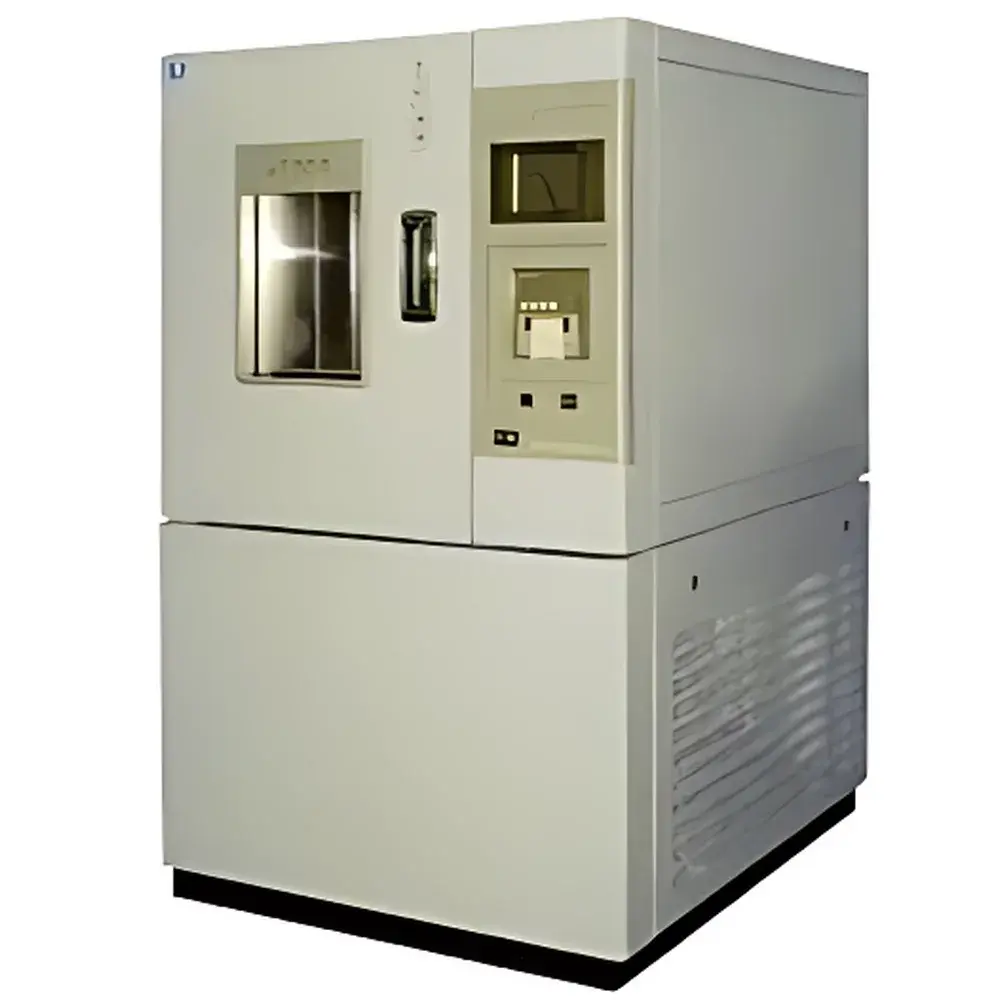
LabCompanion P-Series LED-Controlled Temperature and Humidity Cycling Chamber
| Brand | LabCompanion |
|---|---|
| Model | P-Series |
| Origin | Guangdong, China |
| Manufacturer | LabCompanion (Guangdong) Co., Ltd. |
| Type | Environmental Test Chamber |
| Compliance | GB/T 2423.1–2001, GB/T 2423.2–2001, GB/T 2423.3–1993 |
| Controller | PID-based microcomputer SSR temperature/humidity controller with Japanese imported digital touch panel |
| Refrigeration | French Tecumseh hermetic compressor |
| Humidification | External boiler-type steam generator (70% energy reduction vs. conventional systems) |
| Insulation | Ultra-fine glass fiber + high/low-temperature resistant non-metallic joint materials |
| Air Circulation | Multi-wing centrifugal blower with optimized inlet/outlet duct design |
| Construction | Inner chamber – SUS304 stainless steel mirror finish or TIG-welded 304B |
| Safety | Independent over-temperature cutoff system |
| Optional | 4–20 mA analog output, data logging interface, 50 mm test port (left side) |
Overview
The LabCompanion P-Series LED-Controlled Temperature and Humidity Cycling Chamber is an engineered environmental simulation system designed for precise, repeatable, and standards-compliant testing of material stability, electronic component reliability, and packaging integrity under dynamic thermal and hygrothermal stress conditions. Based on dual-loop PID control architecture and thermodynamic cycle optimization, the chamber delivers tightly regulated temperature transitions (–70 °C to +150 °C typical range) and humidity control (20–98% RH, non-condensing), enabling rigorous execution of accelerated aging, thermal shock, damp heat, and cyclic conditioning protocols per IEC 60068-2, MIL-STD-810, and JEDEC JESD22-A104/A110. Its structural design integrates aerospace-grade thermal isolation principles—featuring multi-layer ultra-fine glass fiber insulation and non-metallic high/low-temperature interface gaskets—to minimize thermal bridging and ensure spatial uniformity (< ±0.5 °C at 100 L working volume, per IEC 60068-3-5). The system is purpose-built for laboratories requiring GLP-aligned operational traceability and long-term stability in mission-critical qualification workflows.
Key Features
- Japanese-sourced digital touch-panel interface with intuitive icon-driven navigation and real-time parameter visualization
- Energy-optimized steam humidification system utilizing external boiler architecture—reducing power consumption by up to 70% compared to resistive immersion heaters
- Dual-stage refrigeration circuit (single- or two-stage cascade configuration) powered by original French Tecumseh hermetic compressors, supported by Parker Hannifin (USA) ALCO dry filters, Taiwan Guanya oil separators, and Castel (Italy) solenoid valves
- Multi-wing centrifugal circulation fan with aerodynamically tuned ductwork ensuring ≤ ±2% RH and ≤ ±0.8 °C spatial uniformity across full test volume
- SUS304 stainless steel inner chamber (mirror-polished or TIG-welded 304B grade) and A3 steel outer shell with epoxy-polyester powder coating for corrosion resistance and mechanical durability
- Independent over-temperature safety cutoff circuit—mechanically isolated from main controller—to guarantee fail-safe thermal protection per EN 61000-6-2
- Large double-glazed observation window with integrated LED lighting for continuous visual monitoring without thermal leakage
Sample Compatibility & Compliance
The P-Series accommodates a broad spectrum of test specimens—including PCB assemblies, polymer films, lithium-ion battery cells, medical device packaging, and automotive ECU modules—within standardized internal dimensions (customizable from 100 L to 1000 L). All operational profiles comply with mandatory national and international test standards: GB/T 2423.1–2001 (cold testing), GB/T 2423.2–2001 (dry heat), GB/T 2423.3–1993 (damp heat, steady state), as well as ISO 16750-4 (road vehicles), IEC 60068-2-1/2/30, and ASTM D4332. Chamber validation documentation supports IQ/OQ protocols and meets baseline requirements for GMP Annex 11 and FDA 21 CFR Part 11 when paired with optional audit-trail-enabled data loggers.
Software & Data Management
The embedded microcontroller firmware supports programmable multi-step cycling profiles with ramp/soak logic, user-defined dwell times, and automatic correction algorithms that dynamically adjust actuator output based on real-time sensor feedback. Optional RS485 Modbus RTU or Ethernet TCP/IP interfaces enable integration into centralized laboratory information management systems (LIMS) and SCADA platforms. With the add-on data logger module, users can export time-stamped CSV files containing temperature, humidity, and alarm status—fully compliant with GLP record retention mandates. Analog 4–20 mA outputs allow seamless connection to third-party chart recorders or PLC-based monitoring networks.
Applications
- Accelerated life testing of consumer electronics under combined thermal-hygric stress
- Validation of moisture barrier performance in pharmaceutical blister packaging (per USP )
- Thermal cycling qualification of automotive ADAS sensors per AEC-Q200
- Stability assessment of OLED display modules under low-temperature storage conditions
- Pre-conditioning of composite materials prior to mechanical tensile or peel testing
- Environmental stress screening (ESS) of avionics hardware in accordance with DO-160 Section 4
FAQ
What temperature and humidity ranges are achievable with the P-Series chamber?
Standard configurations support –70 °C to +150 °C and 20–98% RH (non-condensing); extended low-temperature variants down to –80 °C are available upon request.
Is the chamber suitable for continuous unattended operation?
Yes—the dual-redundant safety architecture, self-diagnostic firmware, and robust compressor protection logic enable 24/7 operation in validated cleanroom or QA lab environments.
Can test data be exported in compliance with FDA 21 CFR Part 11?
When equipped with the optional audit-trail data logger and user access control module, the system satisfies electronic record and signature requirements including role-based permissions, event logging, and immutable data archiving.
What maintenance intervals are recommended for optimal long-term performance?
Compressor oil inspection every 12 months, steam generator descaling every 3 months (frequency dependent on local water hardness), and filter replacement every 6 months—documented in the included preventive maintenance checklist.
Does LabCompanion provide IQ/OQ documentation packages?
Yes—factory-applied calibration certificates (NIST-traceable sensors), installation qualification templates, and operational qualification test scripts are supplied standard with each unit.



