
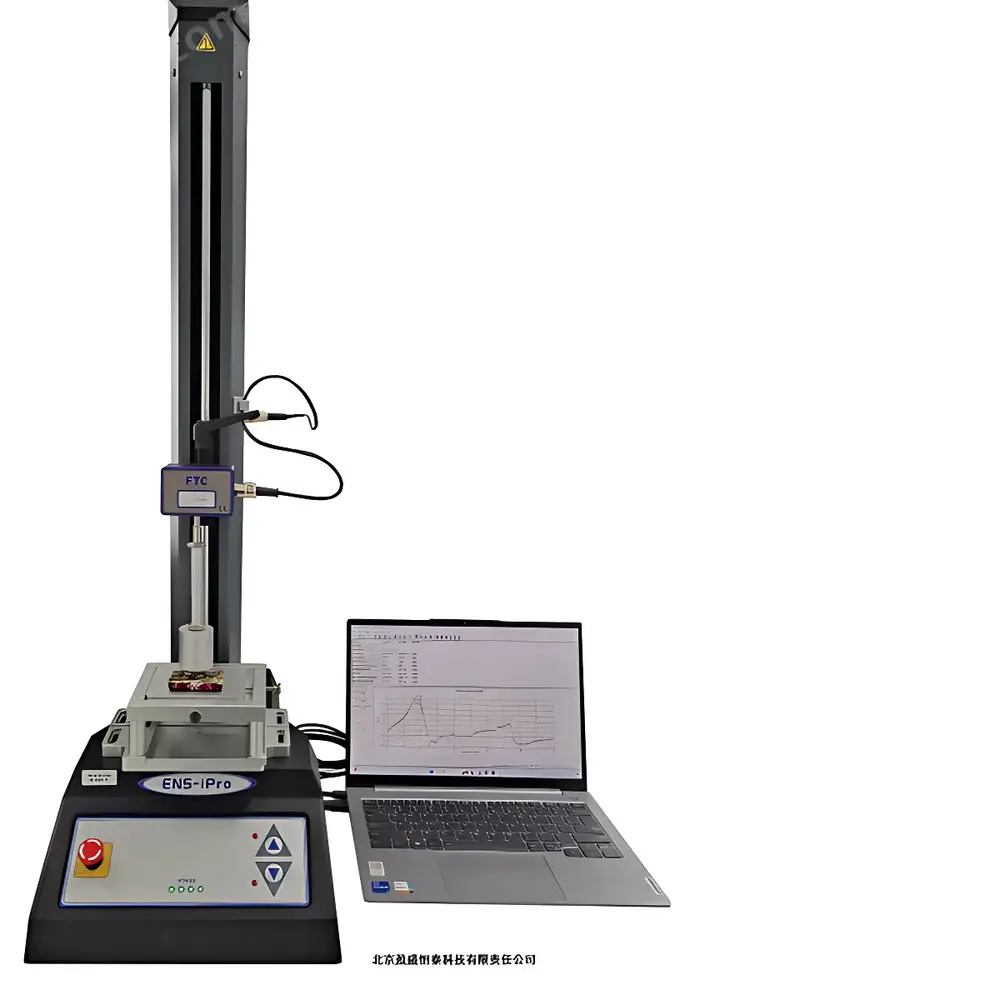
ENSoul ENS Series Texture Analyzer for Materials Science
| Brand | ENSoul |
|---|---|
| Origin | Beijing, China |
| Manufacturer Type | Authorized Distributor |
| Country of Origin | China |
| Model | ENS Series Texture Analyzer (Materials-Focused Configuration) |
| Pricing | Available Upon Request |
Overview
The ENSoul ENS Series Texture Analyzer is a precision-engineered mechanical testing instrument designed specifically for materials science applications. Based on the fundamental principles of uniaxial compression, tension, bending, and puncture deformation under controlled displacement and force feedback, it quantifies mechanical behavior through standardized probe–sample interaction protocols. Developed in collaboration with Food Technology Corporation (FTC), USA, the system integrates high-fidelity load cell technology, sub-micron positional resolution, and programmable motorized actuation to deliver repeatable, traceable mechanical property data. It is not limited to food or pharmaceutical use but engineered for cross-material applicability—including polymeric films, elastomers, metallic foils, composite laminates, hydrogels, and micro-structured solids—making it suitable for academic research, industrial R&D, and QC/QA laboratories requiring ASTM D638, ISO 6892-1, ISO 179-1, and BS EN 14372 compliant testing workflows.
Key Features
- High-stability electromechanical drive system with closed-loop position control (±0.001 mm repeatability) and bidirectional force sensing capability
- Modular transducer architecture: interchangeable load cells (ranging from 5 N to 500 N full-scale) selected per sample stiffness and expected deformation range
- Standardized probe library compliant with ASTM F3122, ISO 1133, and USP <1217> geometries—including spherical, cylindrical, wedge, blade, and tensile grips
- Custom probe design service available for non-standard geometries, including micro-indentation tips (diameter down to 0.5 mm) and multi-point array fixtures
- Real-time force–displacement acquisition at up to 2,000 Hz sampling rate, synchronized with motor position and time stamps
- Integrated automatic zeroing and span calibration routines traceable to NIST-certified reference standards
Sample Compatibility & Compliance
The ENS Series accommodates solid and semi-solid specimens ranging from sub-millimeter microspheres (e.g., polymer beads, ceramic granules) to rigid metallic wires (diameter ≥0.3 mm) and flexible packaging substrates (thickness 12 µm–3 mm). Sample holders include adjustable clamping stages, temperature-controlled platens (optional −10 °C to +80 °C), and vacuum-assisted fixation for low-adhesion surfaces. All test methods align with internationally recognized material characterization frameworks: ASTM D790 (flexural properties), ASTM D882 (tensile properties of thin plastics), ISO 14129 (interlaminar shear), and DIN 53455 (hardness of rubber and elastomers). The system supports GLP-compliant operation via audit-trail-enabled software (see Software section) and meets ISO 9001:2015 certified manufacturing and documentation standards.
Software & Data Management
The ENS Control Suite is a Windows-based application supporting method-driven test execution, real-time visualization, and post-acquisition analysis. It includes preconfigured test templates for hardness (TPA), snap/tear strength, Young’s modulus extraction, stress relaxation, and creep compliance. Users may define custom test sequences using drag-and-drop logic blocks, set conditional triggers (e.g., “stop at 80% strain” or “record peak force only”), and apply mathematical transformations (derivative, smoothing, normalization) directly within the dataset. All raw data (force, displacement, time) are stored in open-format CSV and HDF5 files. Audit trails record user ID, timestamp, parameter changes, and calibration events—fully compliant with FDA 21 CFR Part 11 requirements when deployed with electronic signature modules and role-based access controls.
Applications
- Quantification of compressive yield strength and recovery ratio in thermoplastic elastomers during injection molding process optimization
- Interfacial adhesion assessment of multilayer packaging films via peel resistance mapping across temperature gradients
- Mechanical screening of biomedical hydrogels for tissue engineering scaffolds (elastic modulus, hysteresis, fracture energy)
- Batch-to-batch consistency evaluation of metal foil anodes in battery electrode development
- Correlation of nanoindentation-derived hardness with macro-scale texture parameters in sintered ceramics
- Teaching laboratory implementation for undergraduate mechanics of materials courses, including stress–strain curve derivation and failure mode classification
FAQ
Is the ENS Series compatible with third-party environmental chambers?
Yes—standardized mounting interfaces and analog/digital I/O ports enable seamless integration with commercial temperature/humidity chambers and rheological accessories.
Can test methods be exported and shared across multiple instruments?
All method definitions (.ensm files) are portable and version-controlled; they retain calibration metadata and probe geometry definitions for cross-system reproducibility.
Does the system support automated pass/fail decision logic based on specification limits?
Yes—the software allows defining upper/lower specification limits per parameter and generates binary QA reports with statistical process control (SPC) charts.
What documentation is provided for regulatory submissions?
Each unit ships with a Factory Acceptance Test (FAT) report, traceable calibration certificates, IQ/OQ documentation templates, and a full ISO 17025-aligned uncertainty budget upon request.
Are firmware updates provided remotely?
Firmware and software updates are distributed via secure HTTPS portal with SHA-256 integrity verification and rollback capability.
Related Products







