
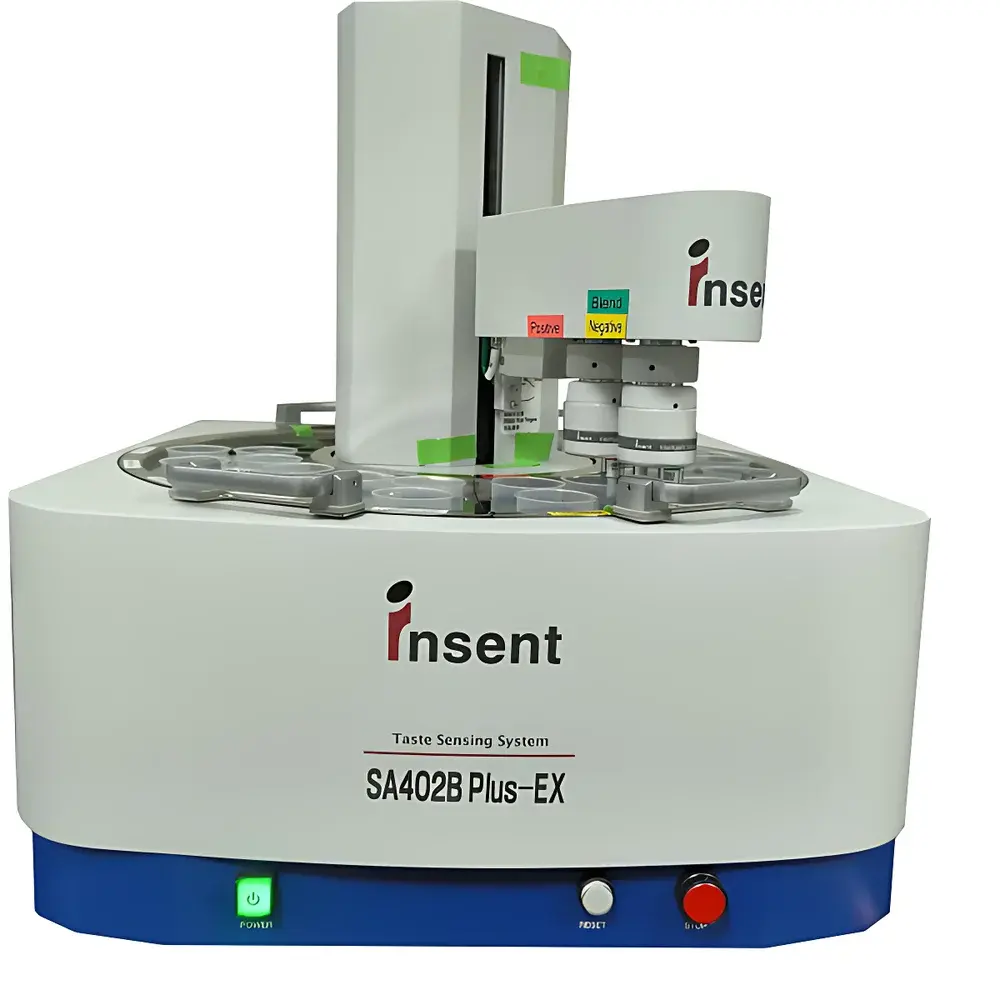
INSENT SA402B Plus-EX Electronic Tongue System
| Brand | INSENT |
|---|---|
| Origin | Japan |
| Model | SA402B Plus-EX |
| Type | Electronic Tongue / Taste Sensing System |
| Sensor Principle | Artificial Lipid Membrane Electrode Array |
| Output Metrics | Sourness, Sweetness, Bitterness, Saltiness, Umami, Astringency, and Their Aftertastes (Bitter, Astringent, Umami Persistence) |
| Compliance | Designed for GLP-compliant sensory laboratories |
| Software Interface | Touchscreen GUI with Macro Programming & Audit-Trail Capable Data Management Server |
| Electromagnetic Immunity | IEC 61326-1 Class A compliant |
Overview
The INSENT SA402B Plus-EX Electronic Tongue System is a precision taste-sensing platform engineered for objective, quantitative evaluation of gustatory profiles in food, pharmaceuticals, and consumer products. Unlike conventional chemical assays that measure individual compounds, this system operates on the principle of cross-reactive artificial lipid membrane electrodes—mimicking the biological transduction mechanism of human taste receptor cells. Each sensor in the proprietary electrode array exhibits partial, overlapping sensitivity to multiple taste modalities (sour, sweet, bitter, salty, umami, and astringent), generating a multidimensional response pattern. These patterns are processed via multivariate statistical algorithms—including Principal Component Analysis (PCA), Discriminant Function Analysis (DFA), and Hierarchical Cluster Analysis (HCA)—to yield reproducible, instrument-based taste maps. The SA402B Plus-EX is not a replacement for human sensory panels but serves as a high-throughput, operator-independent complement—particularly valuable in routine QC, shelf-life determination, formulation screening, and off-flavor root-cause analysis.
Key Features
- Proprietary artificial lipid membrane sensor array with six primary taste-selective electrodes and two reference electrodes, enabling simultaneous detection of five basic tastes plus astringency and their temporal aftertaste profiles.
- Integrated touchscreen interface with guided workflow navigation—no programming expertise required for standard operation.
- Macro scripting functionality allows users to automate repetitive test sequences (e.g., sample dilution series, rinse cycles, calibration routines), reducing operator variability and increasing throughput.
- Dedicated data management server supports centralized storage, version-controlled result archiving, user-level access permissions, and audit-trail generation per FDA 21 CFR Part 11 and ISO/IEC 17025 requirements.
- Electromagnetic interference (EMI) shielding compliant with IEC 61326-1 Class A ensures stable signal acquisition in shared laboratory environments with centrifuges, refrigerators, or RF-emitting equipment.
- Real-time visualization suite includes radar charts, PCA score plots, loading plots, and temporal response curves—facilitating rapid interpretation of taste similarity, discrimination thresholds, and dynamic taste evolution.
Sample Compatibility & Compliance
The SA402B Plus-EX accepts liquid, semi-liquid, and soluble solid samples without derivatization or extraction—provided they are filtered (≤0.45 µm) and pH-adjusted within operational range (pH 3.0–8.5). Compatible matrices include beverages, sauces, dairy products, oral suspensions, herbal extracts, and lyophilized formulations reconstituted in water or saline. All sensor surfaces are chemically resistant to common food-grade acids, salts, and low-concentration ethanol. The system meets design and documentation standards aligned with Good Laboratory Practice (GLP) and supports traceability frameworks required under ISO 22000 (food safety), ICH Q5C (biopharmaceutical stability), and USP (validation of compendial procedures). Calibration and performance verification follow INSENT’s documented SOPs, including daily reference solution checks and quarterly sensor sensitivity validation using certified taste standard solutions.
Software & Data Management
The embedded TasteView™ software (v5.2+) provides full lifecycle data handling—from method setup and real-time monitoring to multivariate modeling and report generation. Raw sensor voltage responses are logged at 10 Hz with 16-bit resolution; all intermediate and final outputs are stored in encrypted SQLite databases with SHA-256 checksum integrity verification. The system supports export to CSV, Excel, and ASTM E1488-compliant ASCII formats for third-party statistical analysis (e.g., SIMCA, JMP, R). Audit trails record user ID, timestamp, action type (e.g., “calibration executed”, “sample ID modified”), and pre-/post-change values—retained for ≥36 months unless purged under formal data retention policy. Remote access via secure HTTPS is available for authorized personnel, enabling cross-site collaboration while maintaining network segmentation per NIST SP 800-53 controls.
Applications
- Accelerated development of reduced-sodium or sugar-free food formulations by quantifying compensatory umami/sour enhancement effects.
- Objective assessment of bitterness masking efficacy in pediatric oral suspensions and chewable tablets—correlating instrumental aftertaste duration with clinical palatability scores.
- Discrimination of counterfeit or adulterated products (e.g., honey, olive oil, wine) based on deviation from authenticated taste fingerprint libraries.
- Shelf-life prediction through longitudinal tracking of sourness increase or umami decay kinetics under accelerated storage conditions.
- Consumer trend analysis via clustering of commercial product taste spaces—identifying unmet sensory niches for new product positioning.
- Supporting regulatory submissions where taste acceptability is a critical quality attribute (CQA), particularly under FDA guidance for orally disintegrating tablets and pediatric dosage forms.
FAQ
How does the SA402B Plus-EX differ from conventional potentiometric or voltammetric sensors?
It employs non-specific, lipid-coated electrodes whose membrane potential shifts respond collectively to ionic strength, hydrophobicity, and proton activity—mirroring biological taste cell depolarization—not single-ion selectivity.
Can the system quantify absolute taste intensity (e.g., “X mM NaCl equivalent”)?
No—it delivers relative, multivariate taste fingerprints. Quantitative correlation to concentration requires separate calibration curves built per matrix and analyte.
What maintenance is required for long-term sensor stability?
Sensors undergo automated cleaning cycles between samples; full regeneration (lipid membrane replenishment) is performed every 3–6 months depending on usage frequency and sample complexity.
Is method transfer possible between SA402B Plus-EX units?
Yes—inter-unit reproducibility is maintained within ±5% Euclidean distance in PCA space when using INSENT-certified reference standards and identical SOPs.
Does the system support integration with LIMS or MES platforms?
Yes—via RESTful API and configurable ODBC drivers supporting structured query of results, metadata, and audit logs.




