
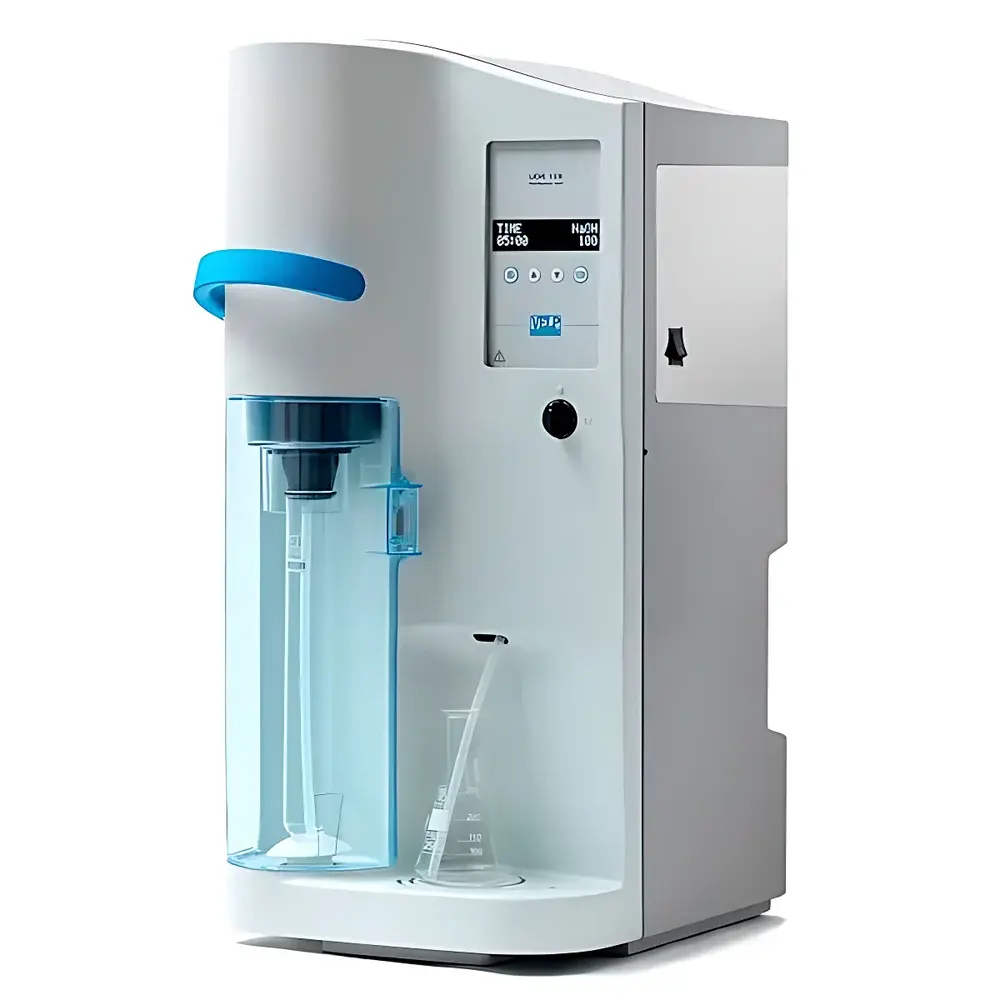
VELP UDK129 Semi-Automatic Kjeldahl Nitrogen Determinator
| Brand | VELP |
|---|---|
| Origin | Italy |
| Model | UDK129 |
| Instrument Type | Kjeldahl Nitrogen Determinator |
| Distillation Time | 1–99 min (typical: 3.5 min per sample) |
| Repeatability | ≤1% RSD |
| Nitrogen Recovery Rate | ≥99.5% |
| Detection Limit | ≥0.1 mg N |
| Cooling Water Flow | 0.5 L/min at 15°C to 1.0 L/min at 30°C |
| Power Consumption | 2100 W |
| Enclosure Material | Reinforced Steel Structure with Chemical-Resistant Coating |
| Sample Tube Compatibility | Conical taper interface supporting digestion tubes up to 500 mL |
| Preheating Time | 90 s |
| Safety Features | Digestion tube presence sensor, closed-alkali delivery system, automatic cooling water shutoff during idle mode |
Overview
The VELP UDK129 Semi-Automatic Kjeldahl Nitrogen Determinator is an engineered evolution of the UDK127 platform, designed for laboratories requiring reliable, reproducible total nitrogen quantification in organic matrices via classical Kjeldahl digestion and steam distillation. Based on the internationally standardized ISO 8968, AOAC 984.13, and ASTM D1142 methodologies, the UDK129 implements a fully integrated semi-automated workflow—combining controlled alkaline digestion, precise steam distillation, and condensate collection—without full robotic automation. Its core measurement principle relies on quantitative conversion of organic nitrogen to ammonium sulfate under acidic digestion, followed by alkaline liberation of ammonia, steam distillation into boric acid trap, and subsequent titrimetric or colorimetric quantification. The instrument is purpose-built for routine QC/QA applications in food & feed, agricultural research, environmental testing, and pharmaceutical raw material analysis where regulatory compliance and method traceability are mandatory.
Key Features
- TEMS (Thermal Efficiency Management System) architecture reduces thermal inertia and energy demand by optimizing steam generation dynamics and heat retention pathways—achieving ~15% lower average power draw versus predecessor models during sustained operation.
- High-efficiency titanium condenser ensures rapid, uniform condensation across variable ambient temperatures; minimizes cooling water consumption via dynamic flow regulation tied to real-time condensation load.
- Integrated reagent delivery system: sealed alkali pump, programmable steam generator, and peristaltic water pump—all operated via front-panel keypad without manual reagent handling or open-bottle transfers.
- 90-second preheat-to-ready state enables immediate start of distillation upon sample loading, reducing turnaround time for sequential analyses.
- Dual-safety interlock: mechanical digestion tube detection prevents activation unless a properly seated tube is verified; closed-loop alkaline addition eliminates operator exposure to concentrated NaOH or KOH solutions.
- Robust steel chassis with epoxy-polyester coating resists corrosion from acid fumes, alkali splashes, and mechanical abrasion—validated for >10,000 operational cycles under GLP-aligned maintenance protocols.
- Conical taper joint design accommodates standard Kjeldahl digestion tubes (250–500 mL), including borosilicate glass and quartz variants, without adapters or alignment tools.
Sample Compatibility & Compliance
The UDK129 accepts homogenized solid, liquid, or semi-solid samples compatible with standard sulfuric acid–catalyst digestion protocols (e.g., CuSO₄/K₂SO₄ or Se-based catalysts). It supports digestion vessels compliant with ISO 5983-1 and AOAC 981.10 specifications. All operational parameters—including distillation duration, alkali volume, and steam pressure—are user-configurable within validated ranges to align with method-specific requirements. The system meets CE marking requirements for electrical safety (EN 61010-1) and electromagnetic compatibility (EN 61326-1). Its design facilitates audit readiness for FDA 21 CFR Part 11 (when paired with compliant titration software), ISO/IEC 17025 accreditation, and GMP/GLP documentation workflows.
Software & Data Management
While the UDK129 operates as a stand-alone benchtop unit with local LCD control (no embedded OS or network stack), its parameter settings—including distillation time, alkali volume, and preheat delay—are stored in non-volatile memory with timestamped change logs. Output data (e.g., titrant volume, sample ID, date/time) must be recorded manually or transferred via RS-232 interface to external LIMS or spreadsheet platforms. For full electronic record integrity, integration with VELP’s optional TitroLine 7700 titrator enables automated endpoint detection and direct CSV export with audit-trail metadata—supporting ALCOA+ principles (Attributable, Legible, Contemporaneous, Original, Accurate, Complete, Consistent, Enduring, Available).
Applications
- Crude protein determination in cereals, dairy products, meat, and pet food per AOAC 981.10 and ISO 20483.
- Nitrogen content verification in fertilizers and soil amendments according to ISO 11261 and EN 15935.
- Quality control of pharmaceutical excipients and active ingredients where nitrogen stoichiometry impacts assay validity.
- Environmental monitoring of wastewater sludge and composted biosolids per EPA Method 350.1 and ISO 14255.
- Research-scale nitrogen balance studies in agronomy and nutritional science requiring high inter-laboratory reproducibility.
FAQ
What digestion methods are compatible with the UDK129?
The UDK129 is designed exclusively for post-digestion distillation and does not include a digestion block. It requires pre-digested samples prepared using standard Kjeldahl digestion systems (e.g., VELP DK series or equivalent) following ISO 5983-1.
Does the UDK129 support automatic titration?
No—the UDK129 performs only distillation and condensate collection. Titration must be performed separately using a manual burette or an external automated titrator such as the TitroLine 7700.
Can the instrument be validated for regulated environments?
Yes—its mechanical repeatability (≤1% RSD), nitrogen recovery (≥99.5%), and documented parameter traceability support IQ/OQ/PQ protocols required under ISO/IEC 17025 and FDA-regulated facilities when combined with appropriate SOPs and calibration records.
Is cooling water temperature monitored or controlled internally?
No—the UDK129 regulates flow rate based on ambient inlet temperature (measured externally), but does not incorporate inline temperature sensors or active chiller integration. Users must ensure stable supply within 15–30°C range.
What maintenance intervals are recommended for long-term reliability?
Daily: visual inspection of condenser cleanliness and tube seating. Quarterly: alkali pump calibration check and gasket integrity assessment. Annually: full steam generator descaling and pressure valve verification per VELP Service Manual UDK129-SM-Rev.4.





